


Thành viên:Nam thừa kế/Môtô địa hình
All-terrain vehicle


Xe môtô địa hình (all-terrain vehicle, viết tắt: ATV), hay còn gọi là utility vehicle hạng nhẹ (light utility vehicle, viết tắt: LUV),[1] a quad bike or quad (if it has four wheels), được định nghĩa bởi American National Standards Institute (ANSI), là một loại phương tiện giao thông chạy bằng lốp áp suất thấp, có một chỗ ngồi that is straddled by the operator, and has handlebars, tương tự với xe gắn máy. As the name implies, it is designed to handle a wider variety of terrain than most other vehicles. It is street-legal in some countries, but not in most states, territories and provinces of Australia, the United States, and Canada.
By the current ANSI definition, ATVs are intended for use by a single operator, but some ATVs, referred to as tandem ATVs, have been developed for use by the driver and one passenger.[2]
The rider sits on and operates these vehicles like a motorcycle, but the extra wheels give more stability at slower speeds. Although most are equipped with three or four wheels, six or eight wheel (tracked) models exist and have existed historically for specialized applications.[3] Multiple-user analogues with side-by-side seating are called utility terrain vehicles (UTVs) or side-by-sides to distinguish the classes of vehicle. Both classes tend to have similar powertrain parts. Engine sizes of ATVs for sale in the United States as of 2008 ranged from 49 đến 1.000 cc (3,0 đến 61 cu in).
Lịch sử phát triển
Thế kỷ 19
.jpg)
Royal Enfield built and sold the first powered four-wheeler in 1893. It had many bicycle components, including handlebars. The Royal Enfield resembles a modern ATV-style quad bike but was designed as a form of horseless carriage for road use.[4]
AATV sáu bánh

The term "ATV" was originally coined to refer to non-straddle ridden, typically six-wheeled, amphibious ATVs, such as the Jiger produced by the Jiger Corporation, the Amphicat produced by Mobility Unlimited Inc, and the Terra Tiger produced by the Allis-Chalmers Manufacturing Company in the mid-1960s and early 1970s. With the introduction of straddle ridden ATVs, the term AATV was introduced to define the original amphibious ATV category.
ATV ba bánh

The first three-wheeled ATV was the Sperry-Rand Tricart. It was designed in 1967 as a graduate project of John Plessinger at the Cranbrook Academy of Arts near Detroit. The Tricart was straddle-ridden with a sit-in rather than sit-on style (similar to the contemporaneous Big Wheel toy). In 1968 Plessinger sold the Tricart patents and design rights to Sperry-Rand New Holland who manufactured them commercially. Numerous small American manufacturers of 3-wheelers followed. These small manufacturers were unable to compete when larger motorcycle companies like Honda entered the market in 1969.
Honda introduced their first sit-on straddle-ridden three-wheeled all-terrain vehicle in 1969, known as a US90, as a 1970 Model. Variations would be popularized in the James Bond movie, Diamonds Are Forever and TV shows such as Doctor Who, Magnum, P.I. and Hart to Hart. In 1973, Honda trademarked the term "All Terrain Cycle" (ATC), applying it to all Honda's three-wheeled ATVs; it became a universal name associated with all vehicles of this type. It was directly influenced by earlier 6-wheeled AATVs of the sixties, and utilized balloon tires for both a low environmental impact and to compensate for a lack of mechanical suspension.[5]
Honda entered the 1980s with a virtual monopoly in the market, due to effective patents on design and engine placement. By 1980, other companies paid patent royalties to Honda to enter the lucrative ATC field with their own machines. Yamaha introduced their first ATC, the Tri-Moto YZ125. Kawasaki followed suit the next year with the KLT200, while Suzuki produced their first model, the ALT125, in 1982. As the popularity of ATCs increased dramatically, rapid development ensued. The ability to go anywhere on terrain that most other vehicles could not cross soon made them popular with US and Canadian hunters. As other manufacturers were entering the market, Honda was diversifying, offering the ATC250R, the first Sport ATC intended for competition, in 1981. The 1982 Honda ATC200E Big Red was a landmark model. It featured both suspension and racks, making it the first ATC designed specifically for utility, and would become the world's best-selling ATC. Honda followed that effort in 1983 with the ATC200X, an easy-to-handle 192 cc (0,192 L; 11,7 in khối) four-stroke Sport ATC that was ideal for new riders.
Not to be outdone, Kawasaki and Yamaha responded with their own Sport ATCs. 1984 saw the release of the Kawasaki KXT250 Tecate, and Yamaha followed in 1985 with the Tri-Z 250. Both were liquid cooled 250 cc two-strokes capable of giving the Honda ATC250R competition. In response to growing market, American Specialty manufacturer Tiger also introduced a series of ATCs, hand-built-to-order models that included the Tiger 500, the largest displacement ATC produced commercially. While Kawasaki and Yamaha both produced utility ATCs, famously making the KLT 250 Police and Yamahauler respectively, Suzuki turned their attention to building Sport Quads.
Honda continued to diversify their line-up (at peak offering 10 distinct models), releasing the larger, fully suspended 250 cc Big Red utility ATC, and introduced the 350X Sport ATC, their largest displacement machine, in 1985. But the bulk of their sales were the 200cc line, offering six models and selling over 500,000 units in 3 years. Honda's response to the Tecate and Tri-Z, the liquid cooled 1985 and 1986 ATC250R, remains one of the most desirable ATCs of the era, and aftermarket support still follows the machine.
U.S. manufacturers
Main articles: Tiger ATV LTD and Polaris Scrambler 250R/es
American-based manufacturers also produced ATCs in this period, albeit in small numbers. Polaris offered the Scrambler in 1985 and 1986, producing appx 1600 units. Speciality manufacturer Tiger ATV also produced a range of ATCs, but their liquidation in 1991 left no official record of how many units were produced. The collector ATV market estimates vary drastically, from 300 to as many as 1000 units total production. Tiger ATCs were offered for three years, with models using 80 đến 500 cc (0,0800 đến 0,500 L; 4,88 đến 30,5 in khối) two-stroke engines provided by KTM and Rotax.
The Tiger 500 is notable for being the fastest consumer ATC available, with tested top speeds of +80 mph from the stock 42 mã lực (31,3 kW)@6500rpm engine and 5 speed gearbox. With final drive gearing changes, the ATC could exceed 100 mph. However, due to the rarity of the machines the brand never became well-known, and as all Tiger Models were custom-ordered and built to the buyer's specifications for the purpose of factory ATV racing, Polaris is generally known as the first American 'Production' ATV producer.
Ngừng sản xuất
Production of three-wheelers was voluntarily ceased by all manufacturers by 1987, in light of safety concerns, and ahead of any legislation.[6] Though later studies showed that three-wheelers were not considered more unstable than four-wheelers (although accidents are equally severe in both classes),[7] manufacturers agreed to a 10-year moratorium on production, and to collectively financing a +US$100 million ATV safety campaign. Despite the moratorium lifting, manufacturers did not return to the ATC market, focusing instead on four-wheeled ATVs. A ban on sales of new or used three-wheelers and a recall of all remaining three-wheelers was proposed by the American Academy of Pediatrics.[8]
These safety issues with three-wheel ATCs caused a shift in the buying public, as the sales of later four-wheel ATV models grew rapidly. While three-wheel models ended production in 1987, agreements between the major manufacturers and the US U.S. Consumer Product Safety Commission to officially cease production and finance safety campaigns moved forward. While the lighter weight of ATCs made them popular with certain riders, manufacturers continued to focus on ATV production.
US Public Law 110-314
US Public Law 110-314, enacted on August 8, 2008,[9] separated ATCs from existing new production ATV safety standards, and requires new standards for three-wheeled ATCs to be drafted. This effectively suspended importation of three-wheeled ATCs, until new standards of safety can be drafted. As of 2020, such standards have not been drafted. While search engines can find informal information suggesting major Japanese manufacturers pressed for this measure due to an influx of inexpensive Chinese ATCs in the American market, no official documentation or cited sources support these claims. Currently, all manufacturers not based in the US are restricted from the manufacture and sale of new Three-Wheeled All Terrain Cycles, until safety standards can be implemented. Below is a summary of Section 232, which effects the ATC ban.
(Sec. 232) Requires the CPSC, notwithstanding any other provision of law, to establish as a mandatory consumer product safety standard a specified American National Standard for four-wheeled all-terrain vehicles developed by the Specialty Vehicle Institute of America. Makes it unlawful for any manufacturer or distributor to import or distribute any new all-terrain vehicle unless: (1) the vehicle complies with the standard, is subject to an all-terrain vehicle action plan, and bears a label certifying such compliance and certain other information; and (2) the manufacturer or distributor is in compliance with the action plan. Prohibits the importation of new three-wheeled all-terrain vehicles until a mandatory consumer product safety standard applicable to three-wheeled all-terrain vehicles is in effect. |
ATV bốn bánh (từ năm 1980)
.jpg)
Suzuki was a leader in the development of mass production four-wheeled ATVs. It sold the first model, the 1982 QuadRunner LT125, which was a recreational machine for beginners.
Adventure Vehicles of Monroe, Louisiana made the first quad ATV in 1980. They called it the Avenger 400. Prior to that, Adventure Vehicles made 3 wheel ATVs and a dump body utility 3 wheeler using Kohler 8 hp engines and Comet drive systems (Comet centrifugal belt-driven clutch, and a Comet forward, neutral, reverse transaxle, with a rigid rear axle or rear differential option.) The Avenger 400 was a rigid suspension vehicle with a fiberglass body and welded tube construction. It was a rudimentary vehicle reminiscent of the Tote Gote of the 1960s.[10]
Suzuki sold the first four-wheeled mini ATV, the LT50, from 1984 to 1987. After the LT50, Suzuki sold the first ATV with a CVT transmission, the LT80, from 1987 to 2006.
In 1985 Suzuki introduced to the industry the first high-performance four-wheel ATV, the Suzuki LT250R QuadRacer. This machine was in production for the 1985–1992 model years. During its production run, it underwent three major engineering makeovers. However, the core features were retained. These were: a sophisticated long-travel suspension, a liquid-cooled, two-stroke motor, and a fully-manual five-speed transmission (for 1985–1986 models), and a six-speed transmission (for the '87–'92 models). It was a machine exclusively designed for racing by highly skilled riders.
Honda responded a year later with the FourTrax TRX250R—a machine that has not been replicated until recently. It currently remains a trophy winner and competitor to big-bore ATVs. Kawasaki responded with its Tecate-4 250. The TRX250R was very similar to the ATC250R it eventually replaced and is often considered one of the greatest sport ATVs ever built.
In 1987, Yamaha Motor Company introduced a different type of high-performance machine, the Banshee 350, which featured a twin-cylinder liquid-cooled two-stroke motor from the RD350LC street motorcycle. Heavier and more difficult to ride in the dirt than the 250s, the Banshee became a popular machine with sand dune riders thanks to its unique power delivery. The Banshee remains popular, but 2006 is the last year it was available in the U.S. (due to EPA emissions regulations); it remained available in Canada until 2008 and in Australia until 2012. The Warrior 350 was introduced in 1987 and went on for years as a light and fast ATV.
Shortly after the introduction of the Banshee in 1987, Suzuki released the LT500R QuadRacer. This unique quad was powered by a 500 cc liquid-cooled two-stroke engine with a five-speed transmission. This ATV earned the nickname "Quadzilla" with its remarkable amount of speed and size. While there are claims of 100+ mph (160 km/h) stock Quadzillas, it was officially recorded by 3&4 Wheel Action magazine as reaching a top speed of over 79 mph (127 km/h) in a high-speed shootout in its 1988 June issue, making it the fastest production four-wheeled ATV ever produced. Suzuki discontinued the production of the LT500R in 1990 after just four years.
At the same time, the development of utility ATVs was rapidly escalating. The 1986 Honda FourTrax TRX350 4x4 ushered in the era of four-wheel-drive ATVs. Other manufacturers quickly followed suit, and 4x4s have remained the most popular type of ATV ever since. These machines are popular with hunters, farmers, ranchers, and workers at construction sites.

Models are divided into the sport and utility markets. Sport models are generally small, light, two-wheel-drive vehicles that accelerate quickly, have a manual transmission, and run at speeds up to approximately 80 mph (130 km/h). Utility models are generally bigger four-wheel-drive vehicles with a maximum speed of up to approximately 70 mph (110 km/h). They can haul small loads on attached racks or small dump beds, and tow small trailers. Due to the different weights, each has advantages on different types of terrain. A popular model is Yamaha's Raptor 700, which has a nearly 700 cc four-stroke engine.
Six-wheel models often have a small dump bed, with an extra set of wheels at the back to increase the payload capacity. They can be either four-wheel-drive (back wheels driving only), or six-wheel-drive.
In 2011 LandFighter was founded, "the first Dutch/European ATV brand". Most production is in Taiwan, to European standards; the ATVs are finally assembled in the Netherlands.
Safety and legal regulation
Safety helmets, mandatory in some jurisdictions, provide the rider with some protection in the case of an accident.[11]
Three-wheel vehicles
Safety courses and educational literature reduced the number and severity of accidents among ATC and ATV riders. As cornering is more challenging on a three-wheel ATC than with a four-wheeled machine, properly leaning into the turn is required to counterbalance the weight and keep the machine stable. Careless operators may roll over at high speeds. The lighter front-end and smaller footprint of ATCs present both a flipping and steering hazard under acceleration and on inclines. Lateral rollovers may also occur when traversing steep inclines. ATCs require unique techniques to ride properly, and turning lean requires more exaggeration than ATVs; Throttle steering is another technique commonly used on ATCs in soft terrain and at high speeds, leaning to the inside of the turn and manipulating the throttle to break traction with the rear tires, resulting in the machines turning on axis while maintaining a forward direction.[12][13][14]
Four-wheel vehicles
Four-wheel quad cycles have a tendency to roll over, often injuring or killing the rider. Suitably designed roll bars can be fitted, which do not prevent the cycle from overturning, but prop it up, providing some protection for the rider.[11]

Studies and protective equipment
Safety has been a major issue with ATVs due to the many deaths and injuries associated with them and the lack of protection due to the absence of a rigid cab.

Modern ATVs were introduced in the early 1970s, with almost immediate alarming injury rates for children and adolescents.[15] Based on analysis of the National Trauma Data Bank, ATVs are more dangerous than dirt bikes, possibly due to crush injuries and failure to wear safety gear such as helmets.[16] They are as dangerous as motorcycles, based on mortality and injury scores.[17] More children and women, who are less likely to wear helmets, are injured on ATVs.[18]
Many common injuries can be prevented with the use of proper protective equipment.[19] Most ATV manufacturers recommend at least a suitable DOT-approved helmet, protective eyewear, gloves and suitable riding boots for all riding conditions. Sport or aggressive riders, or riders on challenging terrain (such as those rock crawling or hillclimbing), may opt for a motocross-style chest protector and knee/shin guards for further protection. Use of tires suited to a particular terrain can also play a vital role in preventing injuries.[cần dẫn nguồn] Fatal accidents typically occur when the vehicle rolls over.[20] Wearing a helmet can reduce the risk of death by 42% and the risk of nonfatal head injury by 64%.[21]
Hoa Kỳ
In the United States, statistics released by the Consumer Product Safety Commission (CPSC) show that in 2016-2020, an estimated 526,900 emergency department treated injuries were associated with off-highway vehicles (an annual average of 105,400), and up to half of these injuries involved children and youth under age 25. From 2016 to 2018, 1591 people died in ATV-associated incidents, with 28% involving children and youth under age 25.[22] Focus has shifted to machine size balanced with the usage of ATVs categorized by age ranges and engine displacements—in line with the consent decrees. ATVs are mandated to bear a label from the manufacturer stating that the use of machines greater than 90 cc by riders under the age of 12 is prohibited. This is a 'manufacturer/CPSC recommendation' and not necessarily state law. Although youth-sized ATVs are designed and available for younger riders, there are serious concerns regarding their appropriateness and safety for youth.[23]
The American Academy of Pediatrics and the CPSC recommended that children under the age of 16 should not ride ATVs.[24] In the United States, about 40,000 children under age 16 are treated in emergency departments for ATV-related injuries each year.[25] A Canadian study stated that "associated injury patterns, severity, and costs to the healthcare system" of pediatric injuries associated to ATVs resemble those caused by motor vehicles, and that public policies should reflect this. Helmets are underutilized and result in Glasgow Coma Scale scores in children presenting from ATV accidents being similar to those in motorcycle accidents.[26]

The Consumer Product Safety Commission met in March 2005 to discuss the dangers of ATVs. Data from 2004 showed 44,000 injuries and almost 150 fatalities in children while riding ATVs. In response to calls for further regulation, the CPSC's director of compliance, John Gibson Mullan, said that because the statistics were not rising, existing measures were working. The New York Times reported an accusation from a staff member that Mullan, who had previously worked as a lawyer for the ATV industry, had distorted the statistics and prevented further debate.[27]
The United States government maintains a website about the safety of ATVs[28] where safety tips are provided, such as not driving ATVs with a passenger (passengers make it difficult or impossible for the driver to shift their weight, as required to drive an ATV) or not driving ATVs on paved roads (ATVs usually have a solid rear axle with no differential).
In 1988, the All-terrain Vehicle Safety Institute (ASI) was formed to provide training and education for ATV riders.[29] The cost of attending the training is minimal[cần giải thích] and is free for purchasers of new machines that fall within the correct age and size guidelines. Successful completion of a safety training class is, in many states, a minimum requirement for minors to be granted permission to ride on public land. Some states have had to implement their own safety training programs, as the ASI program cannot include those riders with ATVs outside of the age and size guidelines, which may still fall within the states' laws.
From January 1, 2019, the United States Consumer Product Safety Commission updated ATV lighting requirements, requiring all categories of ATVs to be equipped with a stop lamp and side reflectors similar to those required on passenger cars.[30]
In industry, agriculture workers are disproportionately at risk for ATV accidents. Most fatalities occur in white men over the age of 55.[20]
Street legality
ATV's have the ability to be officially street legal and can be used on at least certain roads in 21 states, requirements vary by state however.[31][32]
Vương quốc Anh
A "quad" is recognised by UK law as a vehicle with four wheels and a mass of less than 550 kg (1.210 lb).[33][34] A quad cycle to be used on a public road in the UK must be taxed, insured and registered, and the driver must have a category B (car) or B1 (motor vehicles with 4 wheels up to 400 kg unladen or 550 kg if designed for carrying goods) licence.In the United Kingdom, the safety issues of cars classed as quad cycles are illustrated by the case of the G-Wiz (REVAi). The electric microcar was given a Euro NCAP specification test, and the results showed that the vehicle's occupants would suffer "serious or life-threatening" injuries in a 64 km/h (40 mph) crash.[35]The UK Department for Transport concluded that there were serious safety concerns when the REVA was crashed at 35 mph (56 km/h).
Australia
After consultation with stakeholders including farmers and quad cycle manufacturers, Australia's Heads of Workplace Safety Authorities (HWSA) in 2011 released a strategy intended to reduce the number of deaths and serious injuries associated with quad-bike use.[36] The development of the report was closely followed by The Weekly Times newspaper and ABC television which reviewed the issue through its 7.30 program.[37] Apart from encouraging of standard safety measures such as helmet-wearing, the strategy also recommend development of a national training curriculum, point of sale material for purchasers and, controversially, a recommendation that owners consider fitting an after-market anti-crush device which may offer added protection in the event of a roll-over.
When the report was released the only model of anti-crush protection on the market was the Australian-made "Quadbar", which was vigorously opposed by the industry through media activity and a poster campaign at regional events for farmers which are often used to showcase new products.[38] The industry argued that the device had not been properly tested and that past studies of tractor-style ROPS such as a full-frame 'cage' around the operator were not only ineffective, but could add to the risk to injury or death.[39][40]
In February 2012, the Melbourne-based Institute for Safety, Compensation and Recovery Research (ISCRR) published a paper which criticised the research claims of the manufacturers in relation to crush protection devices. The paper reviewed research in a number of countries since 1993 in relation to rollover protection and found that the industry's opposition to rollover protection could not be supported because of limitations in past research. It recommended further research on the topic and the development of research tools based on the use of ATV/quadbikes in Australian conditions.[41]
Canada
 | section này đang bị thiếu thông tin về ATV laws in various provinces. (October 2023) |

In most provinces, ATV users are required to register their vehicle and have a designated off-highway license plate. Some provinces, like Nova Scotia, recently moved to allow ATVs limited road shoulder usage for the purpose of travelling from one trailhead to another.[42]
Germany
In Germany the legal situation is very unrestrictive, but complex.
Street legality and registration
Almost, if not any manufacturer ATV registered at the KBA (Kraftfahrtbundesamt) can be registered for road use in Germany. Vehicle-taxes, insurance and a number plate as well as a MOT (TÜV) are required.
Quads can be accredited in two different ways in Germany. Usually they are taxed and insured as a regular automobile, which results in the tax being calculated by emissions and displacement in 100ccm steps. ATVs registered as an automobile have to be restricted to a power output of 20 hp/15 kW and are allowed to be driven with a passenger, provided a passenger seat is registered in the vehicle papers.
The quad must have at least one rear mirror on the left side, minimum 10x5cm. Right side mirror is optional.
The vehicle must have a high-/low-beam headlight, brake light, indicators, a number plate mount on front and back, and a horn.
ATVs under 400 kilôgam (880 lb) do not need a reverse gear. Over 400 kilôgam (880 lb) empty weight, a reverse gear and reverse light are required.
The maximum engine noise restrictions depend on date of first registration and engine displacement.
On the other hand, ATVs can be registered "as agricultural and silvicultural" (LoF/Land- oder Forstwirtschaftlich) giving the owner some benefits: The quad can be driven with power outputs more than 20 hp and tax is much cheaper, being calculated by empty weight. The insurance cost is much lower than for other agricultural vehicles and ATVs,.
However, there are some restrictions and requirements for registering ATVS as an agricultural vehicle:
- the ATV may never be driven with a passenger, even if a passenger seat is available.
- in addition to the street registration requirements, it needs:
- additional hazard flashers
- a rear fog light
- a minimum of 2 headlights
- a trailer coupling including electric kit for trailer lighting.
- a reverse gear, even under 400 kg empty weight
Customization
Custom builds and engine replacements are possible to get street legal, by undergoing a single-acceptance procedure from the MOT(TÜV). This results in some custom quads popularly sporting 4-cycle motorcycle engines street legal. A common example are Yamaha Raptor 700 Conversions to a Yamaha 1000 cc engine from the early Yamaha Fazer and R1.
Driving license
ATVS are mostly treated as a regular automobile in Germany, which means no special-vehicle or motorcycle licence is needed. The regular driving license class B (multiple track motorised vehicles up to 3.5 tons) is sufficient even for LoF registered vehicles. Consequently, until 2013, quads could be driven only by people at least 18 years old with a drivers license. People under 18 may have a 50 cc or 125 cc bike license, but this does not allow them to drive quad bikes.
In 2013 the class AM licence was introduced, allowing 16-year-olds to drive microcars that do not exceed a speed of 50 km/h (such as the infamous Ellenator); this permits the use of an ATV limited to 50 cc with a top speed not exceeding 45 km/h
Special restrictions
As quad bikes were treated as automobiles, wearing a helmet was not required until January 2006, when helmets became required for ATVs, three-wheelers, trikes, etc. No additional protective gear is required.
Officially, driving a quad requires the owner to always carry a hazard triangle and a first-aid kit, and a reflective vest if the quad is registered as an agricultural vehicle. Due to the lack of storage room, police usually don't check the back of the vehicle[cần giải thích], but if they lack the required equipment, they may be prosecuted.
Environmental issues
Emissions
ATVs accounted for 58% of the SI (spark ignited) recreational vehicles in the US in the year 2000. That year, recreational SI vehicles produced 0.16% of NOx, 8% of HC, 5% of CO and 0.8% of PM emissions for all vehicles, both highway and nonroad. As a point of comparison, the nonroad SI < 19 kW (~25 hp) category (small spark ignition engines such as lawnmowers) comprised 20% of HC and 23% of CO total emissions.[43] While recreational SI vehicles produce an aggregate of <4% of all HC emissions in the US, based on the relatively small population of ATVs (<1.2M) and small annual usage (<350 hrs), EPA emission regulations now include such engines, starting with the model year 2006. Engines meeting these standards now produce only 3% of the HC emissions that previously unregulated engines did.[44]
Terrain damage

While the deep treads on some ATV tires are effective for navigating rocky, muddy and root covered terrain, these treads are also capable of digging channels that may drain bogs, increase sedimentation in streams at crossings and damage groomed snowmobile trails. Proper trail construction techniques can mitigate these effects.[45]
In some countries where fencing is not common, such as the US, Canada and Australia, some ATV riders knowingly cross privately owned property in rural areas and travel over public or private properties, although only permitted on trails. Subsequently, environmentalists criticize ATV riding as a sport for excessive use in areas which biologists consider to be sensitive, especially wetlands and sand dunes and in much of inland Australia.
Because both scientific studies and U.S. National Forest Service personnel have identified unregulated Off-Road Vehicles (ORVs) as the source of major detrimental impacts on national forests, the U.S. Forest Service is currently engaged in the Travel Management Process, wherein individual forests are restricting all off-road motorized travel to approved trails and roads.[45] This is in contrast to its previously allowed, unregulated cross-country travel across all national forest lands, except for specifically designated wilderness areas. Although ORVs had been identified 30 years ago as a threat to wild ecosystems by the Forest Service, only after pressure by an unlikely alliance of environmentalists, private landowners, hunters, ranchers, fishermen, quiet recreationists and forest rangers themselves (who identified ORVs as a "significant law enforcement problem" in national forests).[46]
Other uses

ATVs using tracks instead of wheels are used at France's Cap Prudhomme in Antarctica.[48]
ATVs are also used in agriculture to bridge the advantages of trucks and tractors.[20]
They are used in a variety of industries for their maneuverability and off-roading ability. These include:[20]
- Border control
- Construction
- Emergency medical services
- Land management
- Law enforcement
- Military
- Mineral exploration
- Oil exploration
- Pipeline transport
- Search and rescue
- Forestry
- Surveying
- Wild land fire control
Sport competition


Sport models are built with performance, rather than utility, in mind. To be successful at fast trail riding, an ATV must have light weight, high power, good suspension and a low center of gravity. These machines can be modified for such racing disciplines as motocross, woods racing (also known as cross country), desert racing (also known as Hare Scrambles), hill climbing, ice racing, speedway, Tourist Trophy (TT), flat track, drag racing and others.
Throughout the United States and the United Kingdom there are many quad racing clubs with enduro and quadcross sections. GNCC Racing began around 1980 and includes hare scramble and enduro type races. To date, events are mainly held in the eastern part of the United States. GNCC racing features many types of obstacles such as, hill climbing, creek and log crossings, dirt roads and wooded trails.
ATV National Motocross Championship[49] was formed around 1985. ATVMX events are hosted at premiere motocross racetracks throughout the United States. ATVMX consists of several groups, including the Pro (AMA Pro) and Amateur (ATVA) series. Friday involves amateur practicing and racing on Saturday and Sunday. Saturday also involves racing for the Pro Am Women and Pro Am Unlimited classes. Sunday involves racing for the Pro and Pro Am production ATVs, but are scored separately. On average weekend over 500 racers will compete.
The FIM organizes the Quadcross of Nations at the end of the year. The competition involves teams of three riders representing their nations. There are three motos with two riders of each nation competing per moto. The location of the event changes from year to year.
Championship Mud Racing/CMR saw its infancy in 2006 as leaders of the ATV industry recognized a need for uniformity of classes and rules of various local mud bog events. Providing standardized rules created the need for a governing body that both racers and event promoters could turn to and CMR was born. Once unified, a true points series was established and lead to a national championship for what was once nothing more than a hobby for most. In 2007 the finalized board of directors was established and the first races were held in 2008. Currently, the CMR schedule includes eight competition dates spanning from March to November. Points are awarded throughout the season in several different competition classes of ATV and SxS Mud Racing. The 2008 year included Mud Bog and Mudda-Cross competitions, but the 2009 and future seasons will only have Mudda-Cross competitions. Classes range from 0–499 cc to a Super-Modified class which will allow any size ATV in competition. The ultimate goal of the CMR is "to see the growth of ATV Mud Racing as a competitive sport and give competitors a pedestal upon which they can receive the recognition from national media and industry sponsors that they have long deserved."[50]
In 2005 the FIM Cross-Country Rallies World Championship started with a Quad Championship and the Dakar Rally added the Quad category in 2008. Because the 2008 Dakar Rally was cancelled, the 2009 Dakar Rally was the first Dakar Rally with Quads.
Amateur and professional three-wheeler racing across the United States has also spiked in popularity once again, at levels not seen since the factory teams raced in the 1980s. Part of the appeal is the cheapness of parts, and how easy it is to get into. Races are held at various local and large venues, particularly in Ohio, New York, Pennsylvania, Arizona, Michigan and California. Payouts are sometimes awarded to winners.
Each year in June, the world's biggest three-wheeler gathering is held at Haspin Acres, in Laurel, Indiana, for the Trikefest event. Over the course of 3 days complete with camping, hundreds of people gather for the event which features competitive racing such as MX style racing, drag racing, mud racing, hill climbs and other events. For those who wish not to compete, there are also many trails a person can ride. as many as 100 or more three-wheelers show up each year, some built and restored to be raffled off, others brought to ride.
The fastest speed recorded on a quad cycle, or ATV given a flying start, is 315.74 km/h (196.19 mph), by Terry Wilmeth (USA), at the Madras Airport in Madras, Oregon, USA, on 15 June 2008.[51]
Xem thêm
- Amphibious ATV
- Car
- Xe ô tô việt dã
- Dune buggy
- John Deere
- Xe gắn máy
- Motorized tricycle
- Motorized quadcycle
- Non-road engine
- Off-road vehicle
- Side-by-side vehicle (SSV)
- Tomcar
- Quadricycle (EU vehicle classification)
Tham khảo
- ↑ "24556 Demonstrate knowledge of the safe operation of a light utility vehicle (LUV)" (PDF). NZQA. 2019.
- ↑ "Standards for All Terrain Vehicles and Ban of Three-Wheeled All Terrain Vehicles; Proposed Rule". Consumer Product Safety Commission (Federal Register). ngày 10 tháng 8 năm 2006. Bản gốc lưu trữ 13 tháng 1 2008. Truy cập 26 tháng 12 2007.
- ↑ "How Many Wheels Did The Original ATV Have? – ATV Trail Reviews" (bằng tiếng Anh). ngày 24 tháng 8 năm 2021. Truy cập ngày 22 tháng 2 năm 2022.
- ↑ "Royal Enfield Owners Club | bicycledeport.com". Bản gốc lưu trữ ngày 9 tháng 9 năm 2015. Truy cập ngày 28 tháng 1 năm 2015. Royal Enfield Early History
- ↑ Chris Cooper. "ATC90 History". Lưu trữ bản gốc ngày 16 tháng 12 năm 2006. Truy cập ngày 2 tháng 1 năm 2007.
- ↑ Centers for Disease Control and Prevention (CDC) (tháng 3 năm 2008). "All-terrain vehicle fatalities—West Virginia, 1999–2006". Morbidity and Mortality Weekly Report. 57 (12): 312–5. PMID 18368006.
- ↑ Ganos D, Crady S, Poortenga S, Hoffman G, Mann R (tháng 7 năm 1988). "Trauma associated with three- and four-wheeled all-terrain vehicles: is the four-wheeler an unrecognized health hazard?". The American Surgeon. 54 (7): 429–33. PMID 3389591.
- ↑ "All-terrain vehicle injury prevention: two-, three-, and four-wheeled unlicensed motor vehicles". Pediatrics. 105 (6): 1352–4. tháng 6 năm 2000. doi:10.1542/peds.105.6.1352. PMID 10835081.
- ↑ "110th Congress (2007-2008): Consumer Product Safety Improvement Act of 2008, H.R.4040". US Congress. ngày 14 tháng 8 năm 2008.
- ↑ First ever made ATV brought back to life Avenger 400 (bằng tiếng Anh), ngày 25 tháng 10 năm 2017, Bản gốc lưu trữ ngày 13 tháng 11 năm 2021, truy cập ngày 24 tháng 7 năm 2021
- 1 2 Tapper, James (ngày 7 tháng 1 năm 2024). "UK ministers in 'embarrassing climbdown' over claims quad bike roll bars increase injury risk". the Guardian.
- ↑ "All-Terrain Vehicle (ATV) Safety (for Parents) - Nemours KidsHealth". kidshealth.org. Truy cập ngày 29 tháng 7 năm 2023.
- ↑ Matine, David (ngày 24 tháng 4 năm 2021). "Safety Concerns About All-Terrain Vehicles". Garmo & Garmo, LLP (bằng tiếng Anh). Truy cập ngày 29 tháng 7 năm 2023.
- ↑ "Safety tips for riding all-terrain vehicles". Minnesota Department of Natural Resources (bằng tiếng Anh). Truy cập ngày 29 tháng 7 năm 2023.
- ↑ Kirkpatrick R, Puffinbarger W, Sullivan JA (2007). "All-terrain vehicle injuries in children". Journal of Pediatric Orthopedics. 27 (7): 725–28. doi:10.1097/BPO.0b013e3181558856. PMID 17878773. S2CID 19674595.
- ↑ Phend, Crystal (ngày 6 tháng 10 năm 2010). "ACS: Off-Road Injuries Worse With Four-Wheelers". MedPage Today.
- ↑ Acosta JA, Rodríguez P (tháng 8 năm 2003). "Morbidity associated with four-wheel all-terrain vehicles and comparison with that of motorcycles". The Journal of Trauma. 55 (2): 282–84. doi:10.1097/01.TA.0000080525.77566.ED. PMID 12913638. S2CID 20526432.
- ↑ Fonseca AH, Ochsner MG, Bromberg WJ, Gantt D (tháng 11 năm 2005). "All-terrain vehicle injuries: are they dangerous? A six-year experience at a level I trauma center after legislative regulations expired". The American Surgeon. 71 (11): 937–40, discussion 940–1. doi:10.1177/000313480507101107. PMID 16372612. S2CID 21477280.
- ↑ "ATV Accidents | Injury Information.com – Information about Injuries, Treatment, and Rehabilitation". www.injuryinformation.com. Truy cập ngày 19 tháng 1 năm 2018.
- 1 2 3 4 Helmkamp, Jim (ngày 24 tháng 10 năm 2012). "All-terrain Vehicles and Work". National Institute for Occupational Safety and Health (NIOSH). Bản gốc lưu trữ ngày 23 tháng 1 năm 2015. Truy cập ngày 22 tháng 1 năm 2015.
- ↑ "The Ultimate Guide How to Drive an ATV Safely Like a Pro". Rockon Recreation Rentals (bằng tiếng Anh). ngày 2 tháng 6 năm 2023. Truy cập ngày 22 tháng 8 năm 2024.
- ↑ Topping, John (tháng 11 năm 2021). "2021 Report of Deaths and Injuries Involving Off-Highway Vehicles with More than Two Wheels" (PDF). www.cpsc.gov. Truy cập ngày 23 tháng 4 năm 2024.
- ↑ Khorsandi, Farzaneh; Wong, Jordan; de Moura Araujo, Guilherme (tháng 9 năm 2025). "Is it safe for children to ride youth-sized all-terrain vehicles?". Journal of Safety Research (bằng tiếng Anh). 94: 216–228. doi:10.1016/j.jsr.2025.06.006.
- ↑ Brown RL, Koepplinger ME, Mehlman CT, Gittelman M, Garcia VF (tháng 3 năm 2002). "All-terrain vehicle and bicycle crashes in children: epidemiology and comparison of injury severity". Journal of Pediatric Surgery. 37 (3): 375–80. doi:10.1053/jpsu.2002.30826. PMID 11877651.
- ↑ "ATV riding is not childs play" (PDF). CultivateSafety.org. Truy cập ngày 25 tháng 6 năm 2024.
- ↑ Miller B, Baig M, Hayes J, Elton S (tháng 9 năm 2006). "Injury outcomes in children following automobile, motorcycle, and all-terrain vehicle accidents: an institutional review". J. Neurosurg. 105 (3 Suppl): 182–6. doi:10.3171/ped.2006.105.3.182. PMID 16970230.
- ↑ Eric Lipton (ngày 2 tháng 9 năm 2007). "Safety Agency Faces Scrutiny Amid Changes". The New York Times. Truy cập ngày 26 tháng 12 năm 2007.
- ↑ ATVsafety.gov
- ↑ "ATV Safety Institute" Lưu trữ ngày 5 tháng 7 năm 2010 tại Wayback Machine
- ↑ "Federal Register :: Request Access". ngày 27 tháng 2 năm 2018.
- ↑ "States Where ATVs are Street Legal 2024".
- ↑ "CONNECTICUT ALL-TERRAIN VEHICLE LAWS". www.cga.ct.gov.
- ↑ "Your full driving license" (PDF). DVLA. ngày 18 tháng 8 năm 2006. Bản gốc lưu trữ ngày 10 tháng 10 năm 2008. Truy cập ngày 16 tháng 4 năm 2008.
- ↑ "Quad bikes: the rules". Government of the United Kingdom. Truy cập ngày 25 tháng 7 năm 2013.
- ↑ "G-Wiz crash test news – Electric shock". Top Gear. ngày 9 tháng 5 năm 2007. Bản gốc lưu trữ ngày 15 tháng 4 năm 2008. Truy cập ngày 28 tháng 2 năm 2008.
- ↑ Quad Bike Industry Solutions Program Trans-Tasman Working Group Lưu trữ ngày 5 tháng 11 năm 2011 tại Wayback Machine
- ↑ "7.30". ABC. ngày 13 tháng 9 năm 2011. Truy cập ngày 18 tháng 11 năm 2012.
- ↑ "Google Image Result for". ngày 16 tháng 6 năm 2011. Truy cập ngày 18 tháng 11 năm 2012.
- ↑ Griffiths, Rhys (ngày 5 tháng 11 năm 2012). "FCAI Moves to De-Bunk ATV Roll-Over Protection Myths" (Thông cáo báo chí). Federal Chamber of Automotive Industries. Lưu trữ bản gốc ngày 28 tháng 9 năm 2011. Truy cập ngày 18 tháng 11 năm 2012.
- ↑ "ATV Safety". ngày 23 tháng 8 năm 2011. Truy cập ngày 18 tháng 11 năm 2012 – qua YouTube.
- ↑ "Quad bike safety devices – case study". Institute for Safety, Compensation and Recovery Research (ISCRR). Bản gốc lưu trữ ngày 25 tháng 2 năm 2014. Truy cập ngày 26 tháng 6 năm 2014.
- ↑ "Nova Scotia to allow off-road vehicles to drive along road shoulders between trails". SaltWire. ngày 29 tháng 9 năm 2023. Truy cập ngày 19 tháng 10 năm 2023.
- ↑ "Emission Modeling for Recreational Vehicles" (PDF). Bản gốc (PDF) lưu trữ ngày 30 tháng 7 năm 2004. Truy cập ngày 21 tháng 9 năm 2006.
- ↑ "EPA Regulatory Announcement on ATV emission standards" (PDF). Bản gốc (PDF) lưu trữ ngày 19 tháng 3 năm 2003. Truy cập ngày 21 tháng 9 năm 2006.
- 1 2 "36 CFR Parts 212, 251, 261, and 295; RIN 0596–AC11; Travel Management; Designated Routes and Areas for Motor Vehicle Use" (PDF). Federal Register. U.S. Forest Service. ngày 9 tháng 11 năm 2005.
- ↑ "Flyrodreel.com". Bản gốc lưu trữ ngày 7 tháng 9 năm 2008. Truy cập ngày 28 tháng 8 năm 2008.
- ↑ Fox, Cathy (ngày 7 tháng 7 năm 2009). "ATV power wash station helping to wash out invasive plants on the Chequamegon-Nicolet NF". United States Department of Agriculture - Forest Service.
- ↑ Eacott, John. Stunning Antarctica. Date: 20 November 2009. Retrieved 30 January 2011.
- ↑ ATVmotorcross.com
- ↑ "CMR – About – Championship Mud Racing". Bản gốc lưu trữ ngày 6 tháng 3 năm 2009. Truy cập ngày 24 tháng 1 năm 2010.
- ↑ Glenday, Craig (2013). Guinness World Records 2014. The Jim Pattison Group. tr. 101. ISBN 978-1-908843-15-9.
Liên kết ngoài

- Years Ahead of its Time, The Standard Jungle Airborne Buggy (JAB) pre-dated the Japanese all-terrain-vehicle revolution by 35 years but it never made it into production.
Bản mẫu:Offroading
Xe máy và văn hóa đi xe máy (phác thảo) | ||
|---|---|---|
| Các chủ đề chung |
|   |
| Phân loại |
| |
| Thiết kế |
| |
| Nhà sản xuất | ||
| Truyền thông |
| |
| Du lịch |
| |
| Thiết bị bảo vệ |
| |
| Thể thao |
| |
| Organizations |
| |
Bản mẫu:Types of motorcyclesBản mẫu:Private transport
Off-road vehicle

An off-road vehicle (ORV), also known as an off-highway vehicle (OHV), overland vehicle or adventure vehicle, is a type of transportation specifically engineered to navigate unpaved roads and surfaces.[1] These include trails, forest roads, and other low-traction terrains. Off-road vehicles are widely used in various contexts, from recreational activities to practical applications like agriculture and construction. Events such as the annual Dakar Rally,[2] which spans multiple countries and challenges participants with diverse and extreme terrains, have brought significant attention to these vehicles.
History

One of the earliest modified off-road vehicles was the Kégresse track, a system for modifying cars developed by Adolphe Kégresse while working for Tsar Nicholas II of Russia between 1906 and 1916.[3] The system employed a caterpillar track with a flexible belt instead of interlocking metal segments, which could be fitted to a conventional vehicle, turning it into a half-track suitable for rough or soft terrain.
After the Russian Revolution of 1917, Kégresse returned to France and the system was used on Citroën cars between 1921 and 1937 for off-road and military vehicles. Citroën sponsored several overland expeditions with these vehicles, crossing North Africa and Central Asia.
The Antarctic Snow Cruiser, a large-wheeled vehicle designed between 1937 and 1939 under the direction of Thomas Poulter, was intended for transport in Antarctica. While the project incorporated novel features, it faced operational difficulties in the harsh Antarctic conditions, and was discontinued.[4]
Jeeps, originally developed as military vehicles during World War II, gained popularity among civilians as utility vehicles. This was also the start of off-roading as a hobby. The wartime Jeeps soon wore out, though, and the Jeep company started to produce civilian derivatives, closely followed by similar vehicles from British Land Rover and Japanese Toyota, Datsun/Nissan, Suzuki, and Mitsubishi. These were all similar: small, compact, four-wheel drive vehicles with, at most, a small hard top to protect the occupants from the elements.
Early off-road vehicles included the U.S. Jeep Wagoneer and Ford Bronco; the British Range Rover; and the Japanese Toyota Land Cruiser, Nissan Patrol, and Suzuki's LJ series. They featured bodies similar to those of a station wagon but on a light truck-like frame, with four-wheel-drive drivetrains. As off-road vehicles increased in popularity during the 1990s, more companies began producing their own lines of what became known as sport utility vehicles (SUV).[5] Manufacturers started incorporating more features to make off-road vehicles competitive with regular vehicles in the consumer market, which eventually evolved into the modern SUV and the newer crossover vehicle, whose off-roading capabilities were reduced in favor of improved on-road handling and luxury.
Technical details

To effectively navigate off the pavement, off-road vehicles require low ground pressure, high ground clearance, and the ability to maintain wheels or track contact on uneven surfaces. Wheeled vehicles achieve this through large or additional tires combined with high and compliant suspension. Tracked vehicles use wide tracks and flexible suspension on the road wheels.

Tracked drivetrains are more expensive to produce and maintain but offer better off-road performance, while wheeled drivetrains are cheaper and allow for higher speeds.
Tires are crucial for wheeled off-road vehicles, and off-road tire tread types vary based on the terrain. Common types include A/T (All-Terrain) and M/T (mud terrain). A/T tires perform well on sand but are less effective in mud. Sand Blaster and Mud bogging tires are used for challenging terrains like dirt, sand, and water to ensure traction at high angles and speeds (off-road motorsport).[6]
Most off-road vehicles are equipped with low gearings, allowing the operator to optimize the engine's available power for slow movement through difficult terrain. An internal combustion engine coupled to a standard gearbox often has an output speed that is too high, which is resolved by using a very low ("granny") first gear (as in all-wheel drive Volkswagen Transporter versions) or an additional gearbox in line with the first, known as a reduction drive. Some vehicles, such as the Bv206, also have torque converters to reduce the gearing.[7]
Criticism
Safety
Sport utility vehicles have a higher center of gravity,[8] making them more prone to rollover accidents than standard passenger cars. A study in the United States found that SUVs have twice the fatality rate of passenger cars and nearly triple the fatality rate in rollover accidents.[9]
In the United States, light trucks (including SUVs) account for 36 percent of all registered vehicles and are involved in about half of all fatal two-vehicle crashes with passenger cars. In 80 percent of these crashes, the fatalities are occupants of the passenger cars.[9]
Environment
In the United States, the number of ORV users has increased sevenfold since 1972, from five million to 36 million in 2000.[10] Government policies that aim to protect wilderness while allowing recreational ORVs have been a subject of debate in the United States and other countries.[11]
All trail and off-trail activities affect natural vegetation and wildlife, leading to erosion, invasive species, habitat loss, and ultimately, species loss,[12][13][14] which reduces an ecosystem's ability to maintain homeostasis.[15] ORVs cause more environmental stress than foot traffic alone, and ORV operators who attempt to challenge natural obstacles can cause significantly more damage than those who stay on legal trails.[16][17] Illegal off-road vehicle use is a serious land management issue, comparable to illegal garbage dumping and other forms of vandalism.[18] Organizations such as Tread Lightly! and the Sierra Club promote responsible trail ethics.[19]
ORVs have also been criticized for creating excessive pollution in otherwise pristine areas, as well as noise pollution that can impair hearing and stress wildlife.[20] In 2002, the United States Environmental Protection Agency adopted emissions standards for all-terrain vehicles that, "when fully implemented in 2012, [...they] are expected to prevent the release of more than two million tons of air pollution each year—the equivalent of removing the pollution from more than 32 million cars every year."[21][22]
- Off-road vehicle erosion
 Negative environmental effects caused by motorcycles to a portion of the Los Padres National Forest
 Negative environmental effects that occurred when off-road vehicle drivers left the posted trail in Anza-Borrego Desert State Park


Civilian use
CommonBản mẫu:Where? commercial vehicles used for off-roading include four-wheel-drive pickup trucks and SUVs such as the Ford F-Series, Jeep Wrangler, and Toyota Land Cruiser, among others. Owners often modify the wheels, tires, suspension, and body to improve off-road performance. Decommissioned military vehicles such as the Jeep CJ and the AM General Hummer have also been repurposed for civilian use. Some vehicles, like early Land Rovers, were adapted for military use from civilian versions. Specialized off-road vehicles include Utility terrain vehicles (UTVs), All-terrain vehicles (ATVs), dirt bikes, dune buggies, rock crawlers vehicles, and sandrails.
 An unmodified Nissan Patrol at the Salar de Uyuni in Bolivia
 Modified Jeep Wrangler off-roading
 Polaris RZR, an example of a UTV
 Sandrail at Silver Lake Sand Dunes
 Ford F-350 modified for driving on snow in Iceland
.jpg)


_of_Iceland_Safari_Tours_(8601247600).jpg)
All-terrain vehicle
Lỗi kịch bản: Hàm “excerpt” không tồn tại.
Other applications
Military vehicle
The military market for off-road vehicles was once substantial but has diminished since the fall of the Iron Curtain in the 1990s. The U.S. jeeps, developed during World War II, popularized the term "jeep" for any light off-road vehicle. In the U.S., the Jeep's successor from the mid-1980s was the AM General HMMWV series. The Red Army used the GAZ-61 and GAZ-64 during World War II, while the Eastern Bloc used the GAZ-69 and UAZ-469 in similar roles.
 Unimog at IDEF'07 Arms Fair
 Volvo L3314N
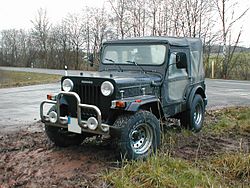 Mahindra and Mahindra Classic used by the Indian Army
 Soldiers from the 101st Airborne Division test prototype off-road vehicles


Experimental vehicle
- Experimental marsh buggy, 1928, stuck in mudExperimental marsh buggy, 1928, stuck in mud
Commercial vehicle
- OKA Bus
- Coober Pedy Oodnadatta One Day Mail Run
- Arctic Trucks
 Off-road bus in Iceland
.jpg)
Scientific vehicle
- Northwest Passage Drive Expedition
- WindSled
Expedition vehicle
Vehicles used as primary transport in an expedition, not for profit, scientific research or personal use.
- American Expedition Vehicles
- AEV Brute
- AEV Prospector
- EarthCruiser
Xem thêm
- Amphibious vehicle
- Off-roading
- Suspension articulation
- Xe thể thao đa dụng (SUV)
- Pickup truck
- Safari vehicle
- Overlanding
Tham khảo
Chú thích
- ↑ "Off-Road Vehicle Act". New Brunswick Acts and regulations. Attorney General, New Brunswick, Canada. ngày 27 tháng 6 năm 1985. Bản gốc (Web) lưu trữ ngày 18 tháng 8 năm 2007. Truy cập ngày 17 tháng 10 năm 2007.
- ↑ "Dakar Rally". Truy cập ngày 8 tháng 11 năm 2024.
- ↑ "MIG-resisteret". migreg/norsk/kiriletz.html. Bản gốc lưu trữ ngày 17 tháng 2 năm 2011. Truy cập ngày 12 tháng 2 năm 2025.
- ↑ "The Antarctic Snow Cruiser & Other Lost Antarctic Vehicles". Antarctica Cruises. ngày 8 tháng 1 năm 2024.
- ↑ "Gone without a Trace: These Are the Forgotten SUVs". Car and Driver (bằng tiếng Anh). ngày 5 tháng 3 năm 2018. Truy cập ngày 21 tháng 11 năm 2024.
- ↑ "Mud terrain vs all-terrain tires – pros, cons & comparison". offroadium.com. Truy cập ngày 17 tháng 4 năm 2017.
- ↑ "Operators manual" (PDF). Bản gốc (PDF) lưu trữ ngày 22 tháng 11 năm 2022.
- ↑ Rodney E. Slater (U.S. Transportation Secretary) (ngày 9 tháng 4 năm 1998). "Secretary Slater Proposes New Label; Warning of Rollover Danger for Sport Utility Vehicles". News Release. National Highway Traffic Safety Administration. Bản gốc (Web) lưu trữ ngày 13 tháng 2 năm 2007. Truy cập ngày 17 tháng 5 năm 2007.
- 1 2 Jeffrey W. Runge, M.D. (Administrator, National Highway Traffic Safety Administration) (ngày 26 tháng 2 năm 2003). "The Honorable Jeffrey W. Runge, M.D. Administrator National Highway Traffic Safety Administration Before the Committee on Commerce, Science, and Transportation United States Senate". Testimony before the Committee on Commerce, Science, And Transportation, United States Senate. National Highway Traffic Safety Administration. Bản gốc (Web) lưu trữ ngày 22 tháng 4 năm 2003. Truy cập ngày 17 tháng 5 năm 2007.
{{Chú thích web}}: Quản lý CS1: nhiều tên: danh sách tác giả (liên kết) - ↑ "Forest Service Rule Revs Up Off-Road Vehicle Fight" (Web). Article. Environment News Service (ENS). ngày 8 tháng 7 năm 2004. Truy cập ngày 24 tháng 6 năm 2007.
- ↑ van Wagtendonk, Jan W. (2003). "Role of Science in Sustainable Management of Yosemite Wilderness" (PDF). USDA Forest Service Proceedings RMRS-P-27. 2003. USDA Forest Service. Truy cập ngày 24 tháng 6 năm 2007.
- ↑ Rice, Kathleen C. "National Collection of Imperiled Plants – Pholisma sonorae". Center for Plant Conservation. Truy cập ngày 8 tháng 6 năm 2012.
- ↑ "Mojave lizard may get protection; off-road vehicles are cited as threat". Los Angeles Times. ngày 12 tháng 1 năm 2008. Truy cập ngày 2 tháng 5 năm 2015.
- ↑ "Officials seek to protect desert reptile". Las Vegas Review-Journal. Truy cập ngày 2 tháng 5 năm 2015.
- ↑ "Technical Notes" (PDF). Conserving Natural and Cultural Resources on Department of Defense Lands; Case Studies from the DoD Conservation Program (Page 13). US Department of Defense. 2004. Bản gốc (PDF) lưu trữ ngày 28 tháng 6 năm 2007. Truy cập ngày 24 tháng 6 năm 2007.
- ↑ Kristine Sowl & Rick Poetter (ngày 16 tháng 4 năm 2004). "Impact Analysis of Off-Road Vehicle Use for Subsistence Purposes on Refuge: Lands and Resources Adjacent to the King Cove Access Project" (PDF). Izembek National Wildlife Refuge (page 6). US Fish and wildlife services Alaska. Bản gốc (PDF) lưu trữ ngày 28 tháng 6 năm 2007. Truy cập ngày 24 tháng 6 năm 2007.
- ↑ "Recreation Management Goals and Strategies" (PDF). Capitol State Forest Recreation and Public Use Plan—Part II (Page 45). Washington State Department of Natural Resources. Bản gốc (PDF) lưu trữ ngày 21 tháng 2 năm 2007. Truy cập ngày 24 tháng 6 năm 2007.
- ↑ "Chapter 11. Field Management Status". Land Management (11.5.2 Identified Concerns of the Parks Department). Central Pine Barrens Joint Planning and Policy Commission. Bản gốc (Web) lưu trữ ngày 18 tháng 11 năm 2005. Truy cập ngày 24 tháng 6 năm 2007.
- ↑ "Codes of Ethics Advocated by Groups Outside of Ontario". Trail Ethics. Trent University. ngày 16 tháng 1 năm 2007. Bản gốc (Web) lưu trữ ngày 17 tháng 2 năm 2019. Truy cập ngày 24 tháng 6 năm 2007.
- ↑ "The Impacts of Off-Road Vehicle Noise on Wildlife". Bản gốc lưu trữ ngày 25 tháng 12 năm 2010. Truy cập ngày 19 tháng 1 năm 2009.
- ↑ "New Air Pollution Rules Target Off-Road Vehicles" (Web). Article. Environment News Service (ENS). ngày 17 tháng 9 năm 2002. Truy cập ngày 24 tháng 6 năm 2007.
- ↑ "Final Rule for Cleaner Large Industrial Spark-Ignition Engines, Recreational Marine Diesel Engines, and Recreational Vehicles". US Environmental Protection Agency. ngày 6 tháng 3 năm 2006. Bản gốc (Web) lưu trữ ngày 21 tháng 10 năm 2002. Truy cập ngày 24 tháng 6 năm 2007.
Danh mục sách tham khảo
- Allen, Jim; Weber, James J. (2021). The Four-Wheeler's Bible: The Complete Guide to Off-Road and Overland Adventure Driving (ấn bản thứ 3). Beverly, MA, USA: Motorbooks. ISBN 9780760368053.
Liên kết ngoài
Tư liệu liên quan tới Off-road vehicles tại Wikimedia Commons
Bản mẫu:Offroading
- ATVs
- Off-road vehicles