
Thành viên:Arest128/Nháp 4
| Reich Chancellery | |
|---|---|
Reichskanzlei | |
Top: The main building and the small courtyard of the Old Reich Chancellery at Wilhelmstraße. Bottom: The entrance on Voßstraße to the Nazi era New Reich Chancellery. | |
| Thông tin chung | |
| Quốc gia | Germany |
| Địa chỉ | Wilhelmstraße 77 |
| Tọa độ | 52°30′42″B 13°22′55″Đ / 52,51167°B 13,38194°Đ |
| Xây dựng | |
| Hoàn thành | 1939 |
| Trùng tu | 1939 |
| Phá hủy | 1945 |
| Thiết kế | |
| Kiến trúc sư | Carl Friedrich Richter |


Văn phòng Thủ tướng Đế chế (tiếng Đức: Reichskanzlei) là tên gọi truyền thống của văn phòng Thủ tướng Đức (khi đó gọi là Reichskanzler) trong thời kỳ Đế chế Đức từ 1878 đến 1945. Địa điểm của Phủ Thủ tướng, được lựa chọn và chuẩn bị từ năm 1875, là cung điện thành phố cũ của Adolf Friedrich Count von der Schulenburg (1685–1741) và sau này thuộc về Hoàng thân Antoni Radziwiłł (1775–1833) nằm trên đường Wilhelmstraße tại Berlin. Cả cung điện này và tòa nhà Văn phòng Thủ tướng Đế chế mới (hoàn thành vào đầu năm 1939) đều bị hư hại nặng nề trong ơThế chiến II và sau đó đã bị phá dỡ.
Ngày nay, văn phòng của Thủ tướng Đức thường được gọi là Kanzleramt (Văn phòng Thủ tướng), hoặc trang trọng hơn là Bundeskanzleramt (Văn phòng Thủ tướng Liên bang). Tên gọi sau cũng chính là tên của trụ sở mới của Văn phòng Thủ tướng, được hoàn thành vào năm 2001.
Phủ Thủ tướng Đế chế cũ Thành viên:Arest128/Nháp 4
Khi liên minh quân sự Liên bang Bắc Đức được tái tổ chức thành một nhà nước liên bang có hiệu lực từ 1 tháng 7 năm 1867, chức vụ Thủ tướng Liên bang (Bundeskanzler) được thành lập tạ Berlin và do Otto von Bismarck, thủ tướng Vương quốc Phổ lúc bấy giờ đảm nhiệm. Sau khi nước Đức được thống nhất vào ngày 18 tháng 1 năm 1871, khi các bang miền Nam Đức gia nhập, Bismarck trở thành Thủ tướng Đế chế của Đế quốc Đức.
Năm 1869, chính phủ Phổ đã mua lại cung điện Rococo của Hoàng thân quá cố Radziwiłł tại số 77 đường Wilhelmstraße (trước đây gọi là Palais Schulenburg), từ năm 1875, tòa nhà này được cải tạo thành trụ sở chính thức của. Nó được khánh thành khi tổ chứ Hội nghị Berlin vào tháng 7 năm 1878, sau đó tiếp tục được sử dụng trong Hiệp hội Quốc tế Congo vào năm 1884.
Trong thời kỳ Cộng hòa Weimar tòa nhà Phủ Thủ tướng được mở rộng đáng kể bằng việc xây thêm một khối nhà phụ phía nam theo phong cách hiện đại, hoàn thành năm 1930. In 1932/33, while his nearby office on Wilhelmstraße No. 73 was renovated, the building also served as the residence of Reich President Paul von Hindenburg, where he appointed Adolf Hitler chancellor on 30 January 1933. The Hitler Cabinet held few meetings here. In 1935, the architects Paul Troost and Leonhard Gall redesigned the interior as Hitler's domicile. They also added a large reception hall/ballroom and conservatory, officially known as the Festsaal mit Wintergarten in the garden area. The latter addition was unique because of the large cellar that led a further one-and-a-half meters down to an air-raid shelter known as the Vorbunker.[1] Once completed in 1936, it was officially called the "Reich Chancellery Air-Raid Shelter" until 1943, with the construction to expand the bunker complex with the addition of the Führerbunker, located one level below.[2] The two bunkers were connected by a stairway set at right angles which could be closed off from each other.[3]
Devastated by air raids and almost completely destroyed during the Battle of Berlin, the ruins of the Old Reich Chancellery were not cleared until 1950.
New Reich Chancellery Thành viên:Arest128/Nháp 4
In late January 1938, Adolf Hitler officially assigned his favourite architect, Albert Speer, to build the New Reich Chancellery around the corner on Voßstraße, a western branch-off of Wilhelmstraße, requesting that the building be completed within a year. Hitler commented that Bismarck's Old Chancellery was "fit for a soap company"[4] and not suitable as headquarters of a Greater German Reich. It nevertheless remained his official residence, where Hitler lived in the so-called Führerwohnung ("Leader apartment"). The Old and New Chancellery shared a large garden area, with the underground Führerbunker, where Hitler ultimately committed suicide at the end of April 1945.
Hitler placed the entire northern side of the Voßstraße at Speer's disposal, assigning him the work of creating grand halls and salons which "will make an impression on people".[5] Speer was given a blank cheque—Hitler stated that the cost of the project was immaterial—and was instructed that the building be of solid construction, and that it be finished by the following January in time for the next New Year's diplomatic reception to be held in the new building.
Speer claimed in his autobiography that he had completed the task of clearing the site, designing, constructing, and furnishing the building in less than a year. In fact, preliminary planning and versions of the designs were already being worked on as early as 1935. To clear the space for the New Reich Chancellery, the buildings on the northern side of Voßstraße No. 2–10 had been demolished in 1937.
Over 4,500 people worked in shifts, so that progress could be made around the clock.[6] The immense construction was finished 48 hours ahead of schedule, and the project earned Speer a reputation as a good organiser, which played a part in the architect becoming Armaments Minister and a director of forced labour later in the war. Speer recalls that the whole work force—masons, carpenters, plumbers, etc. were invited to inspect the finished building. Hitler then addressed the workers in the Sportpalast; interior fittings, however, were not finished until the early 1940s. In the end, the project cost over 90 million Reichsmarks (equivalent to 388 million 2021 €), and hosted the various ministries of the Reich.[7]
In his memoirs, Speer described the impression of the Reichskanzlei on a visitor:
From Wilhelmsplatz an arriving diplomat drove through great gates into a court of honour. By way of an outside staircase he first entered a medium-sized reception room from which double doors almost 5,2 m (17 ft)[chuyển đổi: số không hợp lệ] high opened into a large hall clad in mosaic. He then ascended several steps, passed through a round room with domed ceiling, and saw before him a gallery 150 m (490 ft) long. Hitler was particularly impressed by my gallery because it was twice as long as the Hall of Mirrors at Versailles. Hitler was delighted: "On the long walk from the entrance to the reception hall they'll get a taste of the power and grandeur of the German Reich!" During the next several months he asked to see the plans again and again but interfered remarkably little in this building, even though it was designed for him personally. He let me work freely.
The series of rooms comprising the approach to Hitler's reception gallery were decorated with a rich variety of materials and colours, and totalled 221 m (725 ft) in length. The gallery itself was 147,5 m (484 ft)[chuyển đổi: số không hợp lệ] long. Hitler's own office was 400 m2 (4.300 foot vuông) in size. From the outside, the chancellery had a stern, authoritarian appearance. From the Wilhelmplatz, guests would enter the Chancellery through the Court of Honour (Ehrenhof). The building's main entrance was flanked by two bronze statues by sculptor Arno Breker: "Wehrmacht" and "Die Partei" ("Armed Forces" and "The Party"). Hitler is said to have been greatly impressed by the building and was uncharacteristically free in his praise for Speer, lauding the architect as a "genius". The chancellor's great study was a particular favourite of the dictator. In it there stood a grand marble-topped table, which remained generally decorative up until 1944, when it served as an important part of the Nazi leader's military headquarters; the study being used for military conferences.[8] On the other hand, the Cabinet room was never used for its intended purpose.
The New Reich Chancellery suffered severe damage during the Battle of Berlin between April and May 1945 (in comparison, the Old Reich Chancellery was not as badly damaged). Andrei Gromyko, who would later become the Soviet foreign minister, visited the partially-destroyed structure a few weeks after the fighting in the city had completely ceased. He recalls, "We reached it not without difficulties. Ruined edifices, formless heaps of metal and ferro-concrete encumbered the way. To the very entrance of the Chancellery, the car could not approach. We had to reach it on foot..."Bản mẫu:Quote without source He noted the New Reich Chancellery "...was almost destroyed... Only the walls remained, riddled by countless shrapnel, yawning by big shot-holes from shells. Ceilings survived only partly. Windows loomed black by emptiness."Bản mẫu:Quote without source
The last stage of defense by defending German troops took place inside the Reich Chancellery, as mentioned by Gromyko, who stated the following:
Doors, windows and chandeliers testified on them the big imprint of the battle, most of them being broken. The lowest floors of the Reich Chancellery represented chaos. Obviously, the garrison of the Citadel fiercely resisted here... All around lie heaps of crossbeams and overhead covers, both metal and wood and huge pieces of ferro-concrete. On both sides of a narrow corridor, there were certain disposed cells, all eroded by explosions… All this produced a grim and distressing impression. If photography of this underground citadel of Hitler existed, they would become a proper illustration to Dante's Hell; just select which circle.[9]
After World War II in Europe ended, the remains in what was then East Berlin (the Soviet-occupied sector of a divided Berlin) were demolished by the order of the Soviet occupation forces. Parts of the building's marble walls were rumoured to have been used in the building of the Soviet war memorial located in Treptower Park, or to renovate and repair the nearby war-damaged Mohrenstraße U-Bahn station. Petrographic analyses of materials used for construction there did not confirm those rumours.[10] Some of the so-called "red marble" (actually limestone) obtained from the demolition of the New Reich Chancellery was also supposedly used in the construction of the Moscow Metro's palatial-style stations after the war.[cần dẫn nguồn] Also, it is alleged that a heater from one of Hitler's rooms was placed in a Protestant hospital located not too far away from the Reich Chancellery.[11]
While the western half of the plot was used by the East German government for the establishment of the so-called "Death-Strip" adjacent to the Berlin Wall in 1961 (when the barrier was being constructed), a Plattenbau apartment block, together with a kindergarten, was built on the eastern half (along Wilhelmstraße) during the 1980s.
Gallery
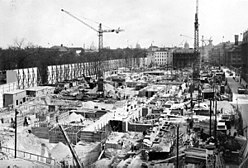 The New Reich Chancellery under construction in 1938
 The New Reich Chancellery, pictured here on the junction of Hermann-Göring-Straße (now Ebertstraße) and Voßstraße in 1939
 The New Reich Chancellery as pictured on Voss Street in 1939
 The New Reich Chancellery's Courtyard of Honor in 1939. The main entrance was flanked by Arno Breker's two bronze statues Die Wehrmacht and Die Partei ("The Armed Forces" and "The Party")
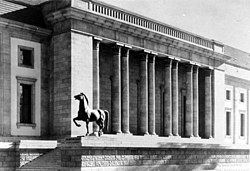 The New Reich Chancellery's garden portal (gateway) in 1939
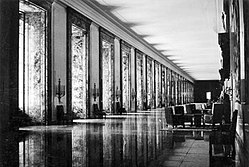 The New Reich Chancellery's grand marble gallery in 1939
 The New Reich Chancellery's work-study office/room for Hitler in 1939
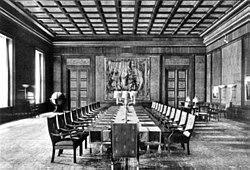 The New Reich Chancellery's Reich government chamber (cabinet room) in 1939
 The location of the Old (15) and the New Reich Chancellery (1), together with the Vorbunker and the Führerbunker (red, 10), between Hermann-Göring-Straße (24) Voßstraße (25) and Wilhelmstraße (26)
 The corner of Wilhelmstraße and Voßstraße today, now occupied by an apartment block and a Chinese restaurant
 A part of the Soviet War Memorial at Treptower Park, supposedly built from red marble – actually granite – which was said to be taken from the ruins of the New Reich Chancellery
 A bronze Nazi eagle from the New Reich Chancellery on display at the Imperial War Museum in London
 Another Eagle-and-swastika on display at National Museum of the United States Air Force in Ohio
 Replica of Arno Breker's Die Wehrmacht (Schwertträger) on display in German Historical Museum in Berlin
 Tapestry from the Reich Chancellery at the former International Museum of World War II, together with uniforms for a party leader and Sturmabteilung member.


_Nazi_statue_at_Reichskanzlei_by_Arno_Breker_1938-39_Foyer_Deutsches_Historiches_Museum_2019-10-13_Not_original_art_Lenin_statue_3683.jpg)

See also Thành viên:Arest128/Nháp 4
- Chief of the Reich Chancellery
- German Chancellery
- Nazi architecture
- Vorbunker
- Welthauptstadt Germania
- Berchtesgaden Chancellery Branch office
References and citations Thành viên:Arest128/Nháp 4
- ↑ Lehrer, Steven (2006). The Reich Chancellery and Führerbunker Complex. An Illustrated History of the Seat of the Nazi Regime. Jefferson, NC: McFarland. tr. 117. ISBN 0-7864-2393-5.
- ↑ Lehrer, Steven (2006). The Reich Chancellery and Führerbunker Complex. An Illustrated History of the Seat of the Nazi Regime. Jefferson, NC: McFarland. tr. 117, 119. ISBN 0-7864-2393-5.
- ↑ Mollo, Andrew; Ramsey, Winston, biên tập (1988). The Reichs Chancellery and the Berlin Bunker then and now. After the Battle. Quyển 61. London: Seymour Press. tr. 28.
- ↑ Speer, Albert (1970). Inside the Third Reich. Orion Books. ISBN 978-1-84212-735-3.
- ↑ Speer, Albert (1970). Inside the Third Reich. Orion Books. ISBN 978-1-84212-735-3.
- ↑ Lehrer, Steven (ngày 27 tháng 4 năm 2006). The Reich Chancellery and Führerbunker Complex (bằng tiếng English). Jefferson, NC: McFarland and Company, Inc., Publishers. tr. 85. ISBN 978-0-7864-2393-4.
{{Chú thích sách}}: Quản lý CS1: ngôn ngữ không rõ (liên kết) - ↑ "Who Was Who in Nazi Germany" Lưu trữ ngày 9 tháng 8 năm 2011 tại Wayback Machine, Nuremberg Trials Project. Harvard University. Retrieved 2 aug 2011
- ↑ Lehrer, Steven (2006). The Reich Chancellery and Führerbunker Complex (bằng tiếng English). Jefferson, NC: McFarland & Co. tr. 84. ISBN 978-0-7864-2393-4.
{{Chú thích sách}}: Quản lý CS1: ngôn ngữ không rõ (liên kết) - ↑ А. Андрей Громыко, Памятное, Москва: Политиздат, 1988, pp 216–217, translated in Maks Ostrovski, The Hyperbole of the World Order, Lanham: Rowman & Littlefield, 2006, pp 144–145.
- ↑ Hans-Ernst Mittig: "Marmor der Reichskanzlei", in: Dieter Bingen / Hans-Martin Hinz (Hrsg.): Die Schleifung / Zerstörung und Wiederaufbau historischer Bauten in Deutschland und Polen. Harrassowitz Verlag, Wiesbaden 2005, ISBN 3-447-05096-9.
- ↑ Architektur der Angst einestages – Zeitgeschichten auf Spiegel Online
General
- Speer, Albert (1970). Inside the Third Reich. New York: Macmillan. LCCN 70-119132.
- Kellerhoff, Sven Felix (2006). Berlin unterm Hakenkreuz (Berlin under the Swastika). Berlin: Berlin Edition be.bra Verlag GmbH. ISBN 978-3-8148-0147-6.
- Allied Intelligence Map of Key Buildings in Berlin (Third Edition, 1945)
Further reading Thành viên:Arest128/Nháp 4
- Lehrer, Steven (2006). The Reich Chancellery and Führerbunker Complex: An Illustrated History of the Seat of the Nazi Regime. McFarland. tr. 214. ISBN 0-7864-2393-5.
- Lehrer, Steven (2002). Hitler Sites: A City-by-city Guidebook (Austria, Germany, France, United States). McFarland. tr. 224. ISBN 0-7864-1045-0.
- Taylor, Blaine. Hitler's Headquarters: From Beer Hall to Bunker, 1920–1945.
- Cowdery, Ray and Josephine. The New German Reichschancellery 1938–1945.
- Schönberger, Angela (1981). Die Neue Reichskanzlei Von Albert Speer. Zum Zusammenhang von nationalsozialistischer Ideologie und Architektur. Berlin: Berlin: Gebr. Mann.
- Scobie, Alex (1990). Hitler's State Architecture: The Impact of Classical Antiquity. University Park and London: Pennsylvania State University Press.
- Taylor, Robert (1974). The Word in Stone. The Role of Architecture in the National Socialist Ideology. Berkeley: University of California Press.
- Speer, Albert (1940). Die Neue Reichskanzlei / Architekt Albert Speer. München: Eher Verlag.
- Neubauer, Christoph (2010). Stadtführer durch Hitlers Berlin (Deutsch/English). Frankfurt (Oder): Flashback Medienverlag. ISBN 978-3-9813977-0-3.
- Neubauer, Christoph (2014): Die Reichskanzlei – Architektur der Macht, Band 1 (1733–1875). Chr. Neubauer Verlag, Großschönau 2014, ISBN 978-3-9813977-1-0.
Documentary Thành viên:Arest128/Nháp 4
- Ruins of the Reich DVD R.J. Adams (Third Reich architecture ruins)
External links Thành viên:Arest128/Nháp 4

- Nazi architecture
- Government buildings completed in 1938
- Buildings and structures in Berlin
- Buildings and structures in Mitte
- Demolished buildings and structures in Germany
- Demolished buildings and structures in Berlin
- Berlin in World War II
- Government of Nazi Germany
- World War II sites in Germany
- Führer Headquarters
- Buildings and structures in Germany destroyed during World War II
- Buildings and structures in Berlin destroyed during World War II
- Former palaces in Germany
- Wilhelmstrasse