


Thành viên:MinhVN1863/nháp/1
 9M-MRO, the aircraft involved in the disappearance, pictured in 2013 | |
| Disappearance | |
|---|---|
| Ngày | 8 tháng 3 năm 2014 |
| Mô tả tai nạn | Inconclusive, some debris found |
| Địa điểm | Indian Ocean, most likely southern |
| Máy bay | |
| Dạng máy bay | Boeing 777-2H6ER[a] |
| Hãng hàng không | Malaysia Airlines |
| Số chuyến bay IATA | MH370 |
| Số chuyến bay ICAO | MAS370 |
| Tín hiệu gọi | MALAYSIAN 370 |
| Số đăng ký | 9M-MRO |
| Xuất phát | Kuala Lumpur International Airport, Sepang District, Malaysia |
| Điểm đến | Beijing Capital International Airport, Beijing, China |
| Số người | 239 |
| Hành khách | 227 |
| Phi hành đoàn | 12 |
| Tử vong | 239 (presumed) |
| Sống sót | 0 (presumed) |
| Chuyến bay 370 của Malaysia Airlines |
|---|
| Tìm kiếm (JACC) · Dòng thời gian · Phân tích truyền thông vệ tinh · Giả thiết |
Malaysia Airlines Flight 370 (MH370 / MAS370) là một chuyến bay quốc tế thường lệ được vận hành bởi Malaysia Airlines mà chính chiếc máy bay này đã biến mất một cách bí ẩn khi đang bay từ sân bay quốc tế Kuala Lumpur đến sân bay quốc tế Thủ đô Bắc Kinh.[1][2][3][4] và được xem là vụ mất tích máy bay với thương vong cao nhất.
The crew of the Boeing 777-200ER, registered as 9M-MRO, last communicated with air traffic control (ATC) around 38 minutes after takeoff when the flight was over the South China Sea. The aircraft was lost from ATC's secondary surveillance radar screens minutes later but was tracked by the Malaysian military's primary radar system for another hour, deviating westward from its planned flight path, crossing the Malay Peninsula and Andaman Sea. It left radar range 200 hải lý (370 km; 230 mi) northwest of Penang Island in northwestern Peninsular Malaysia.
With all 227 passengers and 12 crew aboard presumed dead, the disappearance of Flight 370 was the deadliest incident involving a Boeing 777, the deadliest of 2014, and the deadliest in Malaysia Airlines' history until it was surpassed in all three regards by Malaysia Airlines Flight 17, which was shot down by Russian-backed forces while flying over Ukraine four months later on 17 July 2014.
The search for the missing aircraft became the most expensive search in the history of aviation. It focused initially on the South China Sea and Andaman Sea, before a novel analysis of the aircraft's automated communications with an Inmarsat satellite indicated that the plane had travelled far southward over the southern Indian Ocean. The lack of official information in the days immediately after the disappearance prompted fierce criticism from the Chinese public, particularly from relatives of the passengers, as most people on board Flight 370 were of Chinese origin. Several pieces of debris washed ashore in the western Indian Ocean during 2015 and 2016; many of these were confirmed to have originated from Flight 370.
After a three-year search across 120,000 km2 (46,332 dặm vuông Anh) of ocean failed to locate the aircraft, the Joint Agency Coordination Centre heading the operation suspended its activities in January 2017. A second search launched in January 2018 by private contractor Ocean Infinity also ended without success after six months.
Relying mostly on the analysis of data from the Inmarsat satellite with which the aircraft last communicated, the Australian Transport Safety Bureau (ATSB) initially proposed that a hypoxia event was the most likely cause given the available evidence, although no consensus has been reached among investigators concerning this theory. At various stages of the investigation, possible hijacking scenarios were considered, including crew involvement, and suspicion of the airplane's cargo manifest; many disappearance theories regarding the flight have also been reported by the media.
The Malaysian Ministry of Transport's final report from July 2018 was inconclusive. It highlighted Malaysian ATC's fruitless attempts to communicate with the aircraft shortly after its disappearance. In the absence of a definitive cause of disappearance, air transport industry safety recommendations and regulations citing Flight 370 have been implemented to prevent a repetition of the circumstances associated with the loss. These include increased battery life on underwater locator beacons, lengthening of recording times on flight data recorders and cockpit voice recorders, and new standards for aircraft position reporting over open ocean. Malaysia had supported 58% of the total cost of the underwater search, Australia 32%, and China 10%.
Timeline

Flight 370 last made voice contact with ATC at 01:19 MYT, 8 March (17:19 UTC, 7 March) when it was over the South China Sea, less than an hour after takeoff. It disappeared from ATC radar screens at 01:22 MYT, but was still tracked on military radar as it turned sharply away from its original northeastern course to head west and cross the Malay Peninsula, continuing that course until leaving the range of the military radar at 02:22 while over the Andaman Sea, 200 hải lý (370 km; 230 mi) northwest of Penang Island, in northwestern Malaysia.[5][6]
The multinational search effort for the aircraft, which was to become the most expensive aviation search in history,[7][8][9] began in the Gulf of Thailand and the South China Sea,[10] where the aircraft's signal was last detected on secondary surveillance radar, and was soon extended to the Strait of Malacca and Andaman Sea. Analysis of satellite communications between the aircraft and Inmarsat's satellite communications network concluded that the flight continued until at least 08:19 (nearly an hour after Malaysia Airlines publicly announced the plane's loss) and flew south into the southern Indian Ocean, although the precise location cannot be determined. Australia assumed charge of the search on 17 March, when the search effort began to emphasise the southern Indian Ocean. On 24 March, the Malaysian government noted that the final location determined by the satellite communication was far from any possible landing sites, and concluded, "Flight MH370 ended in the southern Indian Ocean."[11]
From October 2016 to January 2017, a comprehensive survey of 120,000 km2 (46,332 dặm vuông Anh) of sea floor about 1,800 km (1,118 mi; 0,972 nmi) southwest of Perth, Western Australia, yielded no evidence of the aircraft. Several pieces of marine debris found on the coast of Africa and on Indian Ocean islands off the coast of Africa—the first of which was discovered on 29 July 2015 on Réunion—have been confirmed as pieces of Flight 370.[12][13][14][15] The bulk of the aircraft has not been located, prompting many theories about its disappearance.
In January 2018, a search by private US marine exploration company Ocean Infinity began in the search zone around 35°36′N 92°48′Đ / 35,6°N 92,8°Đ, the most likely crash site according to the drift study published in 2017.[16][17][18] In a previous search attempt, Malaysia had established a Joint Investigation Team (JIT) to investigate the incident, working with foreign aviation authorities and experts. Malaysia released a final report concerning Flight 370 on 17 October 2017.[19] Neither the crew nor the aircraft's communication systems relayed a distress signal, indications of bad weather, or technical problems before the aircraft vanished.[20]
Two Iranian passengers travelling on stolen passports were investigated, but eliminated as suspects. Malaysian police identified the captain as the prime suspect if human intervention was the cause of the disappearance, after clearing all others on the flight of suspicion over possible motives. Power was lost to the aircraft's satellite data unit (SDU) at some point between 01:07 and 02:03; the SDU logged onto Inmarsat's satellite communication network at 02:25, which was three minutes after the aircraft had left the range of radar. Based on analysis of the satellite communications, the aircraft was postulated to have turned south after passing north of Sumatra and then to have flown for six hours with little deviation in its track, ending when its fuel was exhausted.[21]
With the loss of all 239 lives on board, Flight 370 is the second-deadliest incident involving a Boeing 777 and the second-deadliest incident of Malaysia Airlines' history, second to Flight 17 in both categories. Malaysia Airlines was struggling financially, a problem that was exacerbated by a decrease of ticket sales after the disappearance of Flight 370 and the downing of Flight 17; the airline was renationalised by the end of 2014. The Malaysian government received significant criticism, especially from China, for failing to disclose information promptly during the early weeks of the search. Flight 370's disappearance brought to public attention the limits of aircraft tracking and flight recorders, including the limited battery life of underwater locator beacons (an issue that had been raised about four years earlier following the loss of Air France Flight 447, but had never been resolved). In response to Flight 370's disappearance, the International Civil Aviation Organization adopted new standards for aircraft position reporting over open ocean, extended recording time for cockpit voice recorders, and, starting from 2020, new aircraft designs have been required to have a means of recovering the flight recorders, or the information they contain, before they sink into the water.[22]
Background


Aircraft
Flight 370 was operated with a Boeing 777-2H6ER,[c] serial number 28420, registered as 9M-MRO. The aircraft was delivered new to Malaysia Airlines on 31 May 2002.[24]:39 The aircraft was powered by two Rolls-Royce Trent 892 engines and configured to carry 282 passengers in total capacity.[25][24]:39 It had accumulated 53,471.6 hours and 7,526 cycles (takeoffs and landings) in service[26]:22 and had not previously been involved in any major incidents,[27] though a minor incident while taxiing at Shanghai Pudong International Airport in August 2012 resulted in a broken wing tip.[28][29] Its last maintenance "A check" was carried out on 23 February 2014.[30] The aircraft was in compliance with all applicable Airworthiness Directives for the airframe and engines. A replenishment of the crew member oxygen system was performed on 7 March 2014, a routine maintenance task; an examination of this procedure found nothing unusual.[26]:27 Ten years after MH370's disappearance, however, leaked documents have shown that MH370 was given supplemental fuel and crew member oxygen supplies just before takeoff.[31]
The Boeing 777 was introduced in 1994 and has an excellent safety record.[32][33] Since its first commercial flight in June 1995, the type has suffered only six other hull losses:
- the crash of British Airways Flight 38 in 2008;
- a cockpit fire in a parked EgyptAir Flight 667 at Cairo International Airport in 2011;[34][35]
- the crash of Asiana Airlines Flight 214 in 2013, in which three people died;
- Malaysia Airlines Flight 17, which was shot down over Ukraine, killing all 298 people aboard in July 2014;[36][37]
- Emirates Flight 521, which crashed and burned out while landing at Dubai International Airport in August 2016 killing one person;[38]
- and in November 2017, the seventh Boeing 777 hull loss occurred when a Singapore Airlines 777-200ER was written off after catching fire and burning out at Singapore Changi Airport.[39]
Passengers and crew
| Nationality[40] | Count |
|---|---|
| Australia | 6 |
| Canada | 2 |
| China | 153[d] |
| France | 4 |
| India[42] | 5 |
| Indonesia | 7 |
| Iran | 2[e] |
| Malaysia | 50[f] |
| Netherlands | 1 |
| New Zealand | 2 |
| Russia | 1 |
| Taiwan | 1 |
| Ukraine | 2 |
| United States | 3 |
| Total (14 nationalities) | 239 |
The aircraft was carrying 12 Malaysian crew members and 227 passengers from 14 different nations.[44] On the day of the disappearance, Malaysia Airlines released the names and nationalities of the passengers and crew, based on the flight manifest.[40] The passenger list was later modified to include two Iranian passengers travelling on stolen Austrian and Italian passports.[43]
Crew
All 12 crew members—two pilots and 10 cabin crew—were Malaysian citizens.[40]
- The pilot in command was 52-year-old Captain Zaharie Ahmad Shah from Penang.[45] He joined Malaysia Airlines as a cadet pilot in 1981, and after training and receiving his commercial pilot's license, he became a second officer with the airline in 1983. He was promoted to captain of the Boeing 737-400 in 1991, captain of the Airbus A330-300 in 1996, and captain of the Boeing 777-200 in 1998. He had been a type-rating instructor and a type-rating examiner since 2007. Zaharie had a total of 18,365 hours of flying experience.[26]:13[46][47]
- The co-pilot was 26-year-old First Officer Fariq Abdul Hamid. He joined Malaysia Airlines as a cadet pilot in 2007; after becoming a second officer of the Boeing 737-400, he was promoted to first officer of the Boeing 737-400 in 2010 and then transitioned to the Airbus A330-300 in 2012. In November 2013, he began training as first officer of the Boeing 777-200 aircraft. Flight 370 was his final training flight, and he was scheduled to be examined on his next flight. Fariq had accumulated 2,763 hours of flying experience.[26]:14[48][49]
Passengers
Of the 227 passengers, 153 were Chinese citizens,[44] including a group of 19 artists with six family members and four staff returning from a calligraphy exhibition of their work in Kuala Lumpur; 38 passengers were Malaysian. The remaining passengers were from 12 different countries.[40][50] Twenty passengers, 12 of whom were from Malaysia and eight from China, were employees of Freescale Semiconductor.[50][51][52]
Through a 2007 agreement with Malaysia Airlines, Tzu Chi (an international Buddhist organisation) immediately sent specially trained teams to Beijing and Malaysia to give emotional assistance to passengers' families.[53][54] The airline also sent its own team of caregivers and volunteers[55] and agreed to bear the expense of bringing family members of the passengers to Kuala Lumpur and providing them with accommodation, medical care, and counselling.[56] Altogether, 115 family members of the Chinese passengers flew to Kuala Lumpur.[57] Some other family members chose to remain in China, fearing they would feel too isolated in Malaysia.[58]
Mất tích

Chuyến bay 370 là một chuyến bay thường lệ vào nửa đêm rạng sáng thứ bảy, ngày 8 tháng 3 năm 2014. Dự kiến cất cánh từ Kuala Lumpur (Malaysia) lúc 00:35 (UTC+8) và sẽ hạ cánh tại Bắc Kinh (Trung Quốc) lúc 06:30 cùng ngày.[59][60] Trên máy bay có 227 hành khách và 12 thành viên phi hành đoàn.[26]:1, 12, 30
Thời gian bay dự kiến là 5 giờ 34 phút. Máy bay mang theo tổng cộng 49,1 tấn nhiên liệu bao gồm cả nhiên liệu dự phòng cho phép thời gian bay tối đa là 7 tiếng 31 phút.[26]:1, 30
Cất cánh
Vào lúc 0 giờ 42 MYT, máy bay cất cánh từ đường băng 32R[26]:1 và được kiểm soát không lưu (ATC) sân bay cấp phép bay lên mực bay 180 (FL 180, độ cao xấp xỉ 18,000 feet) trong khi bay đến điểm tham chiếu IGARI. Chuyến bay sau đó được bàn giao sang trung tâm kiểm soát đường dài Kuala Lumpur (ACC Kuala Lumpur) và tiếp tục được ACC Kuala Lumpur cấp phép máy bay bay lên FL 350 lúc 0 giờ 46. Tiếp theo vào lúc 1 giờ 1, tổ bay thông báo lại với ACC Kuala Lumpur rằng họ đã đạt đến mực bay này.[26]:1–2[61]
Mất liên lạc
 ATC conversations with Flight 370 Audio recordings of conversations between ATC and Flight 370 from pre-departure to final contact (00:25–01:19). ATC conversations with Flight 370 Audio recordings of conversations between ATC and Flight 370 from pre-departure to final contact (00:25–01:19). |
Vào lúc 01:06, ACARS tự động truyền đi một thông báo về dữ liệu chuyến bay, đây cũng là lần truyền dữ liệu chuyến bay cuối cùng từ MH370.[62]:2[63][64]:36[65]:9 Còn lần liên lạc cuối cùng giữa tổ bay và ATC được thực hiện vào lúc 1 giờ 19 phút khi cơ trưởng Zaharie xác nhận bàn giao chuyến bay từ ACC Kuala Lumpur sang trung tâm kiểm soát đường dài Hồ Chí Minh (ACC Hồ Chí Minh). Đoạn hội thoại có nội dung như sau:[26]:2, 21[61][66]
ACC Kuala Lumpur : "Malaysian three seven zero, contact Ho Chi Minh one two zero decimal nine. Good night."
(ACC Kuala Lumpur: "Malaysian 370, liên lạc Hồ Chí Minh 120.9. Tạm biệt.")
Flight 370: "Good night. Malaysian three seven zero."
(MH370: "Tạm biệt, Malaysian 370.")
Sau khi vào vùng thông báo bay Hồ Chí Minh (FIR Hồ Chí Minh), tổ bay không liên lạc với ACC Hồ Chí Minh theo kế hoạch.[67][68] Vào lúc 1 giờ 30, cơ trưởng của một máy bay khác đã cố gắng liên lạc với MH370 thông qua tần số khẩn cấp theo yêu cầu của ATC; anh ấy sau đó nói rằng có kết nối được với MH370, nhưng chỉ nghe những âm thanh "lẩm bẩm" và tiếng rè.[69] Các lần cố gắng liên lạc sau đó vào lúc 2 giờ 39 và 7 giờ 13 đều kết nối được với máy bay, nhưng không nhận được phản hồi.[62]:18[64]:40
Biến mất khỏi Radar
Vào lúc 1 giờ 21, khi máy bay vừa bay qua điểm tham chiếu IGARI và đang ở gần điểm BITOD thì chuyến bay đồng thời biến mất khỏi màn hình radar của ACC Kuala Lumpur và ACC Hồ Chí Minh.[26]:2[61] Do ATC chủ yếu sử dụng radar thứ cấp, tức là dựa vào tín hiệu được phát ra từ bộ phát đáp của máy bay; do đó khi mà bộ phát đáp máy bay ngừng phát tín hiệu, máy bay cũng biến mất khỏi màn hình radar. Lần truyền tín hiệu cuối cùng của bộ phát đáp cho biết máy bay vẫn đang bay ở độ cao hành trình (FL 350) với tốc độ 471 hải lý trên giờ (872 km/h).[70] Thời tiết lúc này chỉ có mây nhẹ và không có mưa hay sấm sét.[26]:33–36 Cuộc điều tra sau đó dự đoán rằng chuyến bay 370 còn lại 41,5 tấn nhiên liệu khi nó biến mất khỏi radar thứ cấp.[26]:30
Radar của quân đội Malaysia sau đó tiếp tục theo dõi chuyến bay 370 do họ sử dụng radar sơ cấp [g]. Sau khi biến mất khỏi radar thứ cấp của hai ACC thì máy bay rẽ trái gần như ngay lập tức về hướng tây nam.[26]:3 Chuyến bay 370 sau đó tiếp tục bay qua Bán đảo Mã Lai với độ cao dao động trong khoảng 31.000 và 33.000 ft (9.400 và 10.100 m).[26]:3[26]:3–4 Vào lúc 1 giờ 52, máy bay bay qua phía Nam đảo Penang, bay tiếp qua eo biển Malacca, điểm tham chiếu VAMPI và Pulau Perak lúc 2 giờ 3. Sau đó bay tiếp theo đường bay N571 đến điểm MEKAR và biến mất khỏi radar quân đội vào lúc 2 giờ 22 khi vừa bay qua điểm MEKAR do đã ra khỏi phạm vi hoạt động của radar này.[62]:3, 38[26]:3, 7[71][72]
Khôi phục liên lạc vệ tinh
Máy bay mất kết nối liên lạc vệ tinh vào lúc 1 giờ 6 phút và sau đó đã không truyền thông tin gì thêm cho đến khi khoảng hơn một tiếng sau vào lúc 2 giờ 25, máy bay gửi cho vệ tinh một yêu cầu đăng nhập và đã liên tiếp xác nhận yêu cầu (hay gọi là cái bắt tay) từ Inmarsat trong 6 tiếng tiếp theo.[62]:18[64] Cái bắt tay cuối cùng được thực hiện lúc 8 giờ 10 và sau đó là yêu cầu đăng nhập từ máy bay lúc 8 giờ 19, đây cũng là lần truyền tin cuối cùng từ chiếc máy bay này do yêu cầu bắt tay sau đó lúc 9 giờ 15 đã không nhận được phản hồi.[62][64][73][74]
Các nhà điều tra phán đoán rằng chuyến bay đã rơi xuống một nơi nào đó ở phía Nam Ấn Độ dương trong khoảng từ 8 giờ 19 đến 9 giờ 15 do hết nhiên liệu. Tuy nhiên, thời gian chính xác hiện vẫn là một ẩn số.
Phản hồi từ kiểm soát không lưu

Sau khoảng 25 phút kể từ lúc liên lạc cuối cùng với ACC Kuala Lumpur, khi mà đáng lẽ ra chuyến bay 370 đã phải xuất hiện trên radar của ACC Hồ Chí Minh và liên lạc với họ nhưng không có động tĩnh gì. ACC Hồ Chí Minh sau đó mới thông báo với ACC Kuala Lumpur rằng họ vẫn chưa kết nối liên lạc được MH370 theo kế hoạch.[61][75]
ACC Kuala Lumpur đã chuyển một thông báo từ trung tâm điều phối của Malaysia Airlines vào lúc 02:03 rằng chuyến bay 370 đang ở trong không phận của Campuchia.[61] Trưởng ca trực tại ACC Kuala Lumpur vào lúc 02:15 đã gọi cho trung tâm điều phối của Malaysia Airlines để hỏi tình hình, bên kia nói rằng vẫn có thể trao đổi thông tin với MH370 rằng nó vẫn đang ở trong không phận Campuchia.[75] ACC Kuala Lumpurt sau đó đã liên lạc lại bên ACC Hồ Chí Minh để hỏi rằng chuyến bay 370 có đường bay qua không phận Campuchia hay không. responded that Flight 370 was not supposed to enter Cambodian airspace and that they had already contacted Phnom Penh ACC (which controls Cambodian airspace), which had no communication with Flight 370.[61] Kuala Lumpur ACC contacted Malaysia Airlines' operations centre at 02:34, inquiring about the communication status with Flight 370, and were informed that Flight 370 was in a normal condition based on a signal download and that it was located at 14°54′B 109°15′Đ / 14,9°B 109,25°Đ.[75] Later, another Malaysia Airlines aircraft (Flight 386 bound for Shanghai) attempted, at the request of Ho Chi Minh ACC, to contact Flight 370 on the Lumpur Radar frequency – the frequency on which Flight 370 last made contact with Malaysian air traffic control – and on emergency frequencies. The attempt was unsuccessful.[61][76]
At 03:30, Malaysia Airlines' operations centre informed Kuala Lumpur ACC that the locations it had provided earlier were "based on flight projection and not reliable for aircraft positioning." Over the next hour, Kuala Lumpur ACC contacted Ho Chi Minh ACC asking whether they had signaled Chinese air traffic control. At 05:09, Singapore ACC was queried for information about Flight 370. At 05:20, an undisclosed official contacted Kuala Lumpur ACC requesting information about Flight 370; he opined that, based on known information, "MH370 never left Malaysian airspace."[61]
The watch supervisor at Kuala Lumpur ACC activated the Kuala Lumpur Aeronautical Rescue Coordination Centre (ARCC) at 05:30, more than four hours after communication was lost with Flight 370.[75] The ARCC is a command post at an Area Control Centre that coordinates search-and-rescue activities when an aircraft is lost.
Thông báo mất tích
Malaysia Airlines issued a media statement at 07:24 MYT on 8 March, one hour after the scheduled arrival time of the flight at Beijing, stating that communication with the flight had been lost by Malaysian ATC at 02:40 and that the government had initiated search-and-rescue operations.[77] Unbeknownst to investigators or Malaysia Airlines at the time, Flight 370 was still airborne at the time of this initial media statement, and search-and-rescue operations were commenced while the plane was still in flight over the Indian Ocean (albeit the search-and-rescue operations initially focused on the South China Sea, not the Indian Ocean where Flight 370 presumably crashed).[cần dẫn nguồn] The time when contact was lost was later corrected to 01:21.[77] Neither the crew nor the aircraft's communication systems relayed a distress signal, indications of bad weather, or technical problems before the aircraft vanished from radar screens.[78]
On 24 March, Malaysian prime minister Najib Razak appeared before media at 22:00 local time to give a statement regarding Flight 370, during which he announced that he had been briefed by the Air Accidents Investigation Branch that it and Inmarsat (the satellite data provider) had concluded that the airliner's last position before it disappeared was in the southern Indian Ocean. As no places exist where it could have landed, the aircraft must therefore have crashed into the sea.[79]
Just before Najib spoke at 22:00 MYT, an emergency meeting was called in Beijing for relatives of Flight 370 passengers.[79] Malaysia Airlines announced that Flight 370 was assumed lost with no survivors. It notified most of the families in person or via telephone, and some received an SMS (in English and Chinese) informing them that the aircraft likely had crashed with no survivors.[11][79][80][81]
On 29 January 2015, the director general of the Department of Civil Aviation Malaysia, Azharuddin Abdul Rahman, announced that the status of Flight 370 would be changed to an "accident", in accordance with the Chicago Convention on International Civil Aviation, and that all passengers and crew are presumed to have lost their lives.[82]
If the official assumption is confirmed, Flight 370 was, at the time of its disappearance, the deadliest aviation incident in the history of Malaysian Airlines, surpassing the 1977 hijacking and crash of Malaysian Airline System Flight 653 that killed all 100 passengers and crew aboard, and the deadliest involving a Boeing 777, surpassing Asiana Airlines Flight 214 (three fatalities).[83][84] In both of those categories, Flight 370 was surpassed 131 days later by Malaysia Airlines Flight 17, another Boeing 777-200ER, which was shot down on 17 July 2014, killing all 298 people aboard.[36]
Reported sightings
The news media reported several sightings of an aircraft fitting the description of the missing Boeing 777. For example, on 19 March 2014, CNN reported that witnesses including fishermen, an oil rig worker, and people on the Kudahuvadhoo island in the Maldives saw the missing airliner (this plane was later identified as a Maldivian plane[85]). A fisherman claimed to have seen an unusually low-flying aircraft off the coast of Kota Bharu, while an oil-rig worker 186 dặm (299 km) southeast of Vung Tau claimed he saw a "burning object" in the sky that morning, a claim credible enough for the Vietnamese authorities to send a search-and-rescue mission, and Indonesian fishermen reported witnessing an aircraft crash near the Malacca Straits.[86] Two days later, the Malaysia-based The Star reported that a Malaysian woman "claimed that she saw the stricken Malaysia Airlines plane partly submerged in the waters off the Andaman Islands" on the day the jet disappeared.[87]
Three months later, the Phuket Gazette reported that a British woman sailing in the Indian Ocean claimed to have seen an aircraft on fire.[88][89]
Search


A search-and-rescue effort was launched in southeast Asia soon after the disappearance of Flight 370. Following the initial analysis of communications between the aircraft and a satellite, the surface search was moved to the southern Indian Ocean one week after the aircraft's disappearance. Between 18 March and 28 April, 19 vessels and 345 sorties by military aircraft searched over 4.600.000 km2 (1.800.000 dặm vuông Anh).[90] The final phase of the search was a bathymetric survey and sonar search of the sea floor, about 1.800 kilômét (970 nmi; 1.100 mi) southwest of Perth, Western Australia.[91] With effect from 30 March 2014, the search was coordinated by the Joint Agency Coordination Centre (JACC), an Australian government agency that was established specifically to manage the effort to locate and recover Flight 370, and which primarily involved the Malaysian, Chinese, and Australian governments.[92]
On 17 January 2017, the official search for Flight 370—which had proven to be the most expensive search operation in aviation history[93][94]—was suspended after yielding no evidence of the aircraft other than some marine debris on the coast of Africa.[95][96][97][98] The final ATSB report, published on 17 October 2017, stated that the underwater search for the aircraft, tính đến ngày 30 tháng 6 năm 2017[cập nhật], had cost a total of US$155 million (~$190 triệu in 2022). The underwater search accounted for 86% of this amount, bathymetry 10%, and programme management 4%. Malaysia had supported 58% of the total cost, Australia 32%, and China 10%.[99] The report also concluded that the location where the aircraft went down had been narrowed to an area of 25,000 km2 (9,653 dặm vuông Anh) by using satellite images and debris drift analysis.[100][101]
In January 2018, the private American marine-exploration company Ocean Infinity resumed the search for MH370 in the narrowed 25,000 km2 area, using the Norwegian ship Seabed Constructor.[102][103][104][105] The search area was significantly extended during the course of the search, and by the end of May 2018, the vessel had searched a total area of more than 112.000 km2 (43.000 dặm vuông Anh) using eight autonomous underwater vehicles (AUVs).[106][107] The contract with the Malaysian government ended soon afterward, and the search was concluded without success on 9 June 2018.[108]
Southeast Asia

The Kuala Lumpur Aeronautical Rescue Coordination Centre (ARCC) was activated at 05:30 MYT—four hours after communication was lost with the aircraft—to coordinate search and rescue efforts.[75] Search efforts began in the Gulf of Thailand and the South China Sea. On the second day of the search, Malaysian officials said that radar recordings indicated that Flight 370 may have turned around before vanishing from radar screens;[50] the search zone was expanded to include part of the Strait of Malacca.[109] On 12 March, the chief of the Royal Malaysian Air Force announced that an unidentified aircraft—believed to be Flight 370—had travelled across the Malay peninsula and was last sighted on military radar 370 km (200 nmi; 230 mi) northwest of the island of Penang; search efforts were subsequently increased in the Andaman Sea and Bay of Bengal.[72]
Records of signals sent between the aircraft and a communications satellite over the Indian Ocean revealed that the plane had continued flying for almost six hours after its final sighting on Malaysian military radar. Initial analysis of these communications determined that Flight 370 was along one of two arcs—equidistant from the satellite—when its last signal was sent. On 15 March, the same day upon which the analysis was disclosed publicly, authorities announced that they would abandon search efforts in the South China Sea, Gulf of Thailand, and Strait of Malacca in order to focus their efforts on the two corridors. The northern arc—from northern Thailand to Kazakhstan—was soon discounted, for the aircraft would have had to pass through heavily militarised airspace, and those countries claimed that their military radar would have detected an unidentified aircraft entering their airspace.[110][111][112]
Southern Indian Ocean

The emphasis of the search was shifted to the southern Indian Ocean west of Australia and within Australia's aeronautical and maritime Search and Rescue regions that extend to 75°E longitude.[113][114] Accordingly, on 17 March, Australia agreed to manage the search in the southern locus from Sumatra to the southern Indian Ocean.[115][116]
Initial search
From 18 to 27 March 2014, the search effort focused on a 315.000 km2 (122.000 dặm vuông Anh) area about 2.600 km (1.400 nmi; 1.600 mi) southwest of Perth.[117] The search area, which Australian prime minister Tony Abbott called "as close to nowhere as it's possible to be", is renowned for its strong winds, inhospitable climate, hostile seas, and deep ocean floors.[118][119] Satellite imagery of the region was analysed;[120] several objects of interest and two possible debris fields were identified on images made between 16 and 26 March. None of these possible objects were found by aircraft or ships.[121]
Revised estimates of the radar track and the aircraft's remaining fuel led to a move of the search 1.100 km (590 nmi; 680 mi) northeast of the previous area on 28 March,[122][123][124] which was followed by another shift on 4 April.[125][126] Between 2 and 17 April, an effort was made to detect the underwater locator beacons (ULBs, informally known as "pingers") attached to the aircraft's flight recorders, because the beacons' batteries were expected to expire around 7 April.[127][128] Australian naval cutter ADV Ocean Shield, equipped with a towed pinger locator (TPL), joined China's Haixun 01, equipped with a hand-held hydrophone, and the Royal Navy's HMS Echo, equipped with a hull-mounted hydrophone, in the search.[62]:11–12[101]:36[127][129][130] Operators considered the effort to have little chance of success[131] given the vast search area and the fact that a TPL can only search up to 130 km2 (50 dặm vuông Anh) per day.[131]
Between 4 and 8 April, several acoustic detections were made that were close to the frequency and rhythm of the sound emitted by the flight recorders' ULBs; analysis of the acoustic detections determined that, although unlikely, the detections could have come from a damaged ULB.[62]:13 A sonar search of the seafloor near the detections was carried out between 14 April and 28 May but yielded no sign of Flight 370.[62]:14 In a March 2015 report, it was revealed that the battery of the ULB attached to Flight 370's flight data recorder may have expired in December 2012 and thus may not have been as capable of sending signals as would an unexpired battery.[132][133]
Underwater search

In late June 2014, details of the next phase of the search were announced;[134] officials have called this phase the "underwater search" despite the previous seafloor sonar survey.[135] Continued refinement of the analysis of Flight 370's satellite communications identified a "wide area search" along the "7th arc"[h] where Flight 370 was located when it last communicated with the satellite. The priority search area was in the southern extent of the wide area search.[136] Some of the equipment used for the underwater search is most effective when towed 200 m (650 ft) above the seafloor at the end of a 9,7 km (6 mi) cable.[137] Available bathymetric data for this region was of poor resolution, thus necessitating a bathymetric survey of the search area before the underwater phase began.[138] Commencing in May, the survey charted around 208.000 km2 (80.000 dặm vuông Anh) of seafloor until 17 December 2014, when it was suspended so that the ship conducting the survey could be mobilised in the underwater search.[139]
The governments of Malaysia, China, and Australia made a joint commitment to thoroughly search 120.000 km2 (46.000 dặm vuông Anh) of seafloor.[140] This phase of the search, which began on 6 October 2014,[136] used three vessels equipped with towed deep-water vehicles that use side-scan sonar, multi-beam echo sounders, and video cameras to locate and identify aircraft debris.[141] A fourth vessel participated in the search between January and May 2015, using an AUV to search areas that could not be effectively searched using equipment on the other vessels.[142][143][144] Following the discovery of the flaperon on Réunion, the Australian Transport Safety Bureau (ATSB) reviewed its drift calculations for debris from the aircraft and, according to the JACC, was satisfied that the search area was still the most likely crash site.[145] Reverse drift modelling of the debris, to determine its origin after 16 months, also supported the underwater search area, although this method is very imprecise over long periods.[145] On 17 January 2017, the three countries jointly announced the suspension of the search for Flight 370.[95][146]
2018 search
On 17 October 2017, Dutch-based Fugro and American company Ocean Infinity offered to resume the search for the aircraft.[147] In January 2018, Ocean Infinity announced that it was planning to resume the search in the narrowed 25.000 km2 (9.700 dặm vuông Anh) area. The search attempt was approved by the Malaysian government, provided that payment would be made only if the wreckage were found.[102][103] Ocean Infinity chartered the Norwegian ship Seabed Constructor to perform the search.[105]
In late January, it was reported that the AIS tracking system had detected the vessel reaching the search zone on 21 January. The vessel then started moving to 35°36′N 92°48′Đ / 35,6°N 92,8°Đ, the most likely crash site according to the drift study by the Commonwealth Scientific and Industrial Research Organisation (CSIRO).[16] The planned search area of "site 1", where the search began, was 33.012 km2 (12.746 dặm vuông Anh), while the extended search area covered a further 48.500 km2 (18.700 dặm vuông Anh).[104] In April, a report by Ocean Infinity revealed that "site 4", farther northeast along the 7th arc,[h] had been added to the search plan.[151] By the end of May 2018, the vessel had searched a total area of over 112.000 km2 (43.000 dặm vuông Anh), using eight AUVs;[106][107] all areas of "site 1" (including areas beyond that originally planned for "site 1"), "site 2", and "site 3" had been searched.[152] The final phase of the search was conducted in "site 4" in May 2018,[152] "before the weather limits Ocean Infinity's ability to continue working this year."[153] Malaysia's new transport minister Loke Siew Fook announced on 23 May 2018 that the search for MH370 would conclude at the end of the month.[154] Ocean Infinity confirmed on 31 May that its contract with the Malaysian government had ended,[155][156] and it was reported on 9 June 2018 that the Ocean Infinity search had come to an end.[108] Ocean-floor mapping data collected during the search has been donated to the Nippon Foundation–GEBCO Seabed 2030 Project, to be incorporated into the global map of the ocean floor.[157][158]
In March 2019, in the wake of the fifth anniversary of the disappearance, the Malaysian government stated that it was willing to look at any "credible leads or specific proposals" regarding a new search.[159] Ocean Infinity stated that it was ready to resume the search on the same no-find, no-fee basis, believing that it would benefit from the experience that it had gained from its search for the wreck of Argentinian submarine ARA San Juan and bulk carrier ship Stellar Daisy. Ocean Infinity believed that the most probable location was still somewhere along the 7th arc around the area identified previously and upon which its 2018 search was based.[160]
In March 2022, Ocean Infinity committed to resuming its search in 2023 or 2024 pending approval by the Malaysian government.[161] In 2023 Ocean Infinity was reviewing data from their previous 2018 search to ensure nothing was missed. CEO Oliver Plunkett hoped to resume the search in mid-2023 using Ocean Infinity's new Armada vessel. The transportation minister of Malaysia, Wee Ka Siong, requested credible new evidence from Ocean Infinity in order to resume the search, which Plunkett was allegedly in possession of.[162] Claims of yet-to-be-identified new evidence has incited victims' families to further push for another search.[163]
In March 2024, days before the tenth anniversary of the disappearance, Malaysia said it would consult with Australia about collaborating on another expedition by the Ocean Infinity team.[164][165][166]
2025-2026 search
On 2 May 2024, Ocean Infinity sent Malaysian Minister of Transport Anthony Loke a proposal for a new MH370 underwater search.[167] On 20 December 2024, the Malaysian Government announced that it would resume the search for MH370 and that it would be carried out by Ocean Infinity to cover a 15,000 square km area in the southern Indian Ocean. It was expected to cost $70m (£56m), but, as with the 2018 search, this search would be on a "no find, no fee" basis.[168]
On 25 February 2025, Minister of Transport Loke confirmed that Ocean Infinity had resumed the search.[169] Subsequently, however, on 3 April 2025, Loke announced that Ocean Infinity had suspended its search due to seasonal weather conditions but that "they will resume the search at the end of this year".[170]
On 3 December 2025, the Malaysian Transport Ministry issued an official statement confirming that search operations for MH370 will resume on 30 December 2025 for a total of 55 days. The search will be conducted intermittently in targeted areas assessed to have the highest probability of locating the aircraft, in line with the service agreement signed between the Malaysian government and Ocean Infinity on 25 March 2025.[171][172] Ocean Infinity is conducting the search on a “no find, no fee” basis, with the company undertaking to search a new 5,800-sq-mile (15,000-sq-km) ocean area and to be paid $70m (£52m) only if wreckage is discovered.[173] The search formally resumed on 31 December, with the Armada 86 05 leaving the port of Fremantle, Western Australia assisted by two autonomous underwater vehicles.[174]
Marine debris
By October 2017, twenty pieces of debris believed to be from 9M-MRO had been recovered from beaches in the western Indian Ocean;[175] 18 of the items were "identified as being very likely or almost certain to originate from MH370", while the other two were "assessed as probably from the accident aircraft."[101]:106 On 16 August 2017, the ATSB released two reports: the analysis of satellite imagery collected on 23 March 2014, two weeks after MH370 disappeared, classifying 12 objects in the ocean as "probably man-made";[176] and a drift study of the recovered objects by the CSIRO, identifying the crash area "with unprecedented precision and certainty" at 35°36′N 92°48′Đ / 35,6°N 92,8°Đ, northeast of the main 120,000 km2 (46,332 dặm vuông Anh) underwater search zone.[177][178]
Flaperon
.jpg)


The first item of debris to be positively identified as originating from Flight 370 was the right flaperon (a trailing edge control surface).[179][180][181] It was discovered in late July 2015 on a beach in Saint-André, Réunion, an island in the western Indian Ocean, about 4.000 km (2.200 nmi; 2.500 mi) west of the underwater search area.[182] The item was transported from Réunion (an overseas department of France) to Toulouse, where it was examined by France's civil aviation accident investigation agency, the Bureau of Enquiry and Analysis for Civil Aviation Safety (BEA), and a French defence ministry laboratory.[182] Malaysia sent its own investigators to both Réunion and Toulouse.[182][183] On 3 September 2015, French officials announced that serial numbers found on internal components of the flaperon linked it "with certainty" to Flight 370.[184] These serial numbers were retrieved using a borescope.[185][186][187][188]
After the discovery, French police conducted a search of the waters around Réunion for additional debris,[182][189][190] and found a damaged suitcase that was initially linked to Flight 370,[191] but officials have since doubted this connection.[192] The location of the discovery was consistent with models of debris dispersal 16 months after an origin in the search area then in progress off the west coast of Australia.[145][182][193][194] A Chinese water bottle and an Indonesian cleaning product were also found in the same area.[195][196]
In August 2015, France carried out an aerial search for possible marine debris around the island, covering an area of 120 nhân 40 km (75 nhân 25 mi) along the east coast of Réunion.[190] Foot patrols were also planned to search for debris along the beaches.[197] Malaysia asked authorities in neighbouring states to be on the alert for marine debris that might have come from an aircraft.[198] On 14 August, it was announced that no debris that could be traced to Flight 370 had been found at sea off Réunion, but that some items had been found on land.[199] Air and sea searches for debris ended on 17 August.[200]
The flaperon was covered in Lepas anatifera barnacles, which grow in certain patterns and only while underwater. Researchers have analysed the barnacles on the flaperon in an attempt to deduce its path to Réunion.[201]
Parts from the right stabiliser and right wing
In late February 2016, an object bearing a stencilled label of "NO STEP" was found off the coast of Mozambique; early photographic analysis suggested that it could have come from the aircraft's horizontal stabiliser or from the leading edges of the wings.[12] The part was found by Blaine Gibson[202] on a sandbank in the Bazaruto Archipelago off the coast of Vilanculos[203] in southern Mozambique, around 2.000 km (1.200 mi) southwest of where the flaperon had been found the previous July.[204][205] The fragment was sent to Australia, where experts identified it as almost certainly a horizontal stabiliser panel from 9M-MRO.[206][207]
In December 2015, Liam Lotter had found a grey piece of debris on a beach in southern Mozambique, but only after reading in March 2016 about Gibson's find—some 300 km (190 mi) from his own—did his family alert authorities.[202] The piece was flown to Australia for analysis. It carried a stencilled code 676EB, which identified it as part of a Boeing 777 flap track fairing,[12][208] and the style of lettering matched that of stencils used by Malaysia Airlines, making it almost certain that the part came from 9M-MRO.[12][13][14][15][202][209]
The locations where the objects were found are consistent with the drift model performed by CSIRO,[13] further corroborating that the parts could have come from Flight 370.
Other debris
On 7 March 2016, more debris, possibly from the aircraft, was found on the island of Réunion. Ab Aziz Kaprawi, Malaysia's deputy transport minister, said that "an unidentified grey item with a blue border" might be linked to Flight 370. Both Malaysian and Australian authorities, coordinating the search in the South Indian Ocean, sent teams to verify whether the debris was from the missing aircraft.[210][211]
On 21 March 2016, South African archaeologist Neels Kruger found a grey piece of debris on a beach near Mossel Bay, South Africa, that had an unmistakable partial logo of Rolls-Royce, the manufacturer of the missing aircraft's engines.[212] The Malaysian ministry of transport acknowledged that the piece could be that of an engine cowling.[213] An additional piece of possible debris, suggested to have come from the interior of the aircraft, was found on the island of Rodrigues, Mauritius, in late March.[214] On 11 May 2016, Australian authorities determined that the two pieces of debris were "almost certainly" from Flight 370.[215]
Flap and further search
On 24 June 2016, Australian transport minister Darren Chester said that a piece of aircraft debris had been found on Pemba Island, off the coast of Tanzania.[216] It was handed over to the authorities so that experts from Malaysia could determine its origin.[217] On 20 July, the Australian government released photographs of the piece, which was believed to be an outboard flap from one of the aircraft's wings.[218] Malaysia's transport ministry confirmed on 15 September that the debris was indeed from the missing aircraft.[219]
On 21 November 2016, families of the victims announced that they would carry out a search for debris in December on the island of Madagascar.[220] On 30 November 2018, five pieces of debris recovered between December 2016 and August 2018 on the Malagasy coast, and believed by victims' relatives to be from MH370, were handed to Malaysian transport minister Anthony Loke.[221]
Texas A&M University mathematics professor Goong Chen has argued that the plane may have entered the sea vertically; any other angle of entry would make the aircraft splinter into many pieces, which would have been found already.[222][223]
Investigation
International participation
Malaysia quickly assembled a Joint Investigation Team (JIT), consisting of specialists from Malaysia, China, the United Kingdom, the United States, and France,[62]:1[224] which was led in accordance with ICAO standards by "an independent investigator in charge".[225][226][227] The team consisted of an airworthiness group, an operations group, and a medical and human factors group. The airworthiness group were tasked with examining issues relating to maintenance records, structures, and systems of the aircraft; the operations group were to review the flight recorders, operations, and meteorology; and the medical and human factors group would investigate psychological, pathological, and survival factors.[228] Malaysia also announced, on 6 April 2014, that it had set up three ministerial committees: a Next of Kin Committee, a committee to organise the formation of the JIT, and a committee responsible for the Malaysian assets deployed in the search effort.[228] The criminal investigation was led by the Royal Malaysia Police,[82]:9 assisted by Interpol and other relevant international law enforcement authorities.[229][230]
On 17 March, Australia took control of co-ordinating the search, rescue, and recovery operations. For the next six weeks, the Australian Maritime Safety Authority (AMSA) and ATSB worked to determine the search area, correlating information with the JIT and other government and academic sources, while the Joint Agency Coordination Centre (JACC) coordinated the search efforts. Following the fourth phase of the search, the ATSB took responsibility for defining the search area. In May, a search strategy working group was established by the ATSB to determine the most likely position of the aircraft at the 00:19 UTC (08:19 MYT) satellite transmission. The working group included aircraft and satellite experts from: Air Accidents Investigation Branch (UK), Boeing (US), Defence Science and Technology Group[i] (Australia), Department of Civil Aviation (Malaysia), Inmarsat (UK), National Transportation Safety Board (US), and Thales (France).[62]:1[232][233]
Tính đến năm October 2018[cập nhật], France was the only country that was continuing the investigation (by means of its Air Transport Gendarmerie), with the intention of verifying all of the technical data transmitted, particularly those provided by Inmarsat.[234][235]
In 2024, researchers at Cardiff University in the United Kingdom conducted a study on underwater hydrophone signals generated by airplane crashes in the ocean. The researchers claimed that these signals could be key to detecting the final resting place of MH370, potentially bringing the UK back into the search efforts.[236]
Interim and final reports
Two interim reports were issued in 8 March 2015, and March 2016. They contained factual information about the plane but no analysis. The final report from the Australian Transport Safety Bureau, published on 3 October 2017, was 440 pages and called for planes to be equipped with more precise flight tracking technology.[99] The final report from the Malaysian Ministry of Transport, was 1,500 pages, released on 30 July 2018.[237] It confirmed that the plane was manually turned around, taking it off its normal flight path just after 01:00 MYT, "either by the pilot or a third party" and that the plane was missing for twenty minutes before anyone was alerted.[24][237] Following these accounts of air traffic control failings, the Chairman of the Civil Aviation Authority of Malaysia, Azharuddin Abdul Rahman, resigned on 31 July 2018.[238][239][240]
Analysis of satellite communication
The communications between Flight 370 and the satellite communication network operated by Inmarsat, which were relayed by the Inmarsat-3 F1 satellite, provide the only significant clues to the location of Flight 370 after disappearing from Malaysian military radar at 02:22 MYT. These communications have also been used to infer possible in-flight events. The investigative team was challenged with reconstructing the flight path of Flight 370 from a limited set of transmissions with no explicit information about the aircraft's location, heading, or speed.[62]:16–17[241]
Technical background

Aeronautical satellite communication (SATCOM) systems are used to transmit messages sent from the aircraft cockpit, as well as automated data signals from onboard equipment, using the ACARS communications protocol. SATCOM may also be used for the transmission of FANS and ATN messages, and for providing voice, fax and data links[242] using other protocols.[241][243][244] The aircraft uses a satellite data unit (SDU) to send and receive signals over the satellite communications network; this operates independently from the other onboard systems that communicate via SATCOM, mostly using the ACARS protocol. Signals from the SDU are transmitted to a communications satellite, which amplifies the signal and changes its frequency before relaying it to a ground station, where the signal is processed and, if applicable, routed to its intended destination (e.g. Malaysia Airlines' operations centre); signals are sent from the ground to the aircraft in reverse order.
When the SDU is first powered on, it attempts to connect with the Inmarsat network by transmitting a log-on request, which is acknowledged by the ground station.[62]:17[244] This is partly to determine whether the SDU belongs to an active service subscriber, and also to identify which satellite should be used for transmitting messages to the SDU.[244] After connecting, if no further contact has been received from the data terminal (the SDU) for one hour,[j] the ground station transmits a "log-on interrogation" message, commonly referred to as a "ping";[62]:18 if the terminal is active, it will respond to the ping automatically. The entire process of interrogating the terminal is referred to as a "handshake".[73][245]
SDU communications
Although the ACARS data link on Flight 370 stopped functioning between 01:07 and 02:03 MYT (most likely around the same time the plane lost contact by secondary radar),[64]:36 the SDU remained operative.[62] After last contact by primary radar west of Malaysia, the following events were recorded in the log of Inmarsat's ground station at Perth, Western Australia (all times are MYT/UTC+8):[62]:18[64][k]
- 02:25:27 – First handshake ("log-on request" initiated by aircraft)
- 02:39:52 – Ground to aircraft telephone call, acknowledged by SDU, unanswered
- 03:41:00 – Second handshake (initiated by ground station)
- 04:41:02 – Third handshake (initiated by ground station)
- 05:41:24 – Fourth handshake (initiated by ground station)
- 06:41:19 – Fifth handshake (initiated by ground station)
- 07:13:58 – Ground to aircraft telephone call, acknowledged by SDU, unanswered
- 08:10:58 – Sixth handshake (initiated by ground station)
- 08:19:29 – Seventh handshake (initiated by aircraft); widely reported as a "partial handshake'", consisting of the following two transmissions:
- 08:19:29.416 – "log-on request" message transmitted by aircraft (seventh "partial" handshake)
- 08:19:37.443 – "log-on acknowledge" message transmitted by aircraft (last transmission received from Flight 370)
The aircraft did not respond to a ping at 09:15.[64]
Inferences
A few inferences can be made from the satellite communications. The first is that the aircraft remained operational until at least 08:19 MYT—seven hours after final contact was made with air traffic control over the South China Sea. The varying burst frequency offset (BFO) values indicate the aircraft was moving at speed. The aircraft's SDU needs location and track information to keep its antenna pointed towards the satellite, so it can also be inferred that the aircraft's navigation system was operational.[246]:4
Since the aircraft did not respond to a ping at 09:15, it can be concluded that at some point between 08:19 and 09:15, the aircraft lost the ability to communicate with the ground station.[73][74][245] The log-on message sent from the aircraft at 08:19:29 was "log-on request"; there are only a few reasons the SDU would transmit this request, such as a power interruption, software failure, loss of critical systems providing input to the SDU, or a loss of the link due to the aircraft's attitude.[62]:22 Investigators consider the most likely reason to be that it was sent during power-up after an electrical outage.[cần dẫn nguồn]
The log-on request sent earlier in the flight at 02:25 also reveals that the satellite communication system was offline from some point after the final ACARS transmission at 01:06 until 02:25, possibly due to a power interruption. However, it is not known why the satellite system booted back up at 02:25 after being offline for some time.[cần dẫn nguồn]
At 08:19, the aircraft had been airborne for 7 hours and 38 minutes; the typical Kuala Lumpur-Beijing flight is 51⁄2 hours, so fuel exhaustion was likely.[62]:33[247] In the event of fuel exhaustion and engine flame-out, which would eliminate power to the SDU, the aircraft's ram air turbine (RAT) would deploy, providing power to some instruments and flight controls, including the SDU.[62]:33 Approximately 90 seconds after the 02:25 handshake—also a log-on request—communications from the aircraft's in-flight entertainment system were recorded in the ground station log. Similar messages would be expected following the 08:19 handshake, but none were received, supporting the fuel-exhaustion scenario.[62]:22
Analysis

Two parameters associated with these transmissions that were recorded in a log at the ground station were key to the investigation:
- Burst time offset (BTO) – the time difference between when a signal is sent from the ground station and when the response is received. This measure is proportional to twice the distance from the ground station via the satellite to the aircraft and includes the time that the SDU takes between receiving and responding to the message and time between reception and processing at the ground station. This measure was analysed to determine the distance between the satellite and the aircraft at the time each of the seven handshakes occurred, and thereby defining seven circles on the Earth's surface the points on whose circumference are equidistant from the satellite at the calculated distance. Those circles were then reduced to arcs by eliminating those parts of each circle that lay outside the aircraft's range.[62]:18[246]:4–6
- Burst frequency offset (BFO) – the difference between the expected and received frequency of transmissions. The difference is caused by: Doppler shifts as the signals travelled from the aircraft to the satellite to the ground station; the frequency translations made in the satellite and at the ground station; a small, constant error (bias) in the SDU that results from drift and ageing; and compensation applied by the SDU to counter the Doppler shift on the uplink. This measure was analysed to determine the aircraft's speed and heading, but multiple combinations of speed and heading can be valid solutions.[62]:18[246]:9–11
By combining the distance between the aircraft and satellite, speed, and heading with aircraft performance constraints (e.g. fuel consumption, possible speeds and altitudes), investigators generated candidate paths that were analysed separately by two methods. The first assumed the aircraft was flying on one of the three autopilot modes (two are further affected by whether the navigation system used magnetic north or true north as a reference), calculated the BTO and BFO values along these routes, and compared them with the values recorded from Flight 370. The second method generated paths which had the aircraft's speed and heading adjusted at the time of each handshake to minimise the difference between the calculated BFO of the path and the values recorded from Flight 370.[62]:18, 25–28[65]:10–11 A probability distribution for each method at the BTO arc of the sixth handshake of the two methods was created and then compared; 80% of the highest probability paths for both analyses combined intersect the BTO arc of the sixth handshake between 32.5°S and 38.1°S, which can be extrapolated to 33.5°S and 38.3°S along the BTO arc of the seventh handshake.[65]:12
Analysis of hydrophone data
In May 2024, researchers at Cardiff University raised questions about the official location and the time of the impact, in Scientific Reports.[249] Usama Kadri stated that hydrophone data relating to MH370's crash identified "only a single, relatively weak signal" within the time frame and location of the official search, unlike the "clear pressure signals" shown in previous accidents' data with such impact.[236] He also noted that, "it is implausible to imagine that a significant crash of an aircraft on the ocean surface would fail to generate a discernible pressure signature,"[250] suggesting that controlled explosion experiments could "almost pinpoint" the aircraft's location, or possibly raise the need to reassess the time frame or location currently established.[236]
Speculated causes of disappearance
Murder-suicide by pilot
Malaysian police investigated the homes of the pilots and examined the financial records of all 12 crew members. According to the preliminary report released by Malaysia in March 2015, there was "no evidence of recent or imminent significant financial transactions carried out" by any pilot or crew member. Additionally, analysis of the pilots' behaviour on CCTV revealed "no significant behavioural changes."[26]:20, 21
Despite this, US officials consider it likely that someone in the cockpit of Flight 370 reprogrammed the aircraft's autopilot to head south over the Indian Ocean.[251][252] Media reports have claimed that Malaysian police identified Captain Zaharie as the prime suspect, should human intervention be proven as the cause of the disappearance.[253][254][255] In 2020, former Australian Prime Minister Tony Abbott stated in a Sky News documentary: "My very clear understanding, from the very top levels of the Malaysian government, is that from very, very early on, they thought it was murder-suicide by the pilot."[256]
In 2023, retired engineers and pilots Jean-Luc Marchand and Patrick Blelly gave several conferences on the pilot suicide theory, supporting this argument with extensive analysis and a detailed report published online.[257]
Pilot's flight simulator
In 2016, New York magazine wrote that a confidential document from the Malaysian police investigation showed an FBI analysis of the flight simulator's computer hard drive found a route on Captain Zaharie's home flight simulator that closely matched the projected flight over the Indian Ocean and that this evidence had been withheld from the publicly released investigative report.[258] New York wrote as follows:
| “ | New York has obtained a confidential document from the Malaysian police investigation into the disappearance of Malaysia Airlines Flight 370 that shows that the plane's captain, Zaharie Ahmad Shah, conducted a simulated flight deep into the remote southern Indian Ocean less than a month before the plane vanished under uncannily similar circumstances. The revelation, which Malaysia withheld from a lengthy public report on the investigation, is the strongest evidence yet that Zaharie made off with the plane in a premeditated act of mass murder-suicide. [...] The newly unveiled documents [...] suggest Malaysian officials have suppressed at least one key piece of incriminating information. This is not entirely surprising: There is a history in aircraft investigations of national safety boards refusing to believe that their pilots could have intentionally crashed an aircraft full of passengers. | ” |
The FBI's findings about the flight simulation were confirmed by the ATSB.[259] News of the simulation was also confirmed by the Malaysian government,[260] but reported as "nothing sinister".[261][262]
Power interruption
The SATCOM link functioned normally from pre-flight (beginning at 00:00 MYT) until it responded to a ground-to-air ACARS message with an acknowledge message at 01:07. At some time between 01:07 and 02:03, power was lost to the Satellite Data Unit (SDU). The final report stated "it is likely that the loss of communication prior to the diversion is due to the systems being manually turned off or power interrupted to them." Malaysian Prime Minister Najib Razak said it was clear that the radar transponders and the flight data transmission system were turned off deliberately by someone trying to hide the plane's position and heading.[263] At 02:25, the aircraft's SDU rebooted itself and sent a log-on request.[62]:22[64]:36–39
Passenger involvement
United States and Malaysian officials reviewed the backgrounds of every passenger named on the manifest.[50] One passenger, who worked as a flight engineer for a Swiss jet charter company, was briefly under suspicion as a potential hijacker because he was thought to have the relevant "aviation skills".[264]
Two men were found to have boarded Flight 370 with stolen passports, which raised suspicion in the immediate aftermath of its disappearance.[265][266] The passports, one Austrian and one Italian, had been reported stolen in Thailand within the preceding two years.[265] The two passengers were later identified as Iranian men, one aged 19 and the other 29, who had entered Malaysia on 28 February using valid Iranian passports. They were believed to be asylum seekers,[267][268] and the Secretary General of Interpol later stated that the organisation was "inclined to conclude that it was not a terrorist incident".[43]
On 18 March, the Chinese government announced that it had checked all of the Chinese citizens on the aircraft and had ruled out the possibility that any were involved in "destruction or terror attacks".[269]
Cargo
Flight 370 was carrying 10.806 kg (23.823 lb) of cargo, of which four unit load devices (standardized cargo containers) of mangosteens (a tropical fruit; total 4.566 kg hay 10.066 lb) and 221 kg (487 lb) of lithium-ion batteries were of interest, according to Malaysian investigators.[26]:103, 107–109 According to the head of Malaysian police, Khalid Abu Bakar, the people who handled the mangosteens and the Chinese importers were questioned to rule out sabotage.[270]
The lithium-ion batteries were contained in a 2.453 kg (5.408 lb) consignment being shipped from Motorola Solutions facilities in Bayan Lepas, Malaysia, to Tianjin, China. They were packaged in accordance with IATA guidelines, but did not go through any additional inspections at Kuala Lumpur International Airport before being loaded onto Flight 370.[26]:104 Lithium-ion batteries can cause intense fires if they overheat and ignite, which has occurred on other flights,[271][272][273] and has led to strict regulations on transport aircraft.[274][271]
Unresponsive crew or hypoxia
An analysis by the ATSB comparing the evidence available for Flight 370 with three categories of accidents—an in-flight upset (e.g., stall), a glide event (e.g., engine failure, fuel exhaustion), and an unresponsive crew or hypoxia event—concluded that an unresponsive crew or hypoxia event "best fit the available evidence" for the five-hour period of the flight as it travelled south over the Indian Ocean without communication or significant deviations in its track,[62]:34 likely on autopilot.[275][276] No consensus exists among investigators on the unresponsive crew or hypoxia theory.[277] If no control inputs were made following flameout and the disengagement of autopilot, the aircraft would likely have entered a spiral dive[62]:33 and entered the ocean within 20 nmi (37 km; 23 mi) of the flameout and disengagement of autopilot.[62]:35
The analysis of the flaperon showed that the landing flaps were not extended, supporting the spiral dive at high speed theory.[278] In May 2018, the ATSB again asserted that the flight was not in control when it crashed, its spokesperson adding that "We have quite a bit of data to tell us that the aircraft, if it was being controlled at the end, it wasn't very successfully being controlled".[279]
Aftermath
Criticism of Malaysian authorities' management of information
Public communication from Malaysian officials regarding the loss of Flight 370 was initially beset with confusion.[l] The Malaysian government and the airline released imprecise, incomplete, and occasionally inaccurate information, with civilian officials sometimes contradicting military leaders.[293] Malaysian officials were criticised for such persistent release of contradictory information, most notably regarding the last location and time of contact with the aircraft.[294]
Malaysia's acting Transport Minister Hishammuddin Hussein, who was also the country's Defence Minister (until May 2018), denied the existence of problems between the participating countries, but academics explained that because of regional conflicts, there were genuine trust issues involved in co-operation and sharing intelligence, and that these were hampering the search. International relations experts suggested that entrenched rivalries over sovereignty, security, intelligence, and national interests made meaningful multilateral co-operation very difficult.[295][296] A Chinese academic made the observation that the parties were searching independently, and it was therefore not a multilateral search effort. The Guardian newspaper noted the Vietnamese permission given for Chinese aircraft to overfly its airspace as a positive sign of co-operation.[296] Vietnam temporarily scaled back its search operations after the country's Deputy Transport Minister cited a lack of communication from Malaysian officials despite requests for more information.[297] China, through the official Xinhua News Agency, urged the Malaysian government to take charge and conduct the operation with greater transparency, a point echoed by the Chinese Foreign Ministry days later.[295][298]
Malaysia had initially declined to release raw data from its military radar, deeming the information "too sensitive", but later acceded.[295][296] Defence experts suggested that giving others access to radar information could be sensitive on a military level, for example: "The rate at which they can take the picture can also reveal how good the radar system is." One suggested that some countries could already have had radar data on the aircraft, but were reluctant to share any information that could potentially reveal their defence capabilities and compromise their own security.[295] Similarly, submarines patrolling the South China Sea might have information in the event of a water impact, and sharing such information could reveal their locations and listening capabilities.[299]
Criticism was also levelled at the delay of the search efforts. On 11 March 2014, three days after the aircraft disappeared, British satellite company Inmarsat (or its partner, SITA) had provided officials with data suggesting that the aircraft was nowhere near the areas in the Gulf of Thailand and the South China Sea being searched at the time, and that it may have diverted its course through a southern or northern corridor. This information was not acknowledged publicly until it was released by the Malaysian Prime Minister in a press conference on 15 March.[241][300] Explaining why information about satellite signals had not been made available earlier, Malaysia Airlines stated that the raw satellite signals needed to be verified and analysed "so that their significance could be properly understood" before it could publicly confirm their existence.[77] Acting Transport Minister Hishammuddin claimed that Malaysian and US investigators had immediately discussed the Inmarsat data upon receipt on 12 March, and that they had agreed to send the data to the US for further processing on two separate occasions. Data analysis was completed on 14 March, by which time the AAIB had independently arrived at the same conclusion.[301]
In June 2014, relatives of passengers on Flight 370 began a crowdfunding campaign on Indiegogo to raise US$100,000 (~$133 nghìn in 2022)—with an ultimate goal of raising US$5 million—as a reward to encourage anyone with knowledge of the location of Flight 370, or the cause of its disappearance, to reveal what they knew.[302][303] The campaign, which ended on 8 August 2014, raised US$100,516 from 1,007 contributors.[302]
Malaysia Airlines
A month after the disappearance, Malaysia Airlines' chief executive Ahmad Jauhari Yahya acknowledged that ticket sales had declined but failed to provide specific details. This may have partially resulted from the suspension of the airline's advertising campaigns following the disappearance. Ahmad stated in an interview with The Wall Street Journal that the airline's "primary focus...is that we do take care of the families in terms of their emotional needs and also their financial needs. It is important that we provide answers for them. It is important that the world has answers, as well."[304] In further remarks, Ahmad said he was not sure when the airline could start repairing its image, but that the airline was adequately insured to cover the financial loss stemming from Flight 370's disappearance.[304][305] In China, where the majority of passengers were from, bookings on Malaysia Airlines were down 60% in March.[306]
Malaysia Airlines retired the MH370 flight number and replaced it with MH318 (Flight 318) beginning 14 March 2014. This follows a common practice among airlines to redesignate flights after notorious accidents.[307][308] As of September 2025, Malaysia Airlines still operates the Kuala Lumpur–Beijing route as MH318, though the flight now lands into Beijing Daxing instead of Beijing Capital.[309]
Malaysia Airlines was given US$110 million (~$140 triệu in 2022) from insurers in March 2014 to cover initial payments to passengers' families and the search effort.[310] In May, remarks from lead reinsurer of the flight, Allianz, indicated the insured market loss on Flight 370, including the search, was about US$350 million.[311][312]
In 2017, Malaysia Airlines announced that they are the first airline to sign up for a new service that would track its airplanes anywhere in the world using orbiting satellites.[313]
Financial troubles
At the time of Flight 370's disappearance, Malaysia Airlines was struggling to cut costs to compete with a wave of new, low-cost carriers in the region. In the previous three years, Malaysia Airlines had booked losses of: RM1.17 billion (US$356 million) in 2013, RM433 million in 2012, and RM2.5 billion in 2011.[304] Malaysia Airlines lost RM443.4 million (US$137.4 million) in the first quarter of 2014 (January–March).[305] The second quarter—the first full quarter in the aftermath of Flight 370's disappearance—saw a loss of RM307.04 million (US$97.6 million), representing a 75% increase over losses from the second quarter of 2013.[314] Industry analysts expected Malaysia Airlines to lose further market share and face a challenging environment to stand out from competitors while addressing its financial plight.[304] The company's stock, down as much as 20% following the disappearance of Flight 370, had fallen 80% over the previous five years, in contrast to a rise in the Malaysian stock market of about 80% over the same period.[306]
Many analysts and the media suggested that Malaysia Airlines would need to rebrand and repair its image and require government assistance to return to profitability.[315][316][317][318][319] The loss of Flight 17 in July greatly exacerbated Malaysia Airline's financial problems. The combined effect on consumer confidence of the loss of Flight 370 and Flight 17, and the airline's poor financial performance, led Khazanah Nasional—the majority shareholder (69.37%)[320] and a Malaysian state-run investment arm—to announce on 8 August its plan to purchase the remainder of the airline, thereby renationalising it.[321][322][323] Malaysia Airlines renationalised on 1 September 2015.
Compensation for passengers' next of kin
Lack of evidence in determining the cause of Flight 370's disappearance, as well as the absence of any physical confirmation that the airplane crashed, raises many issues regarding responsibility for the accident and the payments made by insurance agencies.[324] Under the Montreal Convention, it is the carrier's responsibility to prove lack of fault in an accident and each passenger's next of kin are automatically entitled, regardless of fault, to a payment of approximately US$175,000[m] from the airline's insurance company—amounting to a total of almost US$40 million for the 227 passengers on board.[324]
Malaysia Airlines was also vulnerable to civil action from passengers' families.[324] Compensation awarded during civil cases (or settlements reached out of court) was likely to vary widely among passengers, based on the country where the proceedings were to take place. An American court could be expected to award upwards of US$8–10 million, while Chinese courts would be likely to award a small fraction of that amount.[325][326] Despite the announcement that the flight ended in the southern Indian Ocean, it was not until 29 January 2015 that the Malaysian government officially declared Flight 370 an accident with no survivors, a move that would allow compensation claims to be made.[327] The first civil case relating to the disappearance was filed in October 2014—even before Flight 370 had been declared an accident—on behalf of two Malaysian boys whose father was a passenger;[n] they were claiming for negligence in failing to contact the aircraft soon after it was lost and for breach of contract for failing to bring the passenger to his destination.[330] Additional civil proceedings against Malaysia Airlines were filed in China and Malaysia.[331]
Soon after the disappearance of Flight 370, Malaysia Airlines offered ex gratia condolence payments to families of the passengers. In China, the families were offered ¥31,000 (approx. US$5,000) "comfort money",[332] but some rejected the offer.[333] It was also reported that Malaysian relatives received only $2,000.[333] In June 2014, Malaysia's deputy Foreign Minister Hamzah Zainuddin said that families of seven passengers received $50,000 advance compensation from Malaysia Airlines, but that full payout would come after the aircraft was found, or officially declared lost[334] (which later occurred in January 2015).[327]
Malaysia

Before 2016
Many air force experts raised questions and the Malaysian opposition levelled criticisms about the state of Malaysia's air force and radar capabilities. Many criticised the failure of the Royal Malaysian Air Force to identify and respond to an unidentified aircraft (later determined to be Flight 370) flying through Malaysian airspace.[335][336][337][338] The Malaysian military became aware of the unidentified aircraft only after reviewing radar recordings several hours after the flight's disappearance.[337] The failure to recognise and react to the unidentified aircraft was a security breach, and was also a missed opportunity to intercept Flight 370 and prevent the time-consuming and expensive search operation.[337][338]
The Malaysian Prime Minister, Najib Razak, responded to criticism of his government in an opinion piece published in The Wall Street Journal in which he acknowledged mistakes had been made, and said time would show that Malaysia had done its best, had helped co-ordinate the search, and would continue to provide support. Najib went on to emphasise the need for the aviation industry to "not only learn the lessons of MH370 but implement them," saying in closing that "the world learned from Air France Flight 447 but didn't act. The same mistake must not be made again."[339]
Opposition leader Anwar Ibrahim criticised the Malaysian government regarding its response to Flight 370's disappearance and the military's response when Flight 370 turned back over the Malay Peninsula; he called for an international committee to take charge of the investigation "to save the image of the country and to save the country."[340] Malaysian authorities have accused Anwar—who was jailed on contentious charges the day before Flight 370 disappeared—of politicising the crisis. Flight 370's captain was a supporter of Anwar, and the two men were acquainted.[340]
Questioned about why Malaysia did not scramble fighter jets to intercept the aircraft as it tracked back across the Malay Peninsula, acting Transport Minister Hishammuddin noted that it was deemed a commercial aircraft and was not hostile, remarking: "If you're not going to shoot it down, what's the point of sending [a fighter jet] up?"[341] According to former air force pilot major Ahmad Zaidi of RMAF Butterworth, no pilot stays on the base during the night, so the aircraft could not have been intercepted.[342][343]
The response to the crisis and lack of transparency in the response brought attention to the state of media in Malaysia. After decades of tight media control, during which government officials were accustomed to passing over issues without scrutiny or accountability, Malaysia was suddenly thrust into the spotlight of the global media and unable to adjust to demands for transparency.[344]
March 2020
On 8 March 2020, six years after the disappearance, two memorial events were held to mark the anniversary.[345][346] Families of MH370 passengers called for a new search for the flight in a bid to seek closure. Malaysia's former Transport Minister Anthony Loke had attended one of the events, expressing regret at being unable to table the compensation documents at the Cabinet level as per his original intent.[347] The families hoped that the new Transport Minister Wee Ka Siong could expedite the compensation matters.[348][349]
Malaysia's transport ministry secretary-general, Datuk Isham Ishak, stated that he had already submitted a request to meet the Prime Minister (Muhyiddin Yassin) the following week of 15 to 22 March so that he could present the paper on compensation for the families of MH370 victims, and that the ministry would also continue to seek support from the new government to resume the search for the missing aircraft.[350]
China
Chinese Deputy Foreign Minister Xie Hangsheng reacted skeptically to the conclusion by the Malaysian government that the aircraft had gone down with no survivors, demanding on 24 March 2014 "all the relevant information and evidence about the satellite data analysis", and said that the Malaysian government must "finish all the work including search and rescue."[351][352] The following day, Chinese president Xi Jinping sent a special envoy to Kuala Lumpur to consult with the Malaysian government over the missing aircraft.[353]
Relatives of passengers
In the days following the disappearance of Flight 370, relatives of those on board became increasingly frustrated at the lack of news.[50] On 25 March 2014, around two hundred family members of the Chinese passengers protested outside the Malaysian embassy in Beijing.[354][355] Relatives who had arrived in Kuala Lumpur after the announcement continued with their protest, accusing Malaysia of hiding the truth and harbouring a murderer. They also wanted an apology from the Malaysian government for its poor initial handling of the disaster and its "premature" conclusion of total loss, drawn without any physical evidence.[356] An op-ed in state media outlet China Daily said that Malaysia was not wholly to be blamed for its poor handling of such a "bizarre" and "unprecedented crisis," and appealed to the Chinese relatives not to allow emotions to prevail over evidence and rationality.[357]
The Chinese ambassador to Malaysia defended the Malaysian government's response, stating that the "radical and irresponsible opinions [of the relatives] do not represent the views of Chinese people and the Chinese government".[358] The ambassador also strongly criticised Western media for having "published false news, stoked conflict and even spread rumours"[359] to the detriment of relatives and of Sino–Malaysian relations.[359] On the other hand, a US Department of Defense official criticised China for what he perceived as providing apparently false leads that detracted from the search effort and wasted time and resources.[360][361]
In July 2019, Beijing-based family members of some MH370 victims received notice from Malaysia Airlines that from July 2019 onwards, MAS would discontinue the "Meet the Families" discussion sessions in Beijing, China. This came after around 50 sessions had taken place.[362]
Boycotts
Some Chinese citizens boycotted all things Malaysian, including holidays and singers, in protest of Malaysia's handling of the Flight 370 investigation.[363][364] Bookings on Malaysia Airlines from China, where the majority of passengers were from, were down 60% in March.[306] In late March, several major Chinese ticketing agencies—eLong, LY.com, Qunar, and Mango—discontinued the sale of airline tickets to Malaysia[363][365] and several large Chinese travel agencies reported a 50% drop in tourists compared to the same period the year before.[366] China was the third-largest source of visitors to Malaysia prior to Flight 370's disappearance, accounting for 1.79 million tourists in 2013. One market analyst predicted a 20–40% drop in Chinese tourists to Malaysia, resulting in a loss of 4–8 billion yuan (RM2.1–4.2 billion; US$0.65–1.3 billion).[366][367]
The boycotts were largely led or supported by celebrities.[368] Film star Chen Kun posted a message to Weibo—where he had 70 million followers—stating that he would be boycotting Malaysia until its government told the truth. The post was shared over 70,000 times and drew over 30,000 comments. More than 337,000 people retweeted a tweet from TV host Meng Fei which said that he would join the boycott.[366]
China and Malaysia had previously nominated 2014 to be the "Malaysia–China Friendship Year" to celebrate 40 years of diplomatic relations between the two countries.[365]
The fact that a modern aircraft could disappear in a digitally connected world was met with surprise and disbelief by the public. While changes in the aviation industry often take years to be implemented, airlines and air transport authorities responded swiftly to take action on several measures to reduce the likelihood of a similar incident.[369][370][371][372]
Aircraft tracking
The International Air Transport Association (IATA)—an industry trade organisation representing more than 240 airlines (accounting for 84% of global air traffic)—and the ICAO began working on implementing new measures to track aircraft in flight in real time.[373] The IATA created a task force (which included several outside stakeholders)[373] to define a minimal set of requirements that any tracking system must meet, allowing airlines to decide the best solution to track their aircraft. The IATA's task force planned to come up with several short-, medium-, and long-term solutions to ensure that information is provided in a timely manner to support search, rescue, and recovery activities in the wake of an aircraft accident.[374] The task force was expected to provide a report to the ICAO on 30 September 2014, but announced on that date that the report would be delayed, citing the need for further clarification on some issues.[375][376] In December 2014, the IATA task force recommended that, within 12 months, airlines track commercial aircraft in no longer than 15-minute intervals. The IATA itself did not support the deadline, which it believed could not be met by all airlines, but the proposed standard had the support of the ICAO. Although the ICAO can set standards, it has no legal authority, and such standards must be adopted by member states.[377][378]
In 2016, the ICAO adopted a standard that, by November 2018, all aircraft over open ocean report their position every 15 minutes.[379] In March, the ICAO approved an amendment to the Chicago Convention requiring new aircraft manufactured after 1 January 2021 to have autonomous tracking devices which could send location information at least once per minute in distress circumstances.[379][380]
In May 2014, Inmarsat said that it would offer its tracking service for free to all aircraft equipped with an Inmarsat satellite connection (which includes the vast majority of commercial airliners).[381] Inmarsat also changed the time period for handshakes with its terminals from one hour to 15 minutes.[246]:2
Transponders
After the terrorist attacks of 11 September 2001, calls were made for transponders to become automated rather than manually operated; no changes were made because aviation experts preferred flexible control, in case of malfunctions or electrical emergencies.[382] In the aftermath of Flight 370's disappearance, the air transport industry was still resistant to the installation of automated transponders, which would likely entail significant costs. Pilots also criticised changes of this kind, insisting on the need to cut power to equipment in the event of a fire. Nonetheless, new types of tamper-proof circuit breakers were being considered.[371]
Flight recorders

The intensive and urgent search for the flight recorders in early April 2014, due to the 30-day battery life of the underwater locator beacons (ULBs) (or "pingers") attached to them, drew attention to their inherent limitations.[o][383] The maximum distance from the ULBs at which the signal can be detected is normally 2.000–3.000 m (6.600–9.800 ft), or 4.500 m (14.800 ft) under favourable conditions.[62]:11 Even if the flight recorders are located, the cockpit voice recorder memory has the capacity to store only two hours of data, continuously recording over the oldest data. This storage capacity complies with regulations, which take account of the fact that it is usually only the data recordings from the last section of a flight that are needed to determine the cause of an accident. However, the events that led to Flight 370 diverting from its course, before disappearing, took place more than two hours before the flight ended.[384] Given these shortcomings, and the importance of the data stored on flight recorders, Flight 370 has brought to attention new technologies that enable data streaming to the ground.[385][386]
A call to increase the battery life of ULBs was made following the unsuccessful initial search in 2009 for the flight recorders on Air France Flight 447, which were not located until 2011. A formal recommendation that the ULB design be upgraded to offer a longer battery life, or to make the recorders ejectable, had been included in the final report of the board of inquiry into the loss of South African Airways Flight 295 over the Indian Ocean in 1987, but it was not until 2014 that the ICAO made such a recommendation, with implementation required by 2018.[385] The European Aviation Safety Agency (EASA) issued new regulations that require the transmitting time of ULBs fitted to aircraft flight recorders to be increased from 30 to 90 days, to be implemented by 1 January 2020.[387] The agency has also proposed that a new underwater locator beacon with a greater range of transmission should be fitted to aircraft that fly over oceans.[374] In June 2015, Dukane, a manufacturer of underwater locator beacons, began selling beacons with a 90-day battery life.[388]
In March 2016, the ICAO adopted several amendments to the Chicago Convention in order to address issues raised by the disappearance of Flight 370. These affected aircraft manufactured after 2020, requiring cockpit voice recorders to record at least 25 hours of data, to ensure that all phases of a flight are recorded.[379][380] Aircraft designs approved after 2020 must incorporate a means of recovering the flight recorders, or the information contained on them, before the recorders sink below the water. This provision is performance-based so that it can be accomplished by different techniques, such as streaming flight recorder data from a stricken aircraft, or using flight recorders that eject from the aircraft and float on the surface of the water.[380] The new regulations do not require modifications to be made to existing aircraft.[379]
Safety recommendations
In January 2015, the U.S. National Transportation Safety Board cited Flight 370 and Air France Flight 447 when it issued eight safety recommendations[p] related to locating aircraft wreckage in remote or underwater locations, and repeated recommendations for a crash-protected cockpit image recorder and tamper-resistant flight recorders and transponders.[389][390]
In popular culture
The disappearance of Malaysia Airlines Flight 370 has been described as "one of the biggest mysteries in modern aviation history".[391][392]
Several documentaries have been produced about the flight. The Smithsonian Channel aired a one-hour documentary on 6 April 2014, titled Malaysia 370: The Plane That Vanished,[393][394] and the Discovery Channel broadcast a one-hour documentary about Flight 370 on 16 April 2014, titled Flight 370: The Missing Links.[395][396]
On 17 June 2014, an episode of the television documentary series Horizon, titled "Where Is Flight MH370?" was broadcast on BBC Two. The programme documents how the aircraft disappeared, what experts believe to have happened to it, and how the search has unfolded. It also examines new technologies, such as flight recorder streaming and automatic dependent surveillance – broadcast (ADS-B), which may help prevent similar disappearances in the future. The programme concludes by noting that Ocean Shield had spent two months searching 850 km2 (330 dặm vuông Anh) of ocean, but that it had searched far to the north of the Inmarsat "hotspot" on the final arc, at approximately 28 degrees south, where the aircraft was most likely to have crashed.[397] On 8 October 2014, a modified version of the Horizon programme was broadcast in the U.S. by PBS as an episode of NOVA, titled "Why Planes Vanish".[398][399][400]
The aviation disaster documentary television series Mayday (also known as Air Crash Investigation and Air Emergency) produced an episode on the disaster, titled "What Happened to Malaysian 370?".[401] The episode aired in the UK on 8 March 2015, the first anniversary of Flight 370's disappearance.[402] In August 2018, the television series Drain the Oceans, which airs on the National Geographic channel, highlighted the disaster, the methods used in the search, and the potential discoveries.[403]
Panoply made a podcast story loosely based on the disappearance of MH370, called "Passenger List". Kelly Marie Tran played the lead character.[404]
Jeff Rake, creator of the NBC show Manifest, said that after he had pitched his idea for the show without any success, the MH370 disappearance led to the TV network's sudden interest.[405]
The first work of fiction about the incident was MH370: A Novella, by New Zealand author Scott Maka.[406]
In 2022, a three-part documentary series, titled MH370: The Lost Flight, was released.[407]
On the ninth anniversary of the flight's disappearance, 8 March 2023, a three-part docuseries, MH370: The Plane That Disappeared premiered on Netflix.[408]
In 2023, American comedian Jocelyn Chia was investigated by Malaysian police for breaching Malaysian laws relating to incitement and offensive online content, after making a joke about the flight at Comedy Cellar in New York City. Acryl Sani Abdullah Sani, chief of the Malaysian police, said an application would be filed to Interpol to find Chia's "full identity" and "latest location". A video of her stand-up performance was removed from TikTok for violating the platform's hate speech guidelines. The Singaporean ambassador to Malaysia stated that Chia (who grew up in Singapore) did not speak for Singaporeans. Vivian Balakrishnan, Singaporean Foreign Minister, called Chia's joke "horrendous statements". Chia stood by the joke, stating that it was being "taken out of context" and had been performed over 100 times without complaints before.[409]
See also
- List of accidents and incidents involving commercial aircraft
- List of aviation accidents and incidents in the 21st century
- List of missing aircraft
- List of people who disappeared mysteriously at sea
- List of unrecovered flight recorders
- List of unsolved deaths
Explanatory notes
- ↑ The aircraft was a Boeing 777-200 (Extended Range "ER") model; Boeing assigns a unique code for each company that buys one of its aircraft, which is applied as an infix to the model number at the time the aircraft is built, hence "777-2H6(ER)" designates a B777-200ER built for Malaysia Airlines (customer code H6).
- ↑ from April 2004
- ↑ The aircraft is a Boeing 777-200ER (for Extended Range) model; Boeing assigns a unique customer code for each company that buys one of its aircraft, which replaces part of the model number at the time the aircraft is built. The code for Malaysia Airlines is "H6", hence "777-2H6ER".[23]
- ↑ Including one Hong Kong resident.[41]
- ↑ The manifest initially released by Malaysia Airlines listed an Austrian and an Italian. These were subsequently identified as two Iranian nationals who boarded Flight 370 using stolen passports.[43]
- ↑ 38 passengers and 12 crew.
- ↑ Radar sơ cấp là loại radar chủ động phát tín hiệu, khi gặp máy bay hay vật thể bay sẽ va chạm và dội ngược lại, radar sẽ sử dụng tín hiệu quay về để xác định vị trí máy bay do đó không cần bộ phát đáp tiếp tục hoạt động để có thể theo dõi máy bay. Nhưng điểm yếu là không biết được máy bay là gì và thường không chính xác bằng.
- 1 2 The 7th arc is a line on the map of possible positions where the aircraft went down due to fuel exhaustion.[148][149] It corresponds to the seventh and final handshake with the tracking satellite at 08:19.[150]
- ↑ The agency's name changed on 1 July 2015. It was previously known as the Defence Science and Technology Organisation.[231]
- ↑ The timing of the log-on interrogation message is determined by an inactivity timer, which was set to one hour at the time of Flight 370's disappearance (it was later reduced to 15 minutes).[62]:18
- ↑ Information released and reported publicly about SATCOM transmissions from Flight 370 have been inconsistent, especially the use of the terms "ping" and "handshake". It was initially reported as six "handshakes" or "pings" with one "partial handshake or ping" sent at 00:19 UTC by Flight 370, unprovoked by the ground station. The events listed may consist of several "transmissions" between the aircraft and ground station over the course of a few seconds. A readable copy of the ground station log of transmissions to and from Flight 370 is available online
- ↑ Examples:
* Malaysia Airlines' chief executive, Ahmad Jauhari Yahya, initially said air traffic control was in contact with the aircraft two hours into the flight, when in fact the last contact with air traffic control was less than an hour after takeoff.[280]
* Malaysian authorities initially reported that four passengers used stolen passports to board the aircraft before settling on two: one Italian and one Austrian.[281]
* Malaysia abruptly widened the search area to the west on 9 March, and only later explained that military radar had detected the aircraft turning back.[281] This was later formally denied by Rodzali Daud.[282]
* Malaysian authorities visited the homes of pilot Zaharie and co-pilot Fariq on 15 March, during which they took away a flight simulator belonging to Zaharie. Malaysian police chief Khalid Abu Bakar said this was the first police visit to those homes. On 17 March, the government contradicted this by saying police first visited the pilots' homes on the day following the flight's disappearance,[283] although this had been previously denied.[284]
* On 16 March, Malaysia's acting transport minister contradicted the prime minister's account on the timing of the final data and communications received. Najib Razak had said that the ACARS system was switched off at 01:07. On 17 March, Malaysian officials said that the system was switched off sometime between 01:07, time of the last ACARS transmission, and 01:37, time of the next expected transmission.[285][286]
* Three days after saying that the aircraft was not transporting anything hazardous, Malaysia Airlines' chief executive Ahmad said that potentially dangerous lithium batteries were on board.[287]
* MAS chief executive initially claimed that the last voice communication from the aircraft was, "all right, good night", with the lack of a call sign fuelling speculation that the flight may have been hijacked.[288][289] Three weeks later Malaysian authorities published the transcript that indicated the last words were "Good night Malaysian three seven zero".[66][290][291][292] - ↑ The exact amount of this compensation is 113,100 special drawing rights. Using the official exchange rates on 16 July 2014, this is worth approximately: RM557,000; ¥1,073,000; US$174,000; €129,000; or £102,000.
- ↑ In March 2014, a petition for discovery was filed in a US court by a law firm, not representing relatives of families, against Boeing and Malaysia Airlines. It sought to obtain the names of manufacturers of aircraft parts along with maintenance records. It was reported in the media as a lawsuit or that Malaysia Airlines was being sued.[328][329]
- ↑ Regulations required ULBs to transmit a minimum of 30 days. The ULBs on the flight recorders on Flight 370 had a minimum 30-day battery life after immersion. The ULB manufacturer predicted the maximum battery life was 40 days after immersion.[62]:11
- ↑ A-15-1 to A-15-8
References
- ↑ MacLeod, Calum; Winter, Michael; Gray, Allison (ngày 8 tháng 3 năm 2014). "Beijing-bound flight from Malaysia missing". USA Today. Lưu trữ bản gốc ngày 11 tháng 11 năm 2020. Truy cập ngày 3 tháng 5 năm 2014.
- ↑ "10 aviation Mysteries of Our Time". caaa.com.au. ngày 8 tháng 8 năm 2022. Truy cập ngày 1 tháng 9 năm 2024.
- ↑ Horton, Adrian (ngày 6 tháng 3 năm 2023). "'The greatest aviation mystery of all time': what really happened to flight MH370?". The Guardian. Lưu trữ bản gốc ngày 16 tháng 3 năm 2024. Truy cập ngày 1 tháng 9 năm 2024.
- ↑ Kadri, Usama (ngày 10 tháng 6 năm 2024). "Flight MH370: can underwater sound signals solve aviation's greatest mystery?". The Conversation. Truy cập ngày 10 tháng 6 năm 2024.
- ↑ "Flimsy 1 MH370 Timeline.pdf" (PDF). www.icao.int. Truy cập ngày 23 tháng 2 năm 2025.
- ↑ "Malaysia Airlines flight vanishes with more than 200 people aboard: March 8, 2014". HISTORY (bằng tiếng Anh). ngày 4 tháng 8 năm 2014. Truy cập ngày 23 tháng 2 năm 2025.
- ↑ "New missing Malaysian plane MH370 search area announced". BBC News. ngày 26 tháng 6 năm 2014. Lưu trữ bản gốc ngày 8 tháng 7 năm 2014. Truy cập ngày 15 tháng 11 năm 2014.
The search for the missing airliner is already among most expensive in aviation history.
- ↑ Wardell, Jane (ngày 8 tháng 4 năm 2014). "Search for MH370 to be most expensive in aviation history". Sydney: Reuters. Lưu trữ bản gốc ngày 14 tháng 4 năm 2014. Truy cập ngày 15 tháng 11 năm 2014.
- ↑ Pearlman, Jonathan (ngày 29 tháng 5 năm 2014). "MH370 search becomes most expensive aviation hunt in history, yet still no clues". The Telegraph. Lưu trữ bản gốc ngày 10 tháng 1 năm 2022. Truy cập ngày 1 tháng 6 năm 2014.
- ↑ Sharp, Tim (ngày 17 tháng 1 năm 2017). "Facts About Malaysia Flight 370: Passengers, Crew & Aircraft". livescience.com. Future plc. Lưu trữ bản gốc ngày 8 tháng 5 năm 2017. Truy cập ngày 20 tháng 8 năm 2019.
- 1 2 "Flight MH370 'crashed in south Indian Ocean' – Malaysia PM". BBC News. ngày 24 tháng 3 năm 2014. Lưu trữ bản gốc ngày 13 tháng 4 năm 2014. Truy cập ngày 8 tháng 5 năm 2014.
- 1 2 3 4 "MH370 search: Mozambique debris 'almost certainly' from missing plane". BBC News. ngày 24 tháng 3 năm 2016. Lưu trữ bản gốc ngày 15 tháng 4 năm 2016.
- 1 2 3 "Experts Complete Examination of Mozambique Debris" (PDF). MH370.gov.my. Ministry of Transport Malaysia. ngày 24 tháng 3 năm 2016. Lưu trữ (PDF) bản gốc ngày 11 tháng 4 năm 2016. Truy cập ngày 30 tháng 3 năm 2016.
- 1 2 "Mozambique debris 'almost certainly from MH370': Australia". Associated Press. ngày 24 tháng 3 năm 2016. Bản gốc lưu trữ ngày 25 tháng 3 năm 2016. Truy cập ngày 24 tháng 3 năm 2016.
- 1 2 "Identification of two items of debris recovered from beaches in Mozambique" (PDF). atsb.gov.au. Australian Transport Safety Bureau. ngày 19 tháng 4 năm 2016. Bản gốc (PDF) lưu trữ ngày 8 tháng 5 năm 2016. Truy cập ngày 11 tháng 5 năm 2016.
- 1 2 "Ship hired to find MH370 arrives in search zone". The Star. Sydney. Reuters. ngày 23 tháng 1 năm 2018. Lưu trữ bản gốc ngày 12 tháng 6 năm 2018. Truy cập ngày 23 tháng 1 năm 2018.
- ↑ Shah, Aliza (ngày 18 tháng 1 năm 2018). "Norwegian vessel to arrive at MH370 search area this weekend". New Straits Times. Kuala Lumpur. Lưu trữ bản gốc ngày 7 tháng 2 năm 2018. Truy cập ngày 19 tháng 1 năm 2018.
- ↑ "Malaysia says search resumes for missing flight MH370". Channel NewsAsia. ngày 23 tháng 1 năm 2018. Bản gốc lưu trữ ngày 24 tháng 1 năm 2018.
- ↑ Brumfiel, Geoff (ngày 3 tháng 10 năm 2017). "Final Report On MH370 Says Failure To Locate Airliner Is 'Almost Inconceivable'". NPR. Lưu trữ bản gốc ngày 3 tháng 4 năm 2023. Truy cập ngày 31 tháng 3 năm 2023.
- ↑ "MH370 disappeared a decade ago. Here's what we know about one of aviation's biggest mysteries". AP News (bằng tiếng Anh). ngày 6 tháng 3 năm 2024. Truy cập ngày 23 tháng 2 năm 2025.
- ↑ Pasztor, Andy; Ostrower, Jon (ngày 13 tháng 3 năm 2014). "U.S. Investigators Suspect Missing Malaysia Airlines Plane Flew On for Hours". The Wall Street Journal. Lưu trữ bản gốc ngày 5 tháng 1 năm 2015. Truy cập ngày 8 tháng 3 năm 2023.
- ↑ "How disappearance of Malaysia Airlines flight is changing safety standards". Chicago Tribune. ngày 4 tháng 3 năm 2016. Lưu trữ bản gốc ngày 12 tháng 3 năm 2023. Truy cập ngày 11 tháng 3 năm 2022.
- ↑ Pither, Tony (1998). The Boeing 707 720 and C-135. England: Air-Britain (Historians) Ltd. ISBN 978-0-85130-236-2.
- 1 2 3 "MH370 Safety Investigation Report" (PDF). Ministry of Transport Malaysia. ngày 30 tháng 7 năm 2018. Bản gốc lưu trữ ngày 11 tháng 11 năm 2020. Truy cập ngày 14 tháng 8 năm 2018.
- ↑ "Boeing 777-200 – Fleet" (bằng tiếng English). Malaysia Airlines. Bản gốc lưu trữ ngày 17 tháng 10 năm 2013. Truy cập ngày 12 tháng 3 năm 2014.
{{Chú thích web}}: Quản lý CS1: ngôn ngữ không rõ (liên kết) - 1 2 3 4 5 6 7 8 9 10 11 12 13 14 15 16 17 18 19 "Factual Information, Safety Investigation: Malaysia Airlines MH370 Boeing 777-200ER (9M-MRO)" (PDF). mh370.mot.gov.my. Malaysia: Malaysia Ministry of Transport. ngày 8 tháng 3 năm 2014. Bản gốc (PDF) lưu trữ ngày 9 tháng 3 năm 2015. Truy cập ngày 9 tháng 3 năm 2015.
- ↑ Waldron, Greg (ngày 8 tháng 3 năm 2014). "Missing MAS 777-200 had no major prior incidents". FlightGlobal. Lưu trữ bản gốc ngày 21 tháng 9 năm 2024. Truy cập ngày 9 tháng 3 năm 2014.
- ↑ 浦东机场滑行跑道内东航马航两飞机剐蹭 [Two planes of Eastern Airlines Malaysia Airlines in the taxiway of Pudong Airport] (bằng tiếng Trung). Xinhua News Agency. ngày 10 tháng 8 năm 2012. Bản gốc lưu trữ ngày 24 tháng 3 năm 2014.
- ↑ "ASN Wikibase Occurrence # 147571". ngày 9 tháng 8 năm 2012. Truy cập ngày 24 tháng 3 năm 2014.
- ↑ Toh, Mavis (ngày 9 tháng 3 năm 2014). "MAS 777 underwent maintenance in Feb". FlightGlobal. Singapore. Lưu trữ bản gốc ngày 17 tháng 2 năm 2020. Truy cập ngày 12 tháng 4 năm 2015.
- ↑ Dunne, John (ngày 8 tháng 3 năm 2024). "MH370 was given extra fuel and oxygen before take off in new twist to missing jet riddle". Evening Standard. Lưu trữ bản gốc ngày 18 tháng 3 năm 2024. Truy cập ngày 9 tháng 4 năm 2024.
- ↑ Zhang, Benjamin (ngày 3 tháng 8 năm 2016). "A Boeing 777 just crashed, but it's still one of the safest planes ever to fly". Business Insider. Lưu trữ bản gốc ngày 3 tháng 8 năm 2020. Truy cập ngày 30 tháng 5 năm 2020.
- ↑ Whitmore, Geoff (ngày 16 tháng 8 năm 2019). "What Is The Safest Airplane To Fly?". Forbes. Lưu trữ bản gốc ngày 1 tháng 2 năm 2021. Truy cập ngày 30 tháng 5 năm 2020.
- ↑ Kaminski-Morrow, David (ngày 30 tháng 11 năm 2012). "EgyptAir 777 fire probe inconclusive but short-circuit suspected". FlightGlobal. Lưu trữ bản gốc ngày 21 tháng 9 năm 2024. Truy cập ngày 30 tháng 3 năm 2014.
- ↑ Hradecky, Simon (ngày 29 tháng 7 năm 2011). "Accident: Egyptair B772 at Cairo on Jul 29th 2011, cockpit fire". The Aviation Herald. Lưu trữ bản gốc ngày 27 tháng 2 năm 2015. Truy cập ngày 30 tháng 3 năm 2014.
- 1 2 Patterson, Thom (ngày 18 tháng 7 năm 2014). "Malaysia Air faces new, serious threat as company". CNN. Lưu trữ bản gốc ngày 18 tháng 5 năm 2024. Truy cập ngày 18 tháng 7 năm 2014.
- ↑ "Malaysia Airlines Flight MH17 reportedly shot down near Ukraine-Russia border". CBC News. Canada: Canadian Broadcasting Corporation. ngày 17 tháng 7 năm 2014. Lưu trữ bản gốc ngày 11 tháng 11 năm 2020. Truy cập ngày 19 tháng 7 năm 2014.
- ↑ "Emirates flight from Trivandrum crash-lands in Dubai, passengers safe". Deccan Chronicle. ngày 3 tháng 8 năm 2016. Lưu trữ bản gốc ngày 17 tháng 9 năm 2020. Truy cập ngày 3 tháng 8 năm 2016.
- ↑ "ASN Aircraft accident Boeing 777-212ER 9V-SQK Singapore-Changi International Airport (SIN)". aviation-safety.net. Lưu trữ bản gốc ngày 22 tháng 10 năm 2020. Truy cập ngày 30 tháng 5 năm 2020.
- 1 2 3 4 "MH370 Passenger Manifest" (PDF) (Thông cáo báo chí). Malaysia Airlines. ngày 8 tháng 3 năm 2014. Bản gốc (PDF) lưu trữ ngày 8 tháng 3 năm 2014.
- ↑ "HK resident was aboard missing plane". RTHK. ngày 10 tháng 3 năm 2014. Bản gốc lưu trữ ngày 20 tháng 3 năm 2014.
- ↑ Singh, Ranjit (ngày 12 tháng 3 năm 2014). "MH370: Five Indian nationals identified". astro AWANI. Lưu trữ bản gốc ngày 12 tháng 10 năm 2014. Truy cập ngày 29 tháng 5 năm 2014.
- 1 2 3 Budisatrijo, Alice; Westcott, Richard (ngày 11 tháng 3 năm 2014). "Malaysia Airlines MH370: Stolen passports 'no terror link'". BBC News. Lưu trữ bản gốc ngày 4 tháng 6 năm 2014. Truy cập ngày 9 tháng 5 năm 2014.
- 1 2 "Missing Malaysia plane: The passengers on board MH370". BBC News. ngày 17 tháng 1 năm 2017. Lưu trữ bản gốc ngày 24 tháng 1 năm 2019. Truy cập ngày 24 tháng 1 năm 2019.
- ↑ Wong, Chun Han; Fernandez, Celine (ngày 10 tháng 3 năm 2014). "Pilot Zaharie, of Missing Malaysia Airlines Plane, a Passionate Aviator". The Wall Street Journal. Lưu trữ bản gốc ngày 16 tháng 8 năm 2024. Truy cập ngày 16 tháng 8 năm 2024.
Those Who Know Capt. Zaharie Ahmad Shah Recall an Amiable Geek Who Loves to Fly
- ↑ "Missing MAS flight: Captain piloting MH370 a Penang boy". The Straits Times. ngày 8 tháng 3 năm 2014. Bản gốc lưu trữ ngày 31 tháng 5 năm 2014. Truy cập ngày 9 tháng 3 năm 2014.
- ↑ Koswanage, Niluksi (ngày 9 tháng 3 năm 2014). "Pilot of missing Malaysian flight an aviation tech geek". Kuala Lumpur: Reuters. Bản gốc lưu trữ ngày 11 tháng 3 năm 2014. Truy cập ngày 10 tháng 3 năm 2014.
- ↑ "MISSING MH370: Co-pilot family awaits for latest updates – Latest". New Straits Times. ngày 8 tháng 3 năm 2014. Bản gốc lưu trữ ngày 4 tháng 6 năm 2014.
- ↑ Watkins, Tom (ngày 9 tháng 3 năm 2014). "First officer on missing jet was transitioning to 777-200s". CNN. Lưu trữ bản gốc ngày 6 tháng 10 năm 2023. Truy cập ngày 10 tháng 3 năm 2014.
- 1 2 3 4 5 Denyer, Simon; Barnes, Robert; Harlan, Chico (ngày 9 tháng 3 năm 2014). "Debris spotted may be from missing Malaysian Airline flight". The Washington Post. Bản gốc lưu trữ ngày 9 tháng 3 năm 2014.
- ↑ Carter, Chelsea J.; Clancy, Jim (ngày 8 tháng 3 năm 2014). "No sign of Malaysia Airline wreckage; questions over stolen passports". CNN. Kuala Lumpur, Malaysia. Lưu trữ bản gốc ngày 16 tháng 4 năm 2024. Truy cập ngày 10 tháng 3 năm 2014.
- ↑ Randewich, Noel (ngày 9 tháng 3 năm 2014). "Loss of employees on Malaysia flight a blow, U.S. chipmaker says". San Francisco: Reuters. Lưu trữ bản gốc ngày 12 tháng 3 năm 2014. Truy cập ngày 15 tháng 3 năm 2014.
- ↑ "Caregiver sacrifices time for family of passengers". New Straits Times. Bản gốc lưu trữ ngày 31 tháng 5 năm 2014.
- ↑ Kuhn, Anthony (ngày 20 tháng 3 năm 2014). "For Flight 370 Families, Every Day Is 'Torment' : Parallels". NPR. Lưu trữ bản gốc ngày 10 tháng 5 năm 2015. Truy cập ngày 11 tháng 5 năm 2014.
- ↑ "Missing MAS flight: Malaysia grateful for assistance in search and rescue operations, says Anifah". The Star. ngày 9 tháng 3 năm 2014. Truy cập ngày 9 tháng 3 năm 2014.
- ↑ "Caregivers from Malaysia, Australia assigned to families of passengers onboard MH370". The Malay Mail. ngày 9 tháng 3 năm 2014. Bản gốc lưu trữ ngày 11 tháng 3 năm 2014. Truy cập ngày 30 tháng 3 năm 2014.
- ↑ "Missing Malaysia jet may have veered off course". CNBC. ngày 12 tháng 3 năm 2014. Lưu trữ bản gốc ngày 6 tháng 10 năm 2023. Truy cập ngày 12 tháng 3 năm 2014.
- ↑ "MISSING MH370: Families cling to faint hopes: psychologist". New Straits Times. ngày 10 tháng 3 năm 2014. Bản gốc lưu trữ ngày 11 tháng 3 năm 2014. Truy cập ngày 12 tháng 3 năm 2014.
- ↑ "Tweet". Twitter. Flightradar24. ngày 7 tháng 3 năm 2014. Lưu trữ bản gốc ngày 31 tháng 5 năm 2014. Truy cập ngày 24 tháng 10 năm 2014.
- ↑ "Malaysia Airlines 2Q loss widens. Restructuring is imminent but outlook remains bleak". CAPA Centre For Aviation. ngày 28 tháng 8 năm 2014. Truy cập ngày 24 tháng 10 năm 2014.
The only significant cut MAS implemented in 2Q2014 was on the Beijing route, which is now served with one daily flight. (MH370 was one of two daily flights MAS had operated to Beijing.)
- 1 2 3 4 5 6 7 8 "Documents: Preliminary report on missing Malaysia Airlines Flight 370". Malaysia Department of Civil Aviation. Lưu trữ bản gốc ngày 1 tháng 5 năm 2014. Truy cập ngày 22 tháng 10 năm 2014 – qua CNN.
- 1 2 3 4 5 6 7 8 9 10 11 12 13 14 15 16 17 18 19 20 21 22 23 24 25 26 27 28 29 "MH 370 – Definition of Underwater Search Areas" (PDF). atsb.gov.au. Australian Transport Safety Bureau. ngày 26 tháng 6 năm 2014. Bản gốc (PDF) lưu trữ ngày 27 tháng 8 năm 2014. Truy cập ngày 12 tháng 4 năm 2015.
- "The Search for MH370: Reports". Australian Transport Safety Bureau. Bản gốc lưu trữ ngày 13 tháng 2 năm 2015. Truy cập ngày 14 tháng 2 năm 2015.
- ↑ "MH370 PC live updates / 530 17th March". Out of Control Videos. Bản gốc lưu trữ ngày 17 tháng 3 năm 2014. Truy cập ngày 16 tháng 7 năm 2014.
Timing of ACARS deactivation unclear. Last ACARS message at 01:07 was not necessarily point at which system was turned off
- 1 2 3 4 5 6 7 8 "Signalling Unit Log for (9M-MRO) Flight MH370" (PDF). Inmarsat/Malaysia Department of Civil Aviation. Bản gốc (PDF) lưu trữ ngày 4 tháng 3 năm 2016. Truy cập ngày 29 tháng 6 năm 2014.
- 1 2 3 "MH370 – Flight Path Analysis Update" (PDF). atsb.gov.au. Australian Transport Safety Bureau. ngày 8 tháng 10 năm 2014. Bản gốc (PDF) lưu trữ ngày 18 tháng 9 năm 2019. Truy cập ngày 15 tháng 11 năm 2014.
- 1 2 Rogers, Abby (ngày 1 tháng 4 năm 2014). "MH370: cockpit transcript in full". theguardian.com. Lưu trữ bản gốc ngày 16 tháng 5 năm 2014. Truy cập ngày 11 tháng 5 năm 2014.
- ↑ "FlightRadar24.com MH370 7 March 2014". Truy cập ngày 12 tháng 2 năm 2019.
- ↑ "Malaysian Airlines System (MH) No. 370 ✈ 08-Mar-2014 ✈ WMKK / KUL – ZBAA / PEK ✈". FlightAware. Lưu trữ bản gốc ngày 8 tháng 3 năm 2014.
- ↑ "Pilot: I established contact with plane". New Straits Times. AsiaOne. ngày 9 tháng 3 năm 2014. Bản gốc lưu trữ ngày 16 tháng 4 năm 2020.
- ↑ Cenciotti, David (ngày 11 tháng 3 năm 2014). "What we know and what we don't about the mysterious Malaysia Airlines MH370 disappearance". The Aviationist. Lưu trữ bản gốc ngày 7 tháng 3 năm 2021. Truy cập ngày 3 tháng 4 năm 2014.
- ↑ Forsythe, Michael; Schmidt, Michael S. (ngày 14 tháng 3 năm 2014). "Radar Suggests Jet Shifted Path More Than Once". The New York Times. Sepang, Malaysia. Lưu trữ bản gốc ngày 24 tháng 12 năm 2023. Truy cập ngày 14 tháng 2 năm 2015.
- 1 2 Koswanage, Niluksi; Govindasamy, Siva (ngày 14 tháng 3 năm 2014). "Exclusive: Radar data suggests missing Malaysia plane deliberately flown way off course – sources". Kuala Lumpur: Reuters. Lưu trữ bản gốc ngày 23 tháng 3 năm 2014. Truy cập ngày 28 tháng 9 năm 2014.
- 1 2 3 "Malaysian government publishes MH370 details from UK AAIB". Inmarsat. Truy cập ngày 26 tháng 3 năm 2014.
- 1 2 "Inmarsat breaks silence on probe into missing jet". Fox News. Truy cập ngày 26 tháng 3 năm 2014.
- 1 2 3 4 5 Broderick, Sean (ngày 1 tháng 5 năm 2014). "First MH370 Report Details Confusion in Hours After Flight Was Lost". Aviation Week. Bản gốc lưu trữ ngày 31 tháng 5 năm 2014. Truy cập ngày 22 tháng 10 năm 2014.
- ↑ Kaminski-Morrow, David (ngày 1 tháng 5 năm 2014). "Inquiry details controllers' hunt as MH370 vanished". FlightGlobal. Lưu trữ bản gốc ngày 16 tháng 11 năm 2018. Truy cập ngày 12 tháng 4 năm 2015.
- 1 2 3 "MH370 Flight Incident (Press statements 8–17 March)". Malaysia Airlines. tháng 3 năm 2014. Bản gốc lưu trữ ngày 18 tháng 12 năm 2014. Truy cập ngày 22 tháng 3 năm 2015.
- ↑ "No MH370 Distress Call, Search Area Widened". Aviation Week & Space Technology. ngày 12 tháng 3 năm 2014. Bản gốc lưu trữ ngày 21 tháng 7 năm 2015. Truy cập ngày 12 tháng 4 năm 2015.
- 1 2 3 Holpuch, Amanda; Weaver, Matthew (ngày 24 tháng 3 năm 2014). "MH370 families attack Malaysian government over loss of plane". The Guardian (News blog). Lưu trữ bản gốc ngày 9 tháng 3 năm 2021. Truy cập ngày 11 tháng 5 năm 2014.
- ↑ Withnall, Adam (ngày 24 tháng 3 năm 2014). "Malaysia Airlines flight MH370: Distraught families told by text message to assume 'beyond doubt no one survived'". The Independent. Lưu trữ bản gốc ngày 21 tháng 9 năm 2024. Truy cập ngày 25 tháng 3 năm 2014.
- ↑ Fuller, Thomas; Buckley, Chris (ngày 24 tháng 3 năm 2014). "Jet Fell Into Ocean With All Lost, Premier Says". The New York Times. Pearce Air Force Base, Australia. Lưu trữ bản gốc ngày 4 tháng 12 năm 2024. Truy cập ngày 12 tháng 4 năm 2015.
- 1 2 Rahma, Azharuddin Abdul (ngày 29 tháng 1 năm 2015). "Announcement on MH370 by Director General" (PDF). Official Site for MH370. Department of Civil Aviation Malaysia. Bản gốc (PDF) lưu trữ ngày 16 tháng 4 năm 2016. Truy cập ngày 31 tháng 1 năm 2015.
- ↑ "Malaysia Airlines: experts surprised at disappearance of 'very safe' Boeing 777". The Guardian. ngày 8 tháng 3 năm 2014. Lưu trữ bản gốc ngày 4 tháng 6 năm 2014. Truy cập ngày 11 tháng 5 năm 2014.
- ↑ Govindasamy, Siva; Scott, Alwyn (ngày 8 tháng 3 năm 2014). "Malaysia Airlines has one of Asia's best safety records". Mumbai: Reuters. Lưu trữ bản gốc ngày 11 tháng 3 năm 2014. Truy cập ngày 9 tháng 3 năm 2014.
- ↑ https://www.abc.net.au/mediawatch/episodes/mh370-maldives-theory-debunked/9973218 MH370 Maldives theory debunked
- ↑ Martinez, Michael (ngày 19 tháng 3 năm 2014). "Flying low? Burning object? Ground witnesses claim they saw Flight 370". CNN. Lưu trữ bản gốc ngày 1 tháng 10 năm 2020. Truy cập ngày 19 tháng 5 năm 2015.
- ↑ "Raja Dalelah: I'm convinced I saw aircraft near Andaman islands - Nation". The Star. ngày 21 tháng 3 năm 2014. Bản gốc lưu trữ ngày 22 tháng 3 năm 2014. Truy cập ngày 27 tháng 10 năm 2025.
- ↑ Husted, Chris (ngày 2 tháng 6 năm 2014). "'I thought I saw MH370 on fire,' says Phuket yachtie". Phuket Gazette. Bản gốc lưu trữ ngày 5 tháng 6 năm 2014. Truy cập ngày 9 tháng 8 năm 2024.
- ↑ Pearlman, Jonathan (ngày 3 tháng 6 năm 2014). "Malaysia Airlines plane search: British yachtswoman 'saw MH370 on fire'". The Telegraph. Lưu trữ bản gốc ngày 10 tháng 1 năm 2022. Truy cập ngày 19 tháng 5 năm 2015.
- ↑ "Search for MH370 Facts and statistics Surface search of the southern Indian Ocean 17 March – 28 April 2014" (PDF). jacc.gov.au. Joint Agency Coordination Centre. Lưu trữ (PDF) bản gốc ngày 11 tháng 3 năm 2015. Truy cập ngày 5 tháng 12 năm 2014.
- ↑ Ironside, Robyn (ngày 9 tháng 10 năm 2014). "MH370 missing Malaysia Airlines plane: Search might be in wrong spot, investigators say". News.com.au. News Corp Australia. Lưu trữ bản gốc ngày 19 tháng 10 năm 2014. Truy cập ngày 19 tháng 10 năm 2014.
- ↑ "About Us". jacc.gov.au. Joint Agency Coordination Centre. Lưu trữ bản gốc ngày 10 tháng 3 năm 2015. Truy cập ngày 5 tháng 12 năm 2014.
- ↑ Brown, Sophie (ngày 16 tháng 6 năm 2014). "MH370: How long will the search continue?". CNN. Lưu trữ bản gốc ngày 14 tháng 12 năm 2014. Truy cập ngày 15 tháng 11 năm 2014.
- ↑ "The Hunt for Malaysia Airlines Flight MH370 Continues". Newsweek. Reuters. ngày 6 tháng 8 năm 2014. Lưu trữ bản gốc ngày 14 tháng 12 năm 2014. Truy cập ngày 15 tháng 11 năm 2014.
- 1 2 "MH370: Families say search suspension for Malaysian plane 'irresponsible'". BBC News. ngày 17 tháng 1 năm 2017. Lưu trữ bản gốc ngày 17 tháng 1 năm 2017. Truy cập ngày 17 tháng 1 năm 2017.
- ↑ Whitley, Angus (ngày 17 tháng 1 năm 2017). "MH370 Search Ends to Leave Aviation's Biggest Mystery Unsolved". Bloomberg News. Lưu trữ bản gốc ngày 17 tháng 1 năm 2017. Truy cập ngày 17 tháng 1 năm 2017.
Australian investigators put the cost of the operation at A$180 million ($135 million).
- ↑ Perry, Juliet; Berlinger, Joshua (ngày 17 tháng 1 năm 2017). "MH370: Underwater search for missing plane suspended". CNN. Lưu trữ bản gốc ngày 17 tháng 1 năm 2017. Truy cập ngày 17 tháng 1 năm 2017.
151 – Estimated cost of search in millions of U.S. dollars
- ↑ "After 3 years, MH370 search ends with no plane, few answers". Chicago Tribune. ngày 17 tháng 1 năm 2017. Lưu trữ bản gốc ngày 17 tháng 1 năm 2017. Truy cập ngày 17 tháng 1 năm 2017.
The Joint Agency Coordination Center in Australia, which has helped lead the $160 million hunt for the Boeing 777 in remote waters west of Australia, said the search had officially been suspended after crews finished their fruitless sweep of the 120,000-square kilometer (46,000-square mile) search zone.
- 1 2 Waldron, Greg (ngày 3 tháng 10 năm 2017). "ATSB final MH370 report calls for more precise flight tracking". FlightGlobal. Lưu trữ bản gốc ngày 3 tháng 10 năm 2017. Truy cập ngày 3 tháng 10 năm 2017.
- ↑ Knaus, Christopher (ngày 3 tháng 10 năm 2017). "MH370's location an 'almost inconceivable' mystery – final report". TheGuardian.com. Lưu trữ bản gốc ngày 17 tháng 10 năm 2017. Truy cập ngày 17 tháng 10 năm 2017.
- 1 2 3 "ATSB Transport Safety Report, External Aviation Investigation, AE-2014-054: The Operational Search for MH370" (PDF). atsb.gov.au. Australian Transport Safety Bureau. ngày 3 tháng 10 năm 2017. Bản gốc (Final report) lưu trữ ngày 10 tháng 3 năm 2020. Truy cập ngày 7 tháng 10 năm 2017.
- 1 2 "US company resumes search for missing flight MH370". The Telegraph (bằng tiếng Anh). Associated Press. ngày 7 tháng 1 năm 2018. ISSN 0307-1235. Lưu trữ bản gốc ngày 10 tháng 1 năm 2022. Truy cập ngày 7 tháng 1 năm 2018.
- 1 2 "MH370: Private company to resume search for lost Malaysia Airlines plane". Lưu trữ bản gốc ngày 7 tháng 1 năm 2018. Truy cập ngày 7 tháng 1 năm 2018.
- 1 2 "MH370 Operational Search Update #1" (PDF). oceaninfinity.com. Government of Malaysia. Bản gốc (PDF) lưu trữ ngày 8 tháng 2 năm 2018. Truy cập ngày 15 tháng 2 năm 2018.
- 1 2 "A fantastical ship has set out to seek Malaysian Airlines flight 370". The Economist. Lưu trữ bản gốc ngày 21 tháng 4 năm 2018. Truy cập ngày 8 tháng 1 năm 2018.
- 1 2 "MH 370 Operational Search Update #5" (PDF). oceaninfinity.com. Government of Malaysia. Bản gốc (PDF) lưu trữ ngày 2 tháng 3 năm 2018. Truy cập ngày 1 tháng 3 năm 2018.
- 1 2 "MH370 Conclusion of current search for Malaysian Airlines Flight MH370". oceaninfinity.com. oceaninfinity. Bản gốc lưu trữ ngày 30 tháng 5 năm 2018. Truy cập ngày 29 tháng 5 năm 2018.
- 1 2 "MH370: Ocean Infinity search ends amid calls for new disclosures and further investigation". ngày 8 tháng 6 năm 2018. Lưu trữ bản gốc ngày 12 tháng 6 năm 2018. Truy cập ngày 30 tháng 7 năm 2018.
- ↑ "RMAF chief: Recordings captured from radar indicate flight deviated from original route". The Star Online. ngày 10 tháng 3 năm 2014. Bản gốc lưu trữ ngày 15 tháng 3 năm 2014.
- ↑ Kamal, Shazwan Mustafa (ngày 15 tháng 3 năm 2014). "MH370 possibly in one of two 'corridors', says PM". Malay Mail. Lưu trữ bản gốc ngày 20 tháng 3 năm 2014.
- ↑ Hodal, Kate (ngày 16 tháng 3 năm 2014). "Flight MH370: Malaysia asks for help in continued search for missing plane". The Guardian. Songkhla. Lưu trữ bản gốc ngày 3 tháng 11 năm 2014. Truy cập ngày 4 tháng 11 năm 2014.
- ↑ Mukherji, Biman; Sugden, Joanna (ngày 15 tháng 3 năm 2014). "India Continues Search for MH370 as Malaysia Ends Hunt in South China Sea". The Wall Street Journal. Lưu trữ bản gốc ngày 10 tháng 9 năm 2015. Truy cập ngày 12 tháng 4 năm 2015.
- ↑ "Arrangements in Australia". Australian Maritime Safety Authority. Bản gốc lưu trữ ngày 24 tháng 2 năm 2015. Truy cập ngày 12 tháng 11 năm 2014.
- ↑ "National Search and Rescue Manual – June 2014 edition" (PDF). Australia Maritime Safety Authority. tr. 231. Bản gốc (PDF) lưu trữ ngày 12 tháng 4 năm 2015. Truy cập ngày 12 tháng 11 năm 2014.
- ↑ "Australia agrees to lead search in Indian Ocean for missing Malaysia Airlines flight MH370". The Canberra Times. ngày 17 tháng 3 năm 2014. Bản gốc lưu trữ ngày 17 tháng 5 năm 2014. Truy cập ngày 12 tháng 4 năm 2015.
- ↑ "Missing MH370: Australia to lead southern search for MH370". The Star. ngày 17 tháng 3 năm 2014.
- ↑ "Incident 2014/1475 search for Malaysian airlines flight MH370 planned search area 19 March 2014" (PDF). Australian Maritime Safety Authority. ngày 19 tháng 3 năm 2014. Bản gốc (PDF) lưu trữ ngày 1 tháng 4 năm 2015. Truy cập ngày 12 tháng 4 năm 2015.
- ↑ Jacobs, Frank (ngày 27 tháng 3 năm 2014). "MH370 and the Secrets of the Deep, Dark Southern Indian Ocean". Foreign Policy. Lưu trữ bản gốc ngày 27 tháng 1 năm 2015. Truy cập ngày 14 tháng 2 năm 2015.
- ↑ "AMSA_MH370_MediaKit " 18/03/2014 – AMSA Search Area Charts". Australian Maritime Safety Authority. ngày 18 tháng 3 năm 2014. Truy cập ngày 12 tháng 4 năm 2015.
- ↑ "Perth remote sensing firm on MH370 mission". The West Australian. ngày 3 tháng 4 năm 2014. Lưu trữ bản gốc ngày 7 tháng 12 năm 2019. Truy cập ngày 10 tháng 12 năm 2019.
- ↑ "Flight MH370: Images of ocean debris". BBC News. ngày 28 tháng 3 năm 2014. Lưu trữ bản gốc ngày 21 tháng 3 năm 2015. Truy cập ngày 10 tháng 11 năm 2014.
- ↑ "Flight MH370: 'Objects spotted' in new search area". BBC News. ngày 28 tháng 3 năm 2014. Lưu trữ bản gốc ngày 27 tháng 4 năm 2014. Truy cập ngày 8 tháng 5 năm 2014.
- ↑ "MH370 Lost in Indian Ocean: "Credible lead" moves search to new area". New Straits Times. ngày 28 tháng 3 năm 2014. Bản gốc lưu trữ ngày 4 tháng 6 năm 2014. Truy cập ngày 17 tháng 1 năm 2015.
- ↑ Shoichet, Catherine E.; Pearson, Michael; Mullen, Jethro. "Flight 370 search area shifts after 'credible lead'". CNN. Lưu trữ bản gốc ngày 13 tháng 4 năm 2024. Truy cập ngày 28 tháng 3 năm 2014.
- ↑ "Search and recovery continues for Malaysian flight MH370 (4 April 2014 am)". Joint Agency Coordination Centre. ngày 4 tháng 4 năm 2014. Lưu trữ bản gốc ngày 5 tháng 5 năm 2014. Truy cập ngày 6 tháng 5 năm 2014.
- ↑ "Incident 2014/1475 – search for Malaysia Airlines flight MH370 – area searched (4 April)" (PDF). Australian Maritime Safety Authority. ngày 4 tháng 4 năm 2014. Lưu trữ (PDF) bản gốc ngày 4 tháng 3 năm 2016. Truy cập ngày 12 tháng 4 năm 2015.
- 1 2 Donnison, Jon (ngày 31 tháng 3 năm 2014). "Malaysia flight MH370: No time limit on search, says Tony Abbott". BBC News. Lưu trữ bản gốc ngày 3 tháng 4 năm 2014. Truy cập ngày 8 tháng 5 năm 2014.
- ↑ "Royal Navy Submarine Joins MH370 Search". Sky News. ngày 2 tháng 4 năm 2014. Lưu trữ bản gốc ngày 7 tháng 7 năm 2015. Truy cập ngày 12 tháng 4 năm 2015.
- ↑ Varandani, Suman (ngày 4 tháng 4 năm 2014). "Malaysia Airlines Flight MH370: Towed Pinger Locators Deployed, Underwater Hunt For Black Box Launched With Hopes Of A Breakthrough". International Business Times. Lưu trữ bản gốc ngày 24 tháng 3 năm 2018. Truy cập ngày 23 tháng 3 năm 2018.
- ↑ "Pinger locator equipment commences operation (4 April 2014)". Joint Agency Coordination Centre. ngày 4 tháng 4 năm 2014. Lưu trữ bản gốc ngày 31 tháng 5 năm 2014. Truy cập ngày 6 tháng 5 năm 2014.
- 1 2 "Only days left before Malaysia airlines flight 370's black box dies". WDAY. ngày 30 tháng 3 năm 2014. Bản gốc lưu trữ ngày 7 tháng 4 năm 2014. Truy cập ngày 13 tháng 7 năm 2014.
- ↑ Ng, Eileen (ngày 8 tháng 3 năm 2015). "MH370 report: Underwater locator beacon battery had expired". phys.org. Lưu trữ bản gốc ngày 14 tháng 10 năm 2017. Truy cập ngày 7 tháng 7 năm 2017.
- ↑ Hawley, Samantha (ngày 8 tháng 3 năm 2015). "Malaysia Airlines MH370: Report finds battery powering locator beacon on black box expired in 2012, no red flags raised over crew or aircraft". Australian Broadcasting Corp. Lưu trữ bản gốc ngày 8 tháng 3 năm 2015. Truy cập ngày 8 tháng 3 năm 2015.
- ↑ Smyth, Jamie (ngày 26 tháng 6 năm 2014). "Search for Malaysia Airlines flight MH370 to resume in new area". Financial Times. Lưu trữ bản gốc ngày 31 tháng 8 năm 2014. Truy cập ngày 18 tháng 11 năm 2014.
- ↑ "Search for MH370". jacc.gov.au. Joint Agency Coordination Centre. Lưu trữ bản gốc ngày 20 tháng 6 năm 2015. Truy cập ngày 14 tháng 12 năm 2014.
- 1 2 "MH370 Operational Search Update". Joint Agency Coordination Centre. ngày 8 tháng 10 năm 2014. Lưu trữ bản gốc ngày 8 tháng 12 năm 2014. Truy cập ngày 12 tháng 11 năm 2014.
- ↑ Innis, Michelle (ngày 6 tháng 10 năm 2014). "Rugged Seabed Seen in New Maps Further Complicates Search for Malaysia Airlines Jet". The New York Times. Lưu trữ bản gốc ngày 27 tháng 10 năm 2014. Truy cập ngày 18 tháng 11 năm 2014.
- ↑ "MH370 Operational Search Update". Joint Agency Coordination Centre. ngày 5 tháng 11 năm 2014. Lưu trữ bản gốc ngày 11 tháng 3 năm 2018. Truy cập ngày 5 tháng 12 năm 2014.
- ↑ "MH370 Operational Search Update". Joint Agency Coordination Centre. ngày 7 tháng 1 năm 2015. Lưu trữ bản gốc ngày 10 tháng 1 năm 2015. Truy cập ngày 8 tháng 1 năm 2015.
- ↑ "MH370 Operational Search Update". JACC. ngày 9 tháng 12 năm 2015. Lưu trữ bản gốc ngày 10 tháng 12 năm 2015. Truy cập ngày 9 tháng 12 năm 2015.
- ↑ Stewart, Robb M. (ngày 6 tháng 10 năm 2014). "Malaysia Airlines Flight 370 Search Reboots". The Wall Street Journal. Lưu trữ bản gốc ngày 9 tháng 10 năm 2014. Truy cập ngày 8 tháng 10 năm 2014.
- ↑ "MH370 Operational Search Update". JACC. ngày 14 tháng 1 năm 2015. Lưu trữ bản gốc ngày 19 tháng 1 năm 2015. Truy cập ngày 2 tháng 2 năm 2015.
Fugro Supporter is expected to arrive in the search area and commence search activities in late January. Fugro Supporter has been equipped with a Kongsberg HUGIN 4500 autonomous underwater vehicle (AUV). The AUV will be used to scan those portions of the search area that cannot be searched effectively by the equipment on the other search vessels.
- ↑ "MH370 Operational Search Update". JACC. ngày 28 tháng 1 năm 2015. Lưu trữ bản gốc ngày 30 tháng 1 năm 2015. Truy cập ngày 1 tháng 2 năm 2015.
- ↑ "MH370 Operational Search Update". JACC. ngày 13 tháng 5 năm 2015. Lưu trữ bản gốc ngày 17 tháng 5 năm 2015. Truy cập ngày 2 tháng 6 năm 2015.
- 1 2 3 "MH370 Operational Search Update". Joint Agency Coordination Centre. ngày 5 tháng 8 năm 2015. Lưu trữ bản gốc ngày 11 tháng 3 năm 2018. Truy cập ngày 8 tháng 8 năm 2015.
- ↑ "MH370 Joint Communique". JACC. ngày 17 tháng 1 năm 2017. Lưu trữ bản gốc ngày 17 tháng 1 năm 2017. Truy cập ngày 20 tháng 1 năm 2017.
- ↑ "MH370: three companies approach Malaysia over restarting search for plane". The Guardian. Reuters. ngày 17 tháng 10 năm 2017. Lưu trữ bản gốc ngày 17 tháng 10 năm 2017. Truy cập ngày 17 tháng 10 năm 2017.
- ↑ "The Search – Maps – The Seventh Arc". atsb.gov.au. Australian Transport Safety Bureau. Lưu trữ bản gốc ngày 2 tháng 10 năm 2019. Truy cập ngày 2 tháng 10 năm 2019.
- ↑ Taylor, Ellis (ngày 3 tháng 12 năm 2015). "New analysis helps refine MH370 search area". FlightGlobal. Lưu trữ bản gốc ngày 2 tháng 10 năm 2019. Truy cập ngày 2 tháng 10 năm 2019. 7th arc is indicated in Figure 1 (by a pink line).
- ↑ "Frequently asked questions: Why is the seventh satellite handshake' or arc so important?". atsb.gov.au. Australian Transport Safety Bureau. Bản gốc lưu trữ ngày 2 tháng 10 năm 2019. Truy cập ngày 2 tháng 10 năm 2019.
The seventh handshake was the last communications MH370 had with the satellite... we are confident that the point where the aircraft ran out of fuel lies on the arc delineated by the seventh handshake.
- ↑ "MH 370 Operational Search Update #12" (PDF). oceaninfinity.com. Government of Malaysia. Bản gốc (PDF) lưu trữ ngày 23 tháng 4 năm 2018. Truy cập ngày 20 tháng 4 năm 2018.
- 1 2 "MH 370 Operational Search Update #18". mh370.gov.my. Government of Malaysia. Bản gốc lưu trữ ngày 20 tháng 9 năm 2019. Truy cập ngày 29 tháng 5 năm 2018.
- ↑ "Update on search for Missing Malaysian Airlines Flight MH370". OceanInfinity.com. ngày 30 tháng 4 năm 2018. Bản gốc lưu trữ ngày 12 tháng 6 năm 2018. Truy cập ngày 30 tháng 7 năm 2018.
- ↑ Dewan, Angela (ngày 23 tháng 5 năm 2018). "MH370 search to end on May 29 after four years". CNN. Lưu trữ bản gốc ngày 23 tháng 5 năm 2018. Truy cập ngày 24 tháng 5 năm 2018.
- ↑ "MH370 hunt continues for few more days". ngày 1 tháng 6 năm 2018. Lưu trữ bản gốc ngày 12 tháng 6 năm 2018. Truy cập ngày 30 tháng 7 năm 2018.
- ↑ "MH370 search: It's not over till it's over". Lưu trữ bản gốc ngày 4 tháng 12 năm 2021. Truy cập ngày 30 tháng 7 năm 2018.
- ↑ "Ocean Infinity Donates Data to Seabed Mapping Project". ngày 21 tháng 6 năm 2018. Lưu trữ bản gốc ngày 21 tháng 6 năm 2018. Truy cập ngày 30 tháng 7 năm 2018.
- ↑ "Ocean Infinity donates 120,000 square kilometres of data from search for missing Malaysian airliner to The Nippon Foundation-GEBCO Seabed 2030 Project" (PDF). Nippon Foundation. ngày 21 tháng 6 năm 2018. Bản gốc (press release) lưu trữ ngày 22 tháng 6 năm 2018. Truy cập ngày 22 tháng 6 năm 2018.
- ↑ Zhou, Naaman (ngày 7 tháng 3 năm 2019). "MH370: relatives call for 'serious commitment' from Malaysia to find plane". The Guardian. Lưu trữ bản gốc ngày 7 tháng 3 năm 2019. Truy cập ngày 23 tháng 3 năm 2019.
- ↑ Creedy, Steve (ngày 4 tháng 3 năm 2019). "MH370: Ocean Infinity stands ready to resume search". Lưu trữ bản gốc ngày 23 tháng 3 năm 2019. Truy cập ngày 23 tháng 3 năm 2019.
- ↑ Thomas, Geoffrey (ngày 6 tháng 3 năm 2022). "Ocean Infinity commits to new search for MH370 in 2023 or 2024". Airline Ratings (bằng tiếng Anh). Lưu trữ bản gốc ngày 6 tháng 3 năm 2022. Truy cập ngày 22 tháng 3 năm 2022.
- ↑ Iskandat, Iylia Marsya (ngày 5 tháng 3 năm 2023). "Ocean Infinity wants to resume MH370 search". New Straits Times. Lưu trữ bản gốc ngày 28 tháng 3 năm 2023. Truy cập ngày 28 tháng 3 năm 2023.
- ↑ Kelly, Cait (ngày 7 tháng 3 năm 2023). "Families of MH370 victims' push for another search as technology firm says it has new evidence". The Guardian (bằng tiếng Anh). ISSN 0261-3077. Lưu trữ bản gốc ngày 31 tháng 3 năm 2023. Truy cập ngày 31 tháng 3 năm 2023.
- ↑ Azhar, Danial; Leong, Mandy (ngày 3 tháng 3 năm 2024). "Malaysia says MH370 search must go on, 10 years after plane vanished". Reuters (bằng tiếng Anh). Lưu trữ bản gốc ngày 3 tháng 3 năm 2024. Truy cập ngày 4 tháng 3 năm 2024.
- ↑ Nazzaro, Miranda (ngày 3 tháng 3 năm 2024). "Malaysia signals it may revive search for missing flight MH370, a decade later". The Hill (bằng tiếng Anh). Lưu trữ bản gốc ngày 4 tháng 3 năm 2024. Truy cập ngày 4 tháng 3 năm 2024.
- ↑ 'The search must go on': Malaysian government 'committed' to finding MH370 (bằng tiếng Anh), ngày 3 tháng 3 năm 2024, lưu trữ bản gốc ngày 4 tháng 3 năm 2024, truy cập ngày 4 tháng 3 năm 2024
- ↑ Godfrey, Richard. "New Search: The Search for MH370" (bằng tiếng Anh). Truy cập ngày 29 tháng 1 năm 2025.
- ↑ Ewe, Koh (ngày 20 tháng 12 năm 2024). "Malaysia approves new search for missing flight MH370". BBC News. Lưu trữ bản gốc ngày 8 tháng 1 năm 2025. Truy cập ngày 20 tháng 12 năm 2024.
- ↑ Sullivan, Helen (ngày 26 tháng 2 năm 2025). "MH370: search for missing Malaysia Airlines flight resumes after 11 years". The Guardian. Truy cập ngày 26 tháng 2 năm 2025.
- ↑ "Search for MH370, long missing Malaysia Airlines flight, suspended after just weeks in Indian Ocean". CBS News. ngày 3 tháng 4 năm 2025. Truy cập ngày 3 tháng 4 năm 2025.
- ↑ Hilmy, Imran (ngày 3 tháng 12 năm 2025). "MH370: Deep-sea search to resume on Dec 30, says Transport Ministry". TheStar. Truy cập ngày 3 tháng 12 năm 2025.
- ↑ Ministry of Transport Malaysia (ngày 3 tháng 12 năm 2025). "Resumption of MH370 Search by Ocean Infinity in the Southern Indian Ocean" (PDF). Truy cập ngày 4 tháng 12 năm 2025.
- ↑ Ratcliffe, Rebecca (ngày 29 tháng 12 năm 2025). "Search for Malaysia Airlines flight MH370 expected to resume on Tuesday". The Guardian. Truy cập ngày 29 tháng 12 năm 2025.
- ↑ "Latest deep-sea search for missing Malaysia Airlines Flight 370 gets underway". AP News (bằng tiếng Anh). Truy cập ngày 31 tháng 12 năm 2025.
- ↑ "Summary of Possible MH370 Debris Recovered" (PDF). Malaysian ICAO Annex 13 Safety Investigation Team for MH370, Ministry of Transport, Malaysia. tháng 4 năm 2017. Bản gốc (PDF) lưu trữ ngày 23 tháng 11 năm 2018. Truy cập ngày 23 tháng 10 năm 2017.
- ↑ Toh, Mavis (ngày 16 tháng 8 năm 2017). "New reports offer clues to MH370 location". FlightGlobal. Lưu trữ bản gốc ngày 6 tháng 10 năm 2017. Truy cập ngày 16 tháng 8 năm 2017.
- ↑ Dron, Alan (ngày 16 tháng 8 năm 2017). "New report suggests resting place of MH370". Aviation Week Network. Lưu trữ bản gốc ngày 18 tháng 8 năm 2017. Truy cập ngày 17 tháng 8 năm 2017.
- ↑ "Australia's CSIRO believes it can locate missing MH370". Aljazeera. ngày 16 tháng 8 năm 2017. Lưu trữ bản gốc ngày 5 tháng 10 năm 2017. Truy cập ngày 6 tháng 10 năm 2017.
- ↑ Safi, Michael; Holmes, Oliver (ngày 30 tháng 7 năm 2015). "MH370 search: what is the 'flaperon' debris found in Réunion?". The Guardian. Lưu trữ bản gốc ngày 2 tháng 2 năm 2017. Truy cập ngày 15 tháng 12 năm 2016.
- ↑ Boeing "777 Aircraft Maintenance Manual" [D633W101-RBA], Chapter 6 Dimensions and Areas, Section 06-44 Wings (Major zones 500 and 600), p. 221, 3 May 2008
- ↑ ATSB final report (AE-2014-054) dated 3 October 2017, p. 103. "The flaperon was the first item of debris positively confirmed to have come from MH370."
- 1 2 3 4 5 "MH370 search: Réunion debris to be tested in France". BBC News. ngày 30 tháng 7 năm 2015. Lưu trữ bản gốc ngày 24 tháng 9 năm 2017. Truy cập ngày 30 tháng 7 năm 2015.
- ↑ "MH370 search: Plane debris arrives in France". BBC News. ngày 1 tháng 8 năm 2015. Lưu trữ bản gốc ngày 5 tháng 10 năm 2017. Truy cập ngày 2 tháng 8 năm 2015.
- ↑ "Le débris d'avion retrouvé fin juillet à La Réunion appartient "avec certitude" au vol MH370, annonce le parquet de Paris" (bằng tiếng Pháp). Francetvinfo. ngày 3 tháng 9 năm 2015. Lưu trữ bản gốc ngày 11 tháng 1 năm 2020. Truy cập ngày 3 tháng 9 năm 2015.
- ↑ Hanna, Jason; Vandoorne, Saskya (ngày 3 tháng 9 năm 2015). "'Certainty' that Reunion debris from MH370, French official says". CNN. Lưu trữ bản gốc ngày 3 tháng 9 năm 2015. Truy cập ngày 3 tháng 9 năm 2015.
- ↑ Clark, Nicola (ngày 3 tháng 9 năm 2015). "Analysis Confirms Plane Debris Came From Malaysia Airlines Flight 370". The New York Times. Lưu trữ bản gốc ngày 5 tháng 10 năm 2017. Truy cập ngày 27 tháng 2 năm 2017.
- ↑ "MH370: Reunion debris is from missing plane, says Najib". BBC News. ngày 6 tháng 8 năm 2015. Lưu trữ bản gốc ngày 28 tháng 8 năm 2015.
- ↑ Shahrestani, Vin (ngày 3 tháng 8 năm 2015). "MH370: Malaysian government confirms debris is from a Boeing 777". The Telegraph. Bản gốc lưu trữ ngày 25 tháng 9 năm 2015. Live video here: MH370: Malaysian government confirms debris is from a Boeing 777. The Telegraph. ngày 3 tháng 8 năm 2015 – qua YouTube.
- ↑ Adamson, Thomas; Ng, Eileen (ngày 2 tháng 8 năm 2015). "Malaysia Seeks Help in Finding More Possible MH370 Debris". ABC News. AP. Bản gốc lưu trữ ngày 4 tháng 8 năm 2015. Truy cập ngày 8 tháng 8 năm 2015.
Malaysia's transport ministry confirmed Sunday that the flaperon that was found has been identified as being from a 777, saying it had been verified by French authorities together with Boeing, the U.S. National Transportation Safety Board and a Malaysian team.
- 1 2 "France launches search for more MH370 debris on Réunion". France24. ngày 7 tháng 8 năm 2015. Lưu trữ bản gốc ngày 8 tháng 8 năm 2015. Truy cập ngày 8 tháng 8 năm 2015.
The prefect of the French overseas department, Dominique Sorain, said Friday that a helicopter and water vehicles would scour an area 120 kilometres (75 miles) by 40 kilometres (25 miles) around the east coast of the island, where the wing part, known as a flaperon, was found. Bad weather forced the suspension of operations on Friday evening with the search set to begin again on Sunday morning.
- ↑ Aubusson, Kate (ngày 31 tháng 7 năm 2015). "MH370: Suitcase reportedly found on Reunion [sic] Island, close to where plane debris recovered". The Sydney Morning Herald. Lưu trữ bản gốc ngày 1 tháng 8 năm 2015. Truy cập ngày 31 tháng 7 năm 2015.
- ↑ Rothwell, James; Crilly, Rob; Ensor, Josie (ngày 31 tháng 7 năm 2015). "MH370 search live: 'Convincing evidence' plane was downed in Indian Ocean - Malaysian offical [sic]". The Telegraph (bằng tiếng Anh). Lưu trữ bản gốc ngày 9 tháng 2 năm 2024. Truy cập ngày 26 tháng 3 năm 2024.
- ↑ "MH370: Aircraft Debris and Drift Modelling". atsb.gov.au. Australian Transport Safety Bureau/The Commonwealth Scientific and Industrial Research Organisation. ngày 4 tháng 8 năm 2015. Lưu trữ bản gốc ngày 5 tháng 8 năm 2015. Truy cập ngày 8 tháng 8 năm 2015.
- ↑ "Malaysia Airlines Flight 370 Searchers Treating Debris as Major Lead". ABC News. Lưu trữ bản gốc ngày 31 tháng 7 năm 2015. Truy cập ngày 30 tháng 7 năm 2015.
- ↑ "'Chinese water bottle, Indonesian canister' wash up on Reunion Island after possible MH370 wing flap find". South China Morning Post. AFP, Reuters. ngày 31 tháng 7 năm 2015. Lưu trữ bản gốc ngày 31 tháng 7 năm 2015. Truy cập ngày 31 tháng 7 năm 2015.
- ↑ "MH370 Search: New Items Wash Ashore On Reunion [sic]". Sky News. ngày 31 tháng 7 năm 2015. Bản gốc lưu trữ ngày 2 tháng 8 năm 2015. Truy cập ngày 31 tháng 7 năm 2015.
- ↑ Mullen, Jethro; Shoichet, Catherine; Fantz, Ashley (ngày 6 tháng 8 năm 2015). "MH370: More plane debris has washed up on Reunion [sic], Malaysia says". CNN. Lưu trữ bản gốc ngày 6 tháng 8 năm 2015. Truy cập ngày 8 tháng 8 năm 2015.
- ↑ Ng, Eileen; Adamson, Thomas (ngày 2 tháng 8 năm 2015). "Malaysia Seeks Help in Finding More Possible MH370 Debris". ABC News (US). AP. Bản gốc lưu trữ ngày 4 tháng 8 năm 2015. Truy cập ngày 8 tháng 8 năm 2015.
- ↑ "MH370: Search on Reunion [sic] island to end Monday". The Star. Malaysia. ngày 14 tháng 8 năm 2015. Lưu trữ bản gốc ngày 14 tháng 8 năm 2015. Truy cập ngày 14 tháng 8 năm 2015.
- ↑ "France ends search for MH370 debris off Réunion coast". The Guardian. AFP. ngày 17 tháng 8 năm 2015. Lưu trữ bản gốc ngày 18 tháng 8 năm 2015. Truy cập ngày 17 tháng 8 năm 2015.
- ↑ Wise, Jeff (ngày 7 tháng 3 năm 2024). "The Sea Creatures That Opened a New Mystery About MH370". Intelligencer. Lưu trữ bản gốc ngày 10 tháng 3 năm 2024. Truy cập ngày 10 tháng 3 năm 2024.
- 1 2 3 Gelineau, Kristen (ngày 24 tháng 3 năm 2016). "Australia: Mozambique debris "highly likely" from Flight 370". WSFA. Associated Press. Bản gốc lưu trữ ngày 25 tháng 3 năm 2016.
- ↑ Langewiesche, William (ngày 17 tháng 6 năm 2019). "What Really Happened to Malaysia's Missing Airplane". The Atlantic. Lưu trữ bản gốc ngày 11 tháng 7 năm 2019. Truy cập ngày 10 tháng 10 năm 2019.
- ↑ "Possible debris from Malaysia flight MH370 found near Mozambique: NBC". New Straits Times. Washington. Reuters. ngày 2 tháng 3 năm 2016. Lưu trữ bản gốc ngày 5 tháng 4 năm 2016.
- ↑ "MH370 search: 'High possibility' debris is from same plane model". BBC News. ngày 3 tháng 3 năm 2016. Lưu trữ bản gốc ngày 15 tháng 3 năm 2016. Truy cập ngày 2 tháng 3 năm 2016.
- ↑ "Possible MH370 debris in Mozambique to be sent to Australia for analysis". AsiaOne. AFP. ngày 3 tháng 3 năm 2016. Lưu trữ bản gốc ngày 7 tháng 10 năm 2017. Truy cập ngày 3 tháng 3 năm 2016.
- ↑ ATSB debris report 1, pp. 2–3
- ↑ ATSB debris report 1, pp. 1–2
- ↑ "ATSB: Two items of debris found on Mozambique coast 'almost certainly' belong to MH370". Aviation Safety Network. ngày 19 tháng 4 năm 2016. Lưu trữ bản gốc ngày 26 tháng 4 năm 2016.
- ↑ "More debris found on Reunion Island". Sky News Australia. ngày 8 tháng 3 năm 2016. Bản gốc lưu trữ ngày 8 tháng 3 năm 2016. Truy cập ngày 8 tháng 3 năm 2016.
- ↑ "Suspected new debris found in Reunion Island could be from MH370". Xinhua. ngày 8 tháng 3 năm 2016. Bản gốc lưu trữ ngày 9 tháng 3 năm 2016. Truy cập ngày 8 tháng 3 năm 2016.
- ↑ "Possible piece of MH370 engine found on South African beach". The Guardian. Kuala Lumpur, Johannesburg. ngày 23 tháng 3 năm 2016. Lưu trữ bản gốc ngày 14 tháng 12 năm 2016. Truy cập ngày 15 tháng 12 năm 2016.
- ↑ Liow, Tiong Lai (ngày 22 tháng 3 năm 2016). "New Debris Located in South Africa" (Media statement). Ministry of Transport (Malaysia). Lưu trữ bản gốc ngày 4 tháng 11 năm 2018.
- ↑ "MH370 search: New debris found in Mauritius to be examined". BBC News. ngày 3 tháng 4 năm 2016. Lưu trữ bản gốc ngày 3 tháng 4 năm 2016. Truy cập ngày 3 tháng 4 năm 2016.
- ↑ "Debris found in South Africa, Mauritius 'almost certainly' from MH370: Malaysian minister". ChannelNews Asia. Singapore. ngày 12 tháng 5 năm 2016. Bản gốc lưu trữ ngày 20 tháng 7 năm 2016. Truy cập ngày 12 tháng 5 năm 2016.
- ↑ "Potential MH370 debris found on island off African coast". The Washington Post. Associated Press. ngày 24 tháng 6 năm 2016. Bản gốc lưu trữ ngày 25 tháng 6 năm 2016.
- ↑ "Suspected MH370 debris to be analysed in Tanzania". The Star Online. Star Media Group Berhad. Agence France-Presse. ngày 1 tháng 7 năm 2016. Lưu trữ bản gốc ngày 7 tháng 7 năm 2016. Truy cập ngày 2 tháng 7 năm 2016.
- ↑ McBride, Brian (ngày 20 tháng 7 năm 2016). "New Photos Show Wing Flap Believed to Be From Missing MH370". ABC News. ABC News Internet Ventures. Lưu trữ bản gốc ngày 21 tháng 7 năm 2016. Truy cập ngày 20 tháng 7 năm 2016.
- ↑ "Malaysia confirms debris found in Tanzania is from MH370". Times of India. Bennett, Coleman & Co. Ltd. Agence France Presse. ngày 15 tháng 9 năm 2016. Lưu trữ bản gốc ngày 9 tháng 12 năm 2016. Truy cập ngày 15 tháng 9 năm 2016.
- ↑ "MH370 relatives to search for debris in Madagascar". BBC News. ngày 21 tháng 11 năm 2016. Lưu trữ bản gốc ngày 22 tháng 11 năm 2016. Truy cập ngày 22 tháng 11 năm 2016.
- ↑ Palin, Megan (ngày 1 tháng 12 năm 2018). "'Massive breakthrough': Flight MH370 'crashed violently'". Cairns Post. Truy cập ngày 2 tháng 12 năm 2018.
- ↑ "Some comments, questions and answers regarding MH370 (related to the recent work by G. Chen et al.)" (PDF). Math.tamu.edu. Bản gốc (PDF) lưu trữ ngày 28 tháng 2 năm 2021. Truy cập ngày 12 tháng 3 năm 2019.
- ↑ Martinez, Michael; Melvin, Don (ngày 30 tháng 7 năm 2015). "MH370 possibly plunged straight into ocean, expert says". Cnn.com. Lưu trữ bản gốc ngày 5 tháng 10 năm 2022. Truy cập ngày 25 tháng 5 năm 2021.
- ↑ Childs, Nick; Westcott, Richard (ngày 6 tháng 4 năm 2014). "Malaysia flight MH370: Search ships to verify signals". BBC News. Lưu trữ bản gốc ngày 31 tháng 5 năm 2014. Truy cập ngày 9 tháng 5 năm 2014.
- ↑ "MH370 Tragedy: DCA has authority to analyse black box of missing plane Read more: MH370 Tragedy: DCA has authority to analyse black box of missing plane". New Straits Times. ngày 7 tháng 4 năm 2014. Bản gốc lưu trữ ngày 14 tháng 7 năm 2014. Truy cập ngày 3 tháng 7 năm 2014.
- ↑ "International Panel To Look into MH370 Incident – Hishammuddin". Bernama.com. National News Agency of Malaysia. ngày 29 tháng 3 năm 2014. Bản gốc lưu trữ ngày 30 tháng 3 năm 2014.
- ↑ Ng, Teddy; Kao, Ernest (ngày 28 tháng 3 năm 2014). "MH370 puts UN search agency's protocol to the test". South China Morning Post. Lưu trữ bản gốc ngày 11 tháng 4 năm 2019. Truy cập ngày 28 tháng 9 năm 2014.
- 1 2 Riegler, Paul (ngày 6 tháng 4 năm 2014). "Malaysia Reorganizes Flight 370 Investigation, Appoints Independent Investigator". Frequent Business Traveler. Lưu trữ bản gốc ngày 24 tháng 2 năm 2021. Truy cập ngày 6 tháng 4 năm 2014.
- ↑ "New phase of search starts on both corridors". Free Malaysia Today. Bản gốc lưu trữ ngày 21 tháng 3 năm 2014. Truy cập ngày 30 tháng 3 năm 2014.
- ↑ Weaver, Matthew; McCarthy, Tom (ngày 17 tháng 3 năm 2014). "MH370: Australia takes lead in Indian Ocean as search area expands". The Guardian (News blog). London, New York. Lưu trữ bản gốc ngày 27 tháng 3 năm 2014. Truy cập ngày 30 tháng 3 năm 2014.
- ↑ "Stop Press! Name Change". DST (Thông cáo báo chí). ngày 31 tháng 7 năm 2015. Lưu trữ bản gốc ngày 19 tháng 9 năm 2015. Truy cập ngày 9 tháng 12 năm 2015.
As part of the First Principles Review implementation, from 1 July 2015 the Defence Science and Technology Organisation (DSTO) has been renamed as the Defence Science and Technology Group.
- ↑ "Air Chief Marshal Angus Houston to lead Joint Agency Coordination Centre". pm.gov.au. Prime Minister of Australia. ngày 30 tháng 3 năm 2014. Bản gốc lưu trữ ngày 3 tháng 11 năm 2014.
- ↑ Milman, Oliver (ngày 30 tháng 3 năm 2014). "Flight MH370: former Australian defence chief to co-ordinate search". The Guardian. Lưu trữ bản gốc ngày 9 tháng 4 năm 2014. Truy cập ngày 11 tháng 5 năm 2014.
- ↑ Ducos, Jean-Marc (ngày 5 tháng 8 năm 2018). "La France relance l'enquête sur le MH 370" [France relaunches investigation into MH 370]. Le Parisien (bằng tiếng Pháp). Lưu trữ bản gốc ngày 8 tháng 8 năm 2018. Truy cập ngày 13 tháng 8 năm 2018.
- ↑ "Disparition du vol MH370 : l'enquête continue" [Disappearance of Flight MH370: the investigation continues]. Le Monde (bằng tiếng Pháp). Agence France-Presse. ngày 19 tháng 10 năm 2018. Lưu trữ bản gốc ngày 2 tháng 1 năm 2019. Truy cập ngày 2 tháng 1 năm 2019.
- 1 2 3 "Underwater signals generated by open sea airplane crashes could be key to detecting final resting place of MH370". Cardiff University (bằng tiếng Anh). ngày 20 tháng 5 năm 2024. Truy cập ngày 23 tháng 5 năm 2024.
- 1 2 Lyons, Kate; Ellis-Petersen, Hannah; Kuo, Lily; Zhou, Naaman (ngày 30 tháng 7 năm 2018). "Malaysian investigators release 1,500-page report into disappearance of MH370 – as it happened". The Guardian (News blog). London. Lưu trữ bản gốc ngày 1 tháng 8 năm 2018. Truy cập ngày 30 tháng 7 năm 2018.
- ↑ "Malaysia aviation chief Azharuddin Abdul Rahman quits over MH370 report". Times Now. ngày 31 tháng 7 năm 2018. Lưu trữ bản gốc ngày 30 tháng 1 năm 2019. Truy cập ngày 30 tháng 1 năm 2019.
- ↑ Ellis-Petersen, Hannah (ngày 31 tháng 7 năm 2018). "MH370 report: Malaysia aviation chief quits over air traffic failings". The Guardian. London. Lưu trữ bản gốc ngày 31 tháng 7 năm 2018. Truy cập ngày 31 tháng 7 năm 2018.
- ↑ Wootson, Cleve R. Jr. (ngày 31 tháng 7 năm 2018). "Malaysian aviation chief resigns after investigation found someone veered MH370 off course". The Washington Post. Bản gốc lưu trữ ngày 1 tháng 8 năm 2018.
- 1 2 3 Rayner, Gordon (ngày 24 tháng 3 năm 2014). "MH370: Britain finds itself at centre of blame game over crucial delays". The Telegraph. Lưu trữ bản gốc ngày 10 tháng 1 năm 2022. Truy cập ngày 26 tháng 3 năm 2014.
- ↑ "Classic Aero services and SwiftBroadband". Inmarsat. Lưu trữ bản gốc ngày 28 tháng 3 năm 2014. Truy cập ngày 28 tháng 3 năm 2014.
- ↑ Kirby, Mary (ngày 14 tháng 3 năm 2014). "SITA aids MH370 investigation; expert explains". Runway Girl Network. Lưu trữ bản gốc ngày 26 tháng 3 năm 2014. Truy cập ngày 26 tháng 3 năm 2014.
- 1 2 3 Turner, Aimee (ngày 16 tháng 3 năm 2014). "Malaysian MH370: SATCOMS 101 (Part One)". AirTrafficManagement.net. Bản gốc lưu trữ ngày 22 tháng 3 năm 2014. Truy cập ngày 26 tháng 3 năm 2014.
- 1 2 Prime Minister's Department (Malaysia) (ngày 25 tháng 3 năm 2014). "Information provided to MH370 investigation by UK Air Accidents Investigation Branch (AAIB)". mh370.dca.gov.my. Department of Civil Aviation Malaysia. Bản gốc lưu trữ ngày 6 tháng 4 năm 2014. Truy cập ngày 6 tháng 5 năm 2014.
- 1 2 3 4 Ashton, Chris; Bruce, Alan Shuster; Colledge, Gary; Dickinson, Mark (ngày 14 tháng 9 năm 2014). "The Search for MH370". The Journal of Navigation. 68 (1): 1–22. Bibcode:2015JNav...68....1A. doi:10.1017/S037346331400068X. ISSN 0373-4633.
- ↑ "Considerations on defining the search area – MH370". atsb.gov.au. Australian Transport Safety Bureau. Lưu trữ bản gốc ngày 26 tháng 5 năm 2014. Truy cập ngày 28 tháng 5 năm 2014.
- ↑ MH370 – Definition of Underwater Search Areas (PDF). atsb.gov.au (Báo cáo). Australian Transport Safety Bureau. ngày 3 tháng 12 năm 2015. Bản gốc (PDF) lưu trữ ngày 12 tháng 4 năm 2021. Truy cập ngày 3 tháng 12 năm 2015.
- ↑ "Scientists plan sea explosions to resolve Malaysian Airlines MH 370 mystery". The Indian Express (bằng tiếng Anh). ngày 23 tháng 5 năm 2024. Truy cập ngày 23 tháng 5 năm 2024.
- ↑ Kadri, Usama (ngày 2 tháng 5 năm 2024). "Underwater acoustic analysis reveals unique pressure signals associated with aircraft crashes in the sea: revisiting MH370". Scientific Reports (bằng tiếng Anh). 14 (1) 10102. Bibcode:2024NatSR..1410102K. doi:10.1038/s41598-024-60529-1. ISSN 2045-2322. PMC 11065988. PMID 38698079.
- ↑ Almasy, Steve; Carter, Chelsea J.; Clancy, Jim (ngày 18 tháng 3 năm 2014). "Malaysia Airlines Flight 370 search grows as pilots face increased scrutiny". CNN. Kuala Lumpur, Malaysia. Lưu trữ bản gốc ngày 13 tháng 9 năm 2024. Truy cập ngày 22 tháng 1 năm 2025.
- ↑ "Deputy PM Warren Truss announces underwater search for missing plane will begin in August". NewsComAu. Bản gốc lưu trữ ngày 27 tháng 6 năm 2014. Truy cập ngày 28 tháng 9 năm 2014.
- ↑ Sheridan, Michael (ngày 22 tháng 6 năm 2014). "Suspicion falls again on Malaysia Airlines flight 370's captain Zaharie Shah". The Australian. Lưu trữ bản gốc ngày 5 tháng 7 năm 2014. Truy cập ngày 3 tháng 7 năm 2014.
- ↑ Sheridan, Michael (ngày 22 tháng 6 năm 2014). "MH370 pilot 'chief suspect'". The Sunday Times. Bản gốc lưu trữ ngày 22 tháng 6 năm 2014. Truy cập ngày 3 tháng 7 năm 2014.
- ↑ Ryall, Jenni (ngày 23 tháng 6 năm 2014). "Malaysian police investigation names MH370 pilot 'prime suspect'". News.com.au. News Corp Australia. Bản gốc lưu trữ ngày 2 tháng 7 năm 2014. Truy cập ngày 3 tháng 7 năm 2014.
- ↑ Lavalette, Tristan (ngày 19 tháng 2 năm 2020). "Abbott says top Malaysian leaders suspected pilot of MH370". AP News. Lưu trữ bản gốc ngày 25 tháng 12 năm 2023.
- ↑ "Independent Investigation Team Presents New Theory On The Disappearance of MH370 - The Aviationist". ngày 16 tháng 9 năm 2023. Bản gốc lưu trữ ngày 16 tháng 9 năm 2023. Truy cập ngày 26 tháng 1 năm 2025.
- ↑ Wise, Jeff (ngày 22 tháng 7 năm 2016). "Exclusive: MH370 Pilot Flew a Suicide Route on His Home Simulator Closely Matching Final Flight". New York Magazine. New York Media. Lưu trữ bản gốc ngày 23 tháng 7 năm 2016. Truy cập ngày 22 tháng 7 năm 2016.
- ↑ Hunt, Elle (ngày 28 tháng 7 năm 2016). "MH370 pilot's flight simulator plotted course over southern Indian Ocean". The Guardian. Sydney. Lưu trữ bản gốc ngày 28 tháng 7 năm 2016. Truy cập ngày 28 tháng 7 năm 2016.
- ↑ "Malaysia confirms Flight 370 pilot plotted fatal route". CBS News. Kuala Lumpur. ngày 5 tháng 8 năm 2016. Lưu trữ bản gốc ngày 15 tháng 5 năm 2018. Truy cập ngày 15 tháng 5 năm 2018.
- ↑ Thomas, Pierre; Margolin, Josh (ngày 2 tháng 4 năm 2014). "FBI Finishes Probe into Malaysia Airlines Captain's Flight Simulator". ABC News. Lưu trữ bản gốc ngày 6 tháng 4 năm 2014. Truy cập ngày 12 tháng 11 năm 2019.
- ↑ Moore, Andy; Donnison, Jon (ngày 29 tháng 3 năm 2014). "Flight MH370: Chinese and Australian ships draw blank". BBC News. Lưu trữ bản gốc ngày 27 tháng 4 năm 2014. Truy cập ngày 9 tháng 5 năm 2014.
- ↑ Marks, Paul (ngày 15 tháng 3 năm 2014). "Data transmission system on MH370 deliberately disabled". New Scientist. Lưu trữ bản gốc ngày 15 tháng 1 năm 2024.
- ↑ "Malaysia police probe flight engineer on missing MH370". The Straits Times. Kuala Lumpur. ngày 17 tháng 3 năm 2014. Bản gốc lưu trữ ngày 10 tháng 9 năm 2015. Truy cập ngày 2 tháng 8 năm 2015.
- 1 2 Fuller, Thomas; Schmitt, Eric (ngày 8 tháng 3 năm 2014). "Passport Theft Adds to Mystery of Missing Malaysia Airlines Jet". The New York Times. Kuala Lumpur, Malaysia. Lưu trữ bản gốc ngày 1 tháng 10 năm 2023. Truy cập ngày 12 tháng 4 năm 2015.
- ↑ Shoichet, Catherine E.; Sanchez, Ray (ngày 9 tháng 3 năm 2014). "Plane bore painters, pilgrims, others from around the world". CNN. Lưu trữ bản gốc ngày 24 tháng 12 năm 2024. Truy cập ngày 8 tháng 3 năm 2014.
- ↑ "MISSING MH370: Man with stolen passport on jet is asylum seeker – Latest". New Straits Times. Bản gốc lưu trữ ngày 13 tháng 3 năm 2014. Truy cập ngày 30 tháng 3 năm 2014.
- ↑ Dehghan, Saeed Kamali (ngày 11 tháng 3 năm 2014). "Iranians travelling on flight MH370 on forged passports 'not linked to terror'". The Guardian. Lưu trữ bản gốc ngày 30 tháng 3 năm 2014. Truy cập ngày 30 tháng 3 năm 2014.
- ↑ Buckley, Chris; Bradsher, Keith (ngày 18 tháng 3 năm 2014). "China Rules Out Terror Ties Among Citizens on Jet". The New York Times. Sepang, Malaysia. Lưu trữ bản gốc ngày 1 tháng 10 năm 2023. Truy cập ngày 19 tháng 3 năm 2014.
- ↑ Pearlman, Jonathan (ngày 3 tháng 4 năm 2014). "MH370: Malaysian police probe fruit farmers as investigation widens". The Telegraph. Lưu trữ bản gốc ngày 10 tháng 1 năm 2022. Truy cập ngày 1 tháng 8 năm 2015.
- 1 2 Knowler, Greg (ngày 15 tháng 4 năm 2015). "Cathay slaps blanket ban on bulk lithium battery shipments". The Journal of Commerce. Lưu trữ bản gốc ngày 23 tháng 9 năm 2015. Truy cập ngày 1 tháng 8 năm 2015.
- ↑ "Safety worries lead U.S. airline to ban battery shipments". BBC News. ngày 3 tháng 3 năm 2015. Lưu trữ bản gốc ngày 27 tháng 7 năm 2015. Truy cập ngày 1 tháng 8 năm 2015.
- ↑ Jansen, Bart (ngày 25 tháng 7 năm 2013). "Crash investigators trace UPS plane fire to batteries". USA Today. Lưu trữ bản gốc ngày 11 tháng 11 năm 2020. Truy cập ngày 1 tháng 8 năm 2015.
- ↑ Levin, Alan (ngày 11 tháng 8 năm 2014). "Exploding Lithium Batteries Riskier to Planes: Research". Bloomberg Business. Lưu trữ bản gốc ngày 11 tháng 9 năm 2015. Truy cập ngày 1 tháng 8 năm 2015.
- ↑ Feast, Lincoln (ngày 26 tháng 6 năm 2014). "Malaysia jet passengers likely suffocated, Australia says". Sydney: Reuters. Lưu trữ bản gốc ngày 28 tháng 6 năm 2014. Truy cập ngày 29 tháng 6 năm 2014.
- ↑ Stacey, Daniel; Pasztor, Andy; Winning, David (ngày 26 tháng 6 năm 2014). "Australian Report Postulates Malaysia Airlines Flight 370 Lost Oxygen". The Wall Street Journal. Lưu trữ bản gốc ngày 26 tháng 4 năm 2023. Truy cập ngày 29 tháng 6 năm 2014.
- ↑ Bradsher, Keith (ngày 27 tháng 6 năm 2014). "Pressure Loss Is Explored in Vanishing of Jetliner". The New York Times. Lưu trữ bản gốc ngày 29 tháng 6 năm 2014. Truy cập ngày 29 tháng 6 năm 2014.
- ↑ Westcott, Ben (ngày 3 tháng 11 năm 2016). "MH370 out of control and spiraling fast before crash, report says". CNN. Lưu trữ bản gốc ngày 30 tháng 7 năm 2017. Truy cập ngày 7 tháng 7 năm 2017.
- ↑ "MH370 not deliberately crashed by pilot, say investigators". BBC News. ngày 22 tháng 5 năm 2018. Lưu trữ bản gốc ngày 24 tháng 5 năm 2018. Truy cập ngày 24 tháng 5 năm 2018.
- ↑ Hodal, Kate (ngày 14 tháng 3 năm 2014). "Flight MH370: a week of false leads and confusion in hunt for missing plane". The Guardian. Songkhla. Lưu trữ bản gốc ngày 24 tháng 3 năm 2014. Truy cập ngày 25 tháng 3 năm 2014.
- 1 2 "Missing Malaysia Airlines flight MH370 – a week of confusion". The Sydney Morning Herald. ngày 14 tháng 3 năm 2014. Lưu trữ bản gốc ngày 6 tháng 10 năm 2023. Truy cập ngày 7 tháng 5 năm 2014.
- ↑ "Missing Malaysia Airlines plane: Air force chief denies tracking jet to Strait of Malacca". The Straits Times. Kuala Lumpur. Reuters. ngày 12 tháng 3 năm 2014. Bản gốc lưu trữ ngày 11 tháng 9 năm 2015.
- ↑ Mader, Ian (ngày 18 tháng 3 năm 2014). "MH370: Further confusion over timing of last words". 3 News. MediaWorks New Zealand. Bản gốc lưu trữ ngày 9 tháng 4 năm 2014.
- ↑ Jamieson, Alastair (ngày 13 tháng 3 năm 2014). "Officials Deny Engine Data Report From Missing MH370". NBC News. Lưu trữ bản gốc ngày 3 tháng 11 năm 2014. Truy cập ngày 12 tháng 4 năm 2015.
- ↑ Calder, Simon; Withnall, Adam (ngày 17 tháng 3 năm 2014). "Missing Malaysia Airlines Flight MH370: Confusion deepens over 'missing 30 minutes' at heart of mystery engulfing stricken jet". The Independent. Lưu trữ bản gốc ngày 9 tháng 4 năm 2014.
- ↑ Bellamy III, Woodrow (ngày 19 tháng 3 năm 2014). "Malaysian PM Clarifies MH370 Avionics Disablement". Avionics International. Truy cập ngày 30 tháng 1 năm 2019.
- ↑ "Not just mangosteens on board, MH370 also carried lithium-ion batteries, says daily". The Malaysian Insider. ngày 22 tháng 3 năm 2014. Bản gốc lưu trữ ngày 5 tháng 9 năm 2015. Truy cập ngày 12 tháng 4 năm 2015.
- ↑ "MH370: "All right, good night" came after system shut down". The Malaysian Times. ngày 17 tháng 3 năm 2014. Bản gốc lưu trữ ngày 7 tháng 4 năm 2014. Truy cập ngày 31 tháng 3 năm 2014.
- ↑ "Malaysia Airlines flight MH370 co-pilot's last message was 'all right, good night' – video". The Guardian. Reuters. ngày 17 tháng 3 năm 2014. Lưu trữ bản gốc ngày 31 tháng 3 năm 2014. Truy cập ngày 31 tháng 3 năm 2014.
- ↑ Rajca, Jennifer; Toohey, Paul; Wockner, Cindy (ngày 1 tháng 4 năm 2014). "Last words transmitted from missing Malaysia Airlines plane were actually 'Good night, Malaysian three seven zero'". News Corp Australia. Bản gốc lưu trữ ngày 31 tháng 3 năm 2014. Truy cập ngày 1 tháng 4 năm 2014.
- ↑ "New account of MH370 pilot's final words". Aljazeera.com. Truy cập ngày 31 tháng 3 năm 2014.
- ↑ Donnison, Jon; Westcott, Richard (ngày 31 tháng 3 năm 2014). "MH370: New account of cockpit last words". BBC News. Lưu trữ bản gốc ngày 31 tháng 5 năm 2014. Truy cập ngày 8 tháng 5 năm 2014.
- ↑ Fuller, Thomas; Perlez, Jane (ngày 11 tháng 3 năm 2014). "Stolen Passports on Plane Not Seen as Terror Link". The New York Times. Sepang, Malaysia. Lưu trữ bản gốc ngày 1 tháng 10 năm 2023. Truy cập ngày 15 tháng 3 năm 2014.
- ↑ Denyer, Simon (ngày 12 tháng 3 năm 2014). "Contradictory statements from Malaysia over missing airliner perplex, infuriate". The Washington Post. Bản gốc lưu trữ ngày 13 tháng 3 năm 2014.
- 1 2 3 4 Malakunas, Karl (ngày 14 tháng 3 năm 2014). "Distrust adding to Malaysian jet confusion: analysts". Agence France-Presse. Truy cập ngày 17 tháng 1 năm 2015.
- 1 2 3 Branigan, Tania (ngày 14 tháng 3 năm 2014). "Malaysia flight MH370 hunt sees suspicion and cooperation". The Guardian. Beijing. Lưu trữ bản gốc ngày 12 tháng 5 năm 2014. Truy cập ngày 11 tháng 5 năm 2014.
- ↑ Harlan, Chico; Denyer, Simon (ngày 11 tháng 3 năm 2014). "Malaysia Airlines plane may have veered wildly off course during flight, military says". The Washington Post. Bản gốc lưu trữ ngày 12 tháng 3 năm 2014.
- ↑ "China appeals to Malaysia for search information". Associated Press. ngày 14 tháng 3 năm 2014. Bản gốc lưu trữ ngày 14 tháng 3 năm 2014. Truy cập ngày 14 tháng 3 năm 2014.
- ↑ Spoonts, Sean (ngày 22 tháng 3 năm 2014). ""Alright, Goodnight" – Does Malaysia Want To Know What Happened To Flight MH-370?". SOFREP.COM (Special Operations Forces Report-Special Ops News & Intel). Sean Spoonts. Lưu trữ bản gốc ngày 30 tháng 3 năm 2014. Truy cập ngày 10 tháng 5 năm 2014.
- ↑ Pasztor, Andy; Ostrower, Jon; Hookway, James (ngày 19 tháng 3 năm 2014). "Critical Data Was Delayed in Search for Missing Malaysia Airlines Flight". The Wall Street Journal. Bản gốc lưu trữ ngày 27 tháng 10 năm 2014. Truy cập ngày 12 tháng 4 năm 2015.
- ↑ Hussein, Hishammuddin (ngày 21 tháng 3 năm 2014). "MH370 Press Briefing by Hishammuddin Hussein on 21st March 2014". Malaysia: Department of Civil Aviation Malaysia. Bản gốc lưu trữ ngày 31 tháng 5 năm 2014. Truy cập ngày 6 tháng 5 năm 2014.
- 1 2 "MH370 Is Missing With 239 People on Board, Help The Families Find The Truth". Indiegogo. Lưu trữ bản gốc ngày 10 tháng 4 năm 2015. Truy cập ngày 10 tháng 4 năm 2015.
- ↑ Molko, David; Yan, Holly (ngày 9 tháng 6 năm 2014). "MH370 families seek $5 million for investigation, reward". CNN. Lưu trữ bản gốc ngày 30 tháng 3 năm 2015. Truy cập ngày 10 tháng 4 năm 2015.
- 1 2 3 4 Raghuvanshi, Gaurav; Ng, Jason (ngày 6 tháng 4 năm 2014). "Malaysia Airlines Says Priority Is Families of the Missing, Though Ticket Sales Fall". The Wall Street Journal. Lưu trữ bản gốc ngày 23 tháng 6 năm 2014. Truy cập ngày 3 tháng 7 năm 2014.
- 1 2 "Malaysia Airlines Records RM443 million Loss for Q1 2014". Malaysia Airlines. ngày 15 tháng 5 năm 2014. Lưu trữ bản gốc ngày 14 tháng 7 năm 2014. Truy cập ngày 3 tháng 7 năm 2014.
Much of the costs associated by MH370 will be covered by insurance.
- 1 2 3 "Flight's Disappearance Knocks Malaysia Airlines". The New York Times. ngày 15 tháng 5 năm 2014. Lưu trữ bản gốc ngày 25 tháng 6 năm 2014. Truy cập ngày 3 tháng 7 năm 2014.
- ↑ Chiu, Joanne (ngày 13 tháng 3 năm 2014). "Malaysia Airlines to Retire Call Sign 370". The Wall Street Journal. Bản gốc lưu trữ ngày 3 tháng 9 năm 2014. Truy cập ngày 30 tháng 8 năm 2014.
- ↑ Neuman, Scott (ngày 13 tháng 3 năm 2014). "When Bad Things Happen To Planes, Flight Codes Get 'Retired'". NPR. Lưu trữ bản gốc ngày 27 tháng 9 năm 2014. Truy cập ngày 30 tháng 8 năm 2014.
- ↑ "MH318 (MAS318) Malaysia Airlines Flight Tracking and History". FlightAware (bằng tiếng Anh). Lưu trữ bản gốc ngày 29 tháng 10 năm 2023. Truy cập ngày 12 tháng 7 năm 2025.
- ↑ Wilson, Harry (ngày 23 tháng 3 năm 2014). "Flight MH370: insurers make first pay out on missing Malaysia Airlines plane". The Telegraph. Lưu trữ bản gốc ngày 10 tháng 1 năm 2022. Truy cập ngày 17 tháng 7 năm 2014.
Malaysia Airlines has already been handed $110 million (£67 million) by insurers over the loss of its missing Boeing 777 on flight MH370
- ↑ Boyle, Charles (ngày 27 tháng 3 năm 2014). "Complex Situation Occludes Details on Loss of Malaysian Airlines Flight MH370". Insurance Journal. Lưu trữ bản gốc ngày 8 tháng 8 năm 2014. Truy cập ngày 17 tháng 7 năm 2014.
Allianz Global Corporate & Specialty has been identified as both the lead insurer and the lead reinsurer. An Allianz spokesperson in London confirmed that it is officially the latter.
- ↑ Mathew, Jerin (ngày 15 tháng 5 năm 2014). "Missing Malaysian Airlines Flight MH370 Hits Allianz with $30m Bill". International Business Times. Lưu trữ bản gốc ngày 27 tháng 7 năm 2014. Truy cập ngày 17 tháng 7 năm 2014.
The insured market loss on the aeroplane is about $350m, which include the costs for searching.
- ↑ Vincent, James (ngày 19 tháng 4 năm 2017). "Malaysia Airlines will be first to use new satellite-based airplane tracking system". The Verge. Lưu trữ bản gốc ngày 27 tháng 8 năm 2023. Truy cập ngày 27 tháng 8 năm 2023.
- ↑ "Malaysia Airlines Financial Losses Grow". The New York Times. Reuters. ngày 29 tháng 8 năm 2014. Lưu trữ bản gốc ngày 29 tháng 8 năm 2014. Truy cập ngày 30 tháng 8 năm 2014.
- ↑ Venkat, P. R.; Raghuvanshi, Gaurav (ngày 2 tháng 7 năm 2014). "Malaysia Airlines Could Go Private". The Wall Street Journal. Lưu trữ bản gốc ngày 27 tháng 7 năm 2014. Truy cập ngày 9 tháng 8 năm 2014.
- ↑ Patterson, Thom (ngày 18 tháng 7 năm 2014). "Malaysia Air faces new, serious threat as company". CNN.com. Lưu trữ bản gốc ngày 11 tháng 4 năm 2019. Truy cập ngày 9 tháng 8 năm 2014.
Analysts said it may take a government rescue to save the company from financial disaster.
- ↑ "Malaysia Airlines considers tie-up with Etihad Airways as restructuring process slowly begins". centreforaviation.com. Centre for Aviation. ngày 17 tháng 6 năm 2014. Lưu trữ bản gốc ngày 10 tháng 8 năm 2014. Truy cập ngày 9 tháng 8 năm 2014.
- ↑ Ngui, Yantoultra (ngày 2 tháng 7 năm 2014). "Exclusive: State fund plans to take Malaysia Airlines private for restructuring: sources". Reuters. Kuala Lumpur. Lưu trữ bản gốc ngày 5 tháng 7 năm 2014. Truy cập ngày 9 tháng 8 năm 2014.
- ↑ Zhang, Benjamin. "How Malaysia Airlines Can Be Saved From Financial And Reputational Ruin". Business Insider. Lưu trữ bản gốc ngày 4 tháng 3 năm 2016. Truy cập ngày 23 tháng 7 năm 2014.
- ↑ Hamzah, Al-Zaquan Amer; Leong, Trinna; Ngui, Yantoultra (ngày 8 tháng 8 năm 2014). "Malaysia Airlines To Go Private With A $435 Million Government Investment". Business Insider. Reuters. Bản gốc lưu trữ ngày 28 tháng 2 năm 2021. Truy cập ngày 9 tháng 8 năm 2014.
- ↑ Mouawad, Jad (ngày 8 tháng 8 năm 2014). "Malaysia Steps in to Save Its Reeling National Airline". The New York Times. Lưu trữ bản gốc ngày 9 tháng 7 năm 2017. Truy cập ngày 9 tháng 8 năm 2014.
- ↑ Creedy, Steve (ngày 9 tháng 8 năm 2014). "Malaysia Airlines in $460m bid to clear air". The Australian. Truy cập ngày 9 tháng 8 năm 2014.
- ↑ Hamzah, Al-Zaquan Amer; Ngui, Yantoultra (ngày 8 tháng 8 năm 2014). "State fund to take over Malaysia Airlines, plans 'complete overhaul'". Reuters. Lưu trữ bản gốc ngày 3 tháng 1 năm 2016. Truy cập ngày 9 tháng 8 năm 2014.
- 1 2 3 "Missing Malaysia Airlines flight MH370 puzzle raises legal problems". The Sydney Morning Herald. ngày 11 tháng 5 năm 2014. Lưu trữ bản gốc ngày 2 tháng 7 năm 2014. Truy cập ngày 17 tháng 7 năm 2014.
- ↑ Bishop, Katrina (ngày 25 tháng 3 năm 2014). "MH370 families face huge compensation disparity". CNBC. Lưu trữ bản gốc ngày 16 tháng 7 năm 2014. Truy cập ngày 17 tháng 7 năm 2014.
- ↑ Wallace, Gregory (ngày 26 tháng 3 năm 2014). "Malaysia Airlines Flight 370: How much will families be paid?". CNN Money. Lưu trữ bản gốc ngày 20 tháng 6 năm 2014. Truy cập ngày 17 tháng 7 năm 2014.
- 1 2 "MH370: Malaysia declares flight disappearance an accident". BBC News. ngày 29 tháng 1 năm 2015. Lưu trữ bản gốc ngày 19 tháng 2 năm 2015.
- ↑ "American law firm plans to bring suit against Boeing and Malaysia Airlines". South China Morning Post. Reuters. ngày 26 tháng 3 năm 2014. Lưu trữ bản gốc ngày 30 tháng 10 năm 2014. Truy cập ngày 31 tháng 1 năm 2015.
- ↑ Liljas, Per (ngày 26 tháng 3 năm 2014). "Family Member Files Lawsuit Over Missing Jet as Frustrating Search Continues". Time. Lưu trữ bản gốc ngày 30 tháng 1 năm 2015. Truy cập ngày 31 tháng 1 năm 2015.
- ↑ Phillip, Abby (ngày 31 tháng 10 năm 2014). "Two Malaysian boys sue airline, government in first case after MH370's mysterious disappearance". The Washington Post. Bản gốc lưu trữ ngày 31 tháng 10 năm 2014.
- ↑ "MH370 disappearance: Chinese families file lawsuits seeking answers". BBC News. ngày 7 tháng 3 năm 2016. Lưu trữ bản gốc ngày 18 tháng 3 năm 2017. Truy cập ngày 18 tháng 3 năm 2017.
- ↑ Ip, Kelly (ngày 13 tháng 3 năm 2014). "Families of missing accept 'comfort money'". The Standard.[liên kết hỏng]
- 1 2 "MAS cash aid snubbed by kin of Chinese aboard MH370". The Malay Mail. ngày 11 tháng 3 năm 2014. Bản gốc lưu trữ ngày 4 tháng 6 năm 2014. Truy cập ngày 12 tháng 3 năm 2014.
- ↑ "Flight 370: Malaysia Airlines begins insurance payments". The Times of India. ngày 13 tháng 6 năm 2014. Bản gốc lưu trữ ngày 25 tháng 3 năm 2016. Truy cập ngày 17 tháng 7 năm 2014.
[Hamzah Zainuddin] said full payout would come after the plane is found or officially declared lost.
- ↑ "MH370 throws spotlight on Malaysia's air force and radar capabilities". The Malaysian Insider. ngày 8 tháng 7 năm 2011. Bản gốc lưu trữ ngày 5 tháng 9 năm 2015. Truy cập ngày 12 tháng 4 năm 2015.
- ↑ Childs, Nick (ngày 16 tháng 3 năm 2014). "Missing Malaysia plane: MH370 and the military gaps". BBC News. Lưu trữ bản gốc ngày 21 tháng 5 năm 2014. Truy cập ngày 9 tháng 5 năm 2014.
- 1 2 3 "Malaysia lets slip chance to intercept MH370". Malaysiakini. ngày 17 tháng 3 năm 2014. Truy cập ngày 6 tháng 4 năm 2014.
- 1 2 Campbell, Charlie (ngày 17 tháng 3 năm 2014). "Another Lesson from MH370: Nobody is Watching Malaysian Airspace". Time. Lưu trữ bản gốc ngày 26 tháng 1 năm 2015. Truy cập ngày 20 tháng 11 năm 2014.
- ↑ Razak, Najib (ngày 13 tháng 5 năm 2014). "Malaysia's Lessons From the Vanished Airplane". The Wall Street Journal. Lưu trữ bản gốc ngày 5 tháng 12 năm 2014. Truy cập ngày 22 tháng 11 năm 2014.
- 1 2 Henderson, Barney (ngày 3 tháng 4 năm 2014). "MH370 Malaysia Airlines: Anwar Ibrahim says government purposefully concealing information". The Telegraph. Lưu trữ bản gốc ngày 10 tháng 1 năm 2022. Truy cập ngày 6 tháng 4 năm 2014.
- ↑ "Multiple authorities let Malaysia Airlines flight MH370 disappear: ABC". Yahoo News 7. ngày 20 tháng 3 năm 2014. Lưu trữ bản gốc ngày 20 tháng 5 năm 2014. Truy cập ngày 22 tháng 11 năm 2014.
- ↑ "Meet Major Zaidi, people's hero". The Rocket (bằng tiếng Anh). ngày 13 tháng 1 năm 2015. Lưu trữ bản gốc ngày 8 tháng 1 năm 2021. Truy cập ngày 6 tháng 1 năm 2021.
- ↑ "VIDEO. Vol MH370 : l'armée malaisienne a-t-elle commis une "grosse bourde" ?". Franceinfo (bằng tiếng Pháp). ngày 26 tháng 7 năm 2017. Lưu trữ bản gốc ngày 7 tháng 1 năm 2021. Truy cập ngày 6 tháng 1 năm 2021.
- ↑ Kingsbury, Damien (ngày 20 tháng 3 năm 2014). "A sclerotic Malaysian government stumbles in MH370 crisis". Crikey. Lưu trữ bản gốc ngày 21 tháng 2 năm 2015. Truy cập ngày 22 tháng 11 năm 2014.
- ↑ "Families want new search for MH370, six years after disappearance". Aljazeera.com. Al Jazeera. ngày 8 tháng 3 năm 2020. Lưu trữ bản gốc ngày 17 tháng 3 năm 2020. Truy cập ngày 17 tháng 3 năm 2020.
- ↑ "沉痛怀缅 MH370六周年" [Memories of the Sixth Anniversary of MH370]. Pocketimes (bằng tiếng Trung). ngày 8 tháng 3 năm 2020. Bản gốc lưu trữ ngày 16 tháng 4 năm 2020. Truy cập ngày 17 tháng 3 năm 2020.
- ↑ "MH370赔偿文件未呈内阁 成陆兆福最大遗憾" [The MH370 compensation document was not submitted to the cabinet]. Sinchew Daily (bằng tiếng Trung). ngày 7 tháng 3 năm 2020. Lưu trữ bản gốc ngày 16 tháng 4 năm 2020. Truy cập ngày 17 tháng 3 năm 2020.
- ↑ "Wee perfect fit for transport minister". Free Malaysia Today. ngày 14 tháng 3 năm 2020. Bản gốc lưu trữ ngày 17 tháng 3 năm 2020. Truy cập ngày 17 tháng 3 năm 2020.
- ↑ "MH370家属盼新交长·优先处理赔偿事宜" [MH370's family members look forward to the new communications director]. Sinchew Daily (bằng tiếng Trung). ngày 11 tháng 3 năm 2020. Lưu trữ bản gốc ngày 16 tháng 4 năm 2020. Truy cập ngày 17 tháng 3 năm 2020.
- ↑ "Transport Ministry to meet PM over compensation for next-of kin of MH370 victims". The Star. ngày 8 tháng 3 năm 2020. Lưu trữ bản gốc ngày 16 tháng 4 năm 2020. Truy cập ngày 17 tháng 3 năm 2020.
- ↑ Bradsher, Keith; Wong, Edward; Fuller, Thomas (ngày 25 tháng 3 năm 2014). "Malaysia Releases Details of Last Contact With Missing Plane". The New York Times. Kuala Lumpur, Malaysia. Lưu trữ bản gốc ngày 1 tháng 10 năm 2023. Truy cập ngày 25 tháng 3 năm 2014.
- ↑ Hatton, Celia (ngày 25 tháng 3 năm 2014). "Malaysia Airlines MH370: Relatives in Beijing scuffles". BBC News. Lưu trữ bản gốc ngày 8 tháng 5 năm 2014. Truy cập ngày 9 tháng 5 năm 2014.
- ↑ "China's Xi to send special envoy to Malaysia over missing plane". Yahoo! News. ngày 25 tháng 3 năm 2014. Truy cập ngày 1 tháng 4 năm 2014.
- ↑ "MH370 passengers' relatives protest in China". Aljazeera.com. ngày 25 tháng 3 năm 2014. Truy cập ngày 25 tháng 3 năm 2014.
- ↑ "(Flight MH370) Message from Beijing: "Liars"". The Standard. ngày 25 tháng 3 năm 2014. Bản gốc lưu trữ ngày 7 tháng 4 năm 2014. Truy cập ngày 6 tháng 4 năm 2014.
- ↑ Branigan, Tania (ngày 30 tháng 3 năm 2014). "Flight MH370: Chinese relatives demand apology from Malaysia". The Guardian. Beijing. Lưu trữ bản gốc ngày 6 tháng 4 năm 2014. Truy cập ngày 6 tháng 4 năm 2014.
- ↑ Mei, Xinyu (ngày 31 tháng 3 năm 2014). "Treat MH370 tragedy rationally". China Daily.
- ↑ Jha, Supriya (ngày 3 tháng 4 năm 2014). "Developments over Malaysian jet search: As it happened". Z News. Truy cập ngày 6 tháng 4 năm 2014.
- 1 2 Murdoch, Lindsay (ngày 3 tháng 4 năm 2014). "Flight MH370: Police investigate whether food on missing plane was poisoned". The Sydney Morning Herald. Lưu trữ bản gốc ngày 13 tháng 3 năm 2024. Truy cập ngày 3 tháng 4 năm 2014.
- ↑ Schmitt, Eric; Semple, Kirk (ngày 15 tháng 4 năm 2014). "Flight MH370: Missteps by China slowed search for missing jet". The Economic Times. Truy cập ngày 17 tháng 1 năm 2015.
- ↑ "China gets taste of world criticism in MH370 hunt". The Malay Mail. ngày 15 tháng 4 năm 2014. Bản gốc lưu trữ ngày 31 tháng 5 năm 2014. Truy cập ngày 23 tháng 4 năm 2014.
- ↑ "MH370失踪逾5年 马航7月起停止召开中国家属见面会". Oriental Daily (bằng tiếng Trung). ngày 20 tháng 7 năm 2019. Lưu trữ bản gốc ngày 16 tháng 4 năm 2020. Truy cập ngày 17 tháng 3 năm 2020.
- 1 2 Demick, Barbara (ngày 28 tháng 3 năm 2014). "Chinese boycott Malaysia over missing jetliner". Los Angeles Times. Lưu trữ bản gốc ngày 5 tháng 9 năm 2014. Truy cập ngày 30 tháng 8 năm 2014.
- ↑ Millward, Steven (ngày 28 tháng 3 năm 2014). "As outrage grows over missing flight, Chinese websites ban Malaysia Airlines ticket sales". TechInAsia. Lưu trữ bản gốc ngày 2 tháng 8 năm 2014. Truy cập ngày 30 tháng 8 năm 2014.
- 1 2 Gat, Aviva. "Several Chinese travel booking sites boycott Malaysia Airlines". Geektime. Bản gốc lưu trữ ngày 3 tháng 9 năm 2014. Truy cập ngày 30 tháng 8 năm 2014.
- 1 2 3 Hong, Zhang; Zhou, Laura (ngày 26 tháng 3 năm 2014). "Chinese tourists boycott Malaysia in wake of MH370 disappearance". South China Morning Post. Lưu trữ bản gốc ngày 3 tháng 9 năm 2014. Truy cập ngày 30 tháng 8 năm 2014.
- ↑ "Malaysia to face losses of up to RM4 billion in tourism revenue due to MH370, say analysts". The Malaysian Insider. ngày 27 tháng 3 năm 2014. Bản gốc lưu trữ ngày 3 tháng 9 năm 2014. Truy cập ngày 30 tháng 8 năm 2014.
- ↑ "Chinese celebs lash out at M'sia over MH370". Malaysiakini. ngày 27 tháng 3 năm 2014. Lưu trữ bản gốc ngày 16 tháng 4 năm 2020. Truy cập ngày 1 tháng 12 năm 2019.
- ↑ "How do you track a plane?". BBC News. ngày 17 tháng 3 năm 2014. Lưu trữ bản gốc ngày 11 tháng 11 năm 2014. Truy cập ngày 25 tháng 11 năm 2014.
- ↑ Pasztor, Andy (ngày 14 tháng 5 năm 2014). "After MH370, Air-Tracking Plan Unveiled". The Wall Street Journal. Lưu trữ bản gốc ngày 13 tháng 3 năm 2024. Truy cập ngày 3 tháng 12 năm 2014.
- 1 2 Pasztor, Andy (ngày 13 tháng 7 năm 2014). "How to Avoid Another Malaysia Flight 370". The Wall Street Journal. Lưu trữ bản gốc ngày 10 tháng 10 năm 2014. Truy cập ngày 3 tháng 12 năm 2014.
- ↑ Rolphe, Martin (ngày 17 tháng 9 năm 2014). "The future of aircraft surveillance and tracking". NATS. Lưu trữ bản gốc ngày 7 tháng 6 năm 2015. Truy cập ngày 12 tháng 4 năm 2015.
- 1 2 "Industry Addressing Aircraft Tracking Options". IATA. ngày 3 tháng 6 năm 2014. Bản gốc lưu trữ ngày 21 tháng 3 năm 2015. Truy cập ngày 25 tháng 11 năm 2014.
- 1 2 Domínguez, Gabriel (ngày 22 tháng 8 năm 2014). "What has the aviation industry learned from Flight MH370?". Deutsche Welle. Lưu trữ bản gốc ngày 19 tháng 10 năm 2014. Truy cập ngày 19 tháng 10 năm 2014.
- ↑ "IATA wants new airline tracking equipment". Malaysia Sun. Bản gốc lưu trữ ngày 14 tháng 7 năm 2014. Truy cập ngày 10 tháng 6 năm 2014.
- ↑ Martell, Allison (ngày 30 tháng 9 năm 2014). "Task force delays aircraft tracking plans promised after MH370 mystery". Toronto: Reuters. Bản gốc lưu trữ ngày 12 tháng 10 năm 2014. Truy cập ngày 8 tháng 10 năm 2014.
- ↑ "UN Aviation Body to Propose 15-minute Flight Tracking Standard". VOA News. Reuters. ngày 6 tháng 1 năm 2015. Lưu trữ bản gốc ngày 9 tháng 1 năm 2015. Truy cập ngày 24 tháng 1 năm 2015.
- ↑ Peterson, Barbara (ngày 12 tháng 12 năm 2014). "Here's Why Airliners Still Don't Have Real-Time Tracking Tech". Popular Mechanics. Lưu trữ bản gốc ngày 13 tháng 3 năm 2024. Truy cập ngày 24 tháng 1 năm 2015.
- 1 2 3 4 Lowy, Joan (ngày 4 tháng 3 năm 2016). "Airlines slow to adopt safety technologies after MH370". phys.org. Science X Network. Associated Press. Lưu trữ bản gốc ngày 7 tháng 4 năm 2016. Truy cập ngày 21 tháng 4 năm 2016.
- 1 2 3 "ICAO updates Annex 6 with requirements to help avoid recurrence of MH370-type disappearances". Aviation Safety Network. ngày 7 tháng 3 năm 2016. Bản gốc lưu trữ ngày 30 tháng 4 năm 2016. Truy cập ngày 21 tháng 4 năm 2016.
- ↑ "Inmarsat offers to track aircraft for free after Malaysia Airlines disaster". The Daily Telegraph. ngày 12 tháng 5 năm 2014. Lưu trữ bản gốc ngày 10 tháng 1 năm 2022. Truy cập ngày 4 tháng 4 năm 2015.
- ↑ "Why can plane transponders be turned off from the cockpit?". CBS News. ngày 19 tháng 3 năm 2014. Lưu trữ bản gốc ngày 16 tháng 6 năm 2024. Truy cập ngày 19 tháng 3 năm 2014.
- ↑ Stupples, David (ngày 9 tháng 4 năm 2014). "MH370 should make us rethink how we monitor planes". Phys.org. Lưu trữ bản gốc ngày 22 tháng 1 năm 2015. Truy cập ngày 20 tháng 1 năm 2015.
- ↑ de Castella, Tom (ngày 25 tháng 3 năm 2014). "Malaysia plane: Why black boxes can't always provide the answers". BBC News. Lưu trữ bản gốc ngày 22 tháng 2 năm 2015. Truy cập ngày 22 tháng 1 năm 2015.
- 1 2 Allard, Tom (ngày 28 tháng 4 năm 2014). "MH370: Expert demands better black box technology". The Sydney Morning Herald. Lưu trữ bản gốc ngày 3 tháng 7 năm 2014. Truy cập ngày 21 tháng 1 năm 2015.
- ↑ Yu, Yijun (ngày 19 tháng 3 năm 2014). "If we'd used the cloud, we might know where MH370 is now". Phys.org. Lưu trữ bản gốc ngày 22 tháng 1 năm 2015. Truy cập ngày 21 tháng 1 năm 2015.
- ↑ "EASA certifies first Long Range Underwater Locator Device designed and manufactured in Europe". European Aviation Safety Agency. ngày 4 tháng 4 năm 2017. Lưu trữ bản gốc ngày 9 tháng 2 năm 2019. Truy cập ngày 9 tháng 2 năm 2019.
- ↑ "Dukane Seacom Creates First Certified 90 Day Underwater Locator Beacon; Extended Triple Life will Facilitate Aircraft Recovery Efforts" (PDF). HEICO News (Thông cáo báo chí). ngày 23 tháng 6 năm 2015. Lưu trữ (PDF) bản gốc ngày 19 tháng 8 năm 2016. Truy cập ngày 19 tháng 8 năm 2016.
- ↑ Huerta, Michael P. (ngày 22 tháng 1 năm 2015). "Safety Recommendation: A – 15 – 1 through – 8" (PDF). NTSB. Lưu trữ (PDF) bản gốc ngày 13 tháng 2 năm 2015. Truy cập ngày 13 tháng 2 năm 2015.
- ↑ "NTSB Calls for Better Ways to Find Aircraft Accident Sites and Retrieve Critical Flight Data". NTSB. ngày 22 tháng 1 năm 2015. Lưu trữ bản gốc ngày 13 tháng 2 năm 2015. Truy cập ngày 13 tháng 2 năm 2015.
- ↑ The disappearance of flight MH370:
- "Malaysia Airlines MH370: One year on, still no trace of plane that disappeared with 239 people onboard". Australia Plus. Australian Broadcasting Corporation. ngày 8 tháng 3 năm 2015. Bản gốc lưu trữ ngày 15 tháng 4 năm 2016. Truy cập ngày 21 tháng 4 năm 2016.
Addressing Parliament on Thursday, [Australian Prime Minister Tony Abbott] said the disappearance of the passenger jet was 'one of the great mysteries of our time.'
- "Can Malaysia Airlines Survive Another Tragedy?". Huffington Post. ngày 18 tháng 7 năm 2014. Lưu trữ bản gốc ngày 10 tháng 12 năm 2020. Truy cập ngày 4 tháng 1 năm 2015.
- "Transcripts". CNN. Lưu trữ bản gốc ngày 24 tháng 2 năm 2021. Truy cập ngày 12 tháng 4 năm 2015.
- "Malaysia Airlines disappearance joins greatest mysteries of all time". PIX 11. ngày 17 tháng 3 năm 2014. Lưu trữ bản gốc ngày 24 tháng 2 năm 2021. Truy cập ngày 4 tháng 1 năm 2015.
- "The most read stories of 2014 on KOMONews.com". KOMO News. Bản gốc lưu trữ ngày 23 tháng 9 năm 2015. Truy cập ngày 4 tháng 1 năm 2015.
- "World Headlines". OSV Newsweekly. Bản gốc lưu trữ ngày 13 tháng 9 năm 2018. Truy cập ngày 4 tháng 1 năm 2015.
- "Malaysia Airlines MH370: One year on, still no trace of plane that disappeared with 239 people onboard". Australia Plus. Australian Broadcasting Corporation. ngày 8 tháng 3 năm 2015. Bản gốc lưu trữ ngày 15 tháng 4 năm 2016. Truy cập ngày 21 tháng 4 năm 2016.
- ↑ Williams, David (ngày 4 tháng 5 năm 2018). "Flight MH370 is still missing, but the search has revealed two ships that vanished 140 years ago". CNN. Lưu trữ bản gốc ngày 19 tháng 8 năm 2020. Truy cập ngày 4 tháng 5 năm 2018.
- ↑ "Malaysia 370: The Plane That Vanished". Smithsonian Channel. Bản gốc lưu trữ ngày 28 tháng 7 năm 2014. Truy cập ngày 18 tháng 6 năm 2014.
- ↑ Morabito, Andrea (ngày 3 tháng 4 năm 2014). "Smithsonian Channel will air documentary on missing jet". New York Post. Lưu trữ bản gốc ngày 9 tháng 7 năm 2014. Truy cập ngày 18 tháng 6 năm 2014.
- ↑ "Flight 370: The Missing Links". Discovery Channel (Asia). Discovery Networks International. Bản gốc lưu trữ ngày 16 tháng 8 năm 2017. Truy cập ngày 18 tháng 6 năm 2014.
- ↑ Kemp, Stuart (ngày 2 tháng 4 năm 2014). "Discovery Networks International Orders Special on Malaysia Flight 370". The Hollywood Reporter. Lưu trữ bản gốc ngày 20 tháng 7 năm 2014. Truy cập ngày 18 tháng 6 năm 2014.
- ↑ "Where is Flight MH370?". BBC Two. BBC. Lưu trữ bản gốc ngày 9 tháng 2 năm 2021. Truy cập ngày 12 tháng 6 năm 2014.
- ↑ "Why Planes Vanish". NOVA. WGBH. Lưu trữ bản gốc ngày 12 tháng 10 năm 2014. Truy cập ngày 10 tháng 10 năm 2014.
FOR BBC Where is Flight MH370?
- ↑ "NOVA – Why Planes Vanish". pbs.org. PBS. Bản gốc lưu trữ ngày 11 tháng 10 năm 2014. Truy cập ngày 10 tháng 10 năm 2014.
- ↑ Goglia, John (ngày 8 tháng 10 năm 2014). "Why Planes Vanish: NOVA Documentary Explores What Happened to Missing Malaysia Boeing-777". Forbes. Lưu trữ bản gốc ngày 11 tháng 10 năm 2014. Truy cập ngày 11 tháng 10 năm 2014.
- ↑ "What Happened to Malaysian 370? - Malaysia Airlines 370". Mayday. Mùa 14. Tập 11. ngày 24 tháng 3 năm 2016. Truy cập ngày 11 tháng 6 năm 2024 – qua YouTube.
- ↑ "Air Crash Investigation". National Geographic. Lưu trữ bản gốc ngày 13 tháng 2 năm 2015. Truy cập ngày 13 tháng 2 năm 2015.
- ↑ "Airdate: Drain the Oceans". TV Tonight (bằng tiếng Anh). ngày 4 tháng 7 năm 2018. Lưu trữ bản gốc ngày 22 tháng 8 năm 2018. Truy cập ngày 21 tháng 8 năm 2018.
- ↑ Hess, Amanda (ngày 13 tháng 9 năm 2018). "The Best New Social Thriller Is a Podcast". The New York Times. Lưu trữ bản gốc ngày 16 tháng 4 năm 2020. Truy cập ngày 18 tháng 9 năm 2018.
- ↑ Was Manifest Inspired by Malaysian Flight 370?. San Diego, CA: Syfy. ngày 22 tháng 7 năm 2018. Sự kiện xảy ra vào lúc 0:03. Lưu trữ bản gốc ngày 26 tháng 4 năm 2019. Truy cập ngày 18 tháng 10 năm 2018.
Seven years later, Malaysian Airlines happened, and suddenly my crazy idea felt a little more real...
- ↑ Teeman, Tim (ngày 14 tháng 6 năm 2014). "The Surprisingly Good Flight 370 Novel: Author Scott Maka Defends His Controversial Book". The Daily Beast. Lưu trữ bản gốc ngày 3 tháng 8 năm 2020. Truy cập ngày 6 tháng 6 năm 2020.
- ↑ "MH370: The Lost Flight | Documentary | SBS On Demand". Sbs.com.au. Lưu trữ bản gốc ngày 24 tháng 5 năm 2022. Truy cập ngày 25 tháng 5 năm 2022.
- ↑ "'MH370: The Plane That Disappeared' Is a Three-Part Quest for Answers". Netflix Tudum. Netflix. Lưu trữ bản gốc ngày 15 tháng 2 năm 2023. Truy cập ngày 16 tháng 2 năm 2023.
- ↑ "MH370 joke: Malaysia asks Interpol to track down comedian" (bằng tiếng Anh). ngày 13 tháng 6 năm 2023. Lưu trữ bản gốc ngày 23 tháng 8 năm 2023. Truy cập ngày 29 tháng 2 năm 2024.
- Stacey, Daniel (ngày 1 tháng 5 năm 2014). "Investigators to Re-Examine Clues in Missing Malaysia Airlines Flight 370". The Wall Street Journal. Lưu trữ bản gốc ngày 3 tháng 4 năm 2023. Truy cập ngày 13 tháng 7 năm 2014.
- "JORN FAQ" (PDF). airforce.gov.au. ngày 26 tháng 5 năm 2016. tr. 4. Bản gốc (PDF) lưu trữ ngày 14 tháng 9 năm 2016. Truy cập ngày 26 tháng 8 năm 2016.
Based on the time of day that MH370 disappeared, and in the context of peacetime tasking, JORN was not operational at the time of the aircraft's disappearance.
- "Airspace Delegated to Malaysia" (PDF). Department of Civil Aviation Malaysia. ngày 25 tháng 8 năm 2011. Bản gốc (PDF) lưu trữ ngày 14 tháng 4 năm 2014. Truy cập ngày 24 tháng 10 năm 2014.
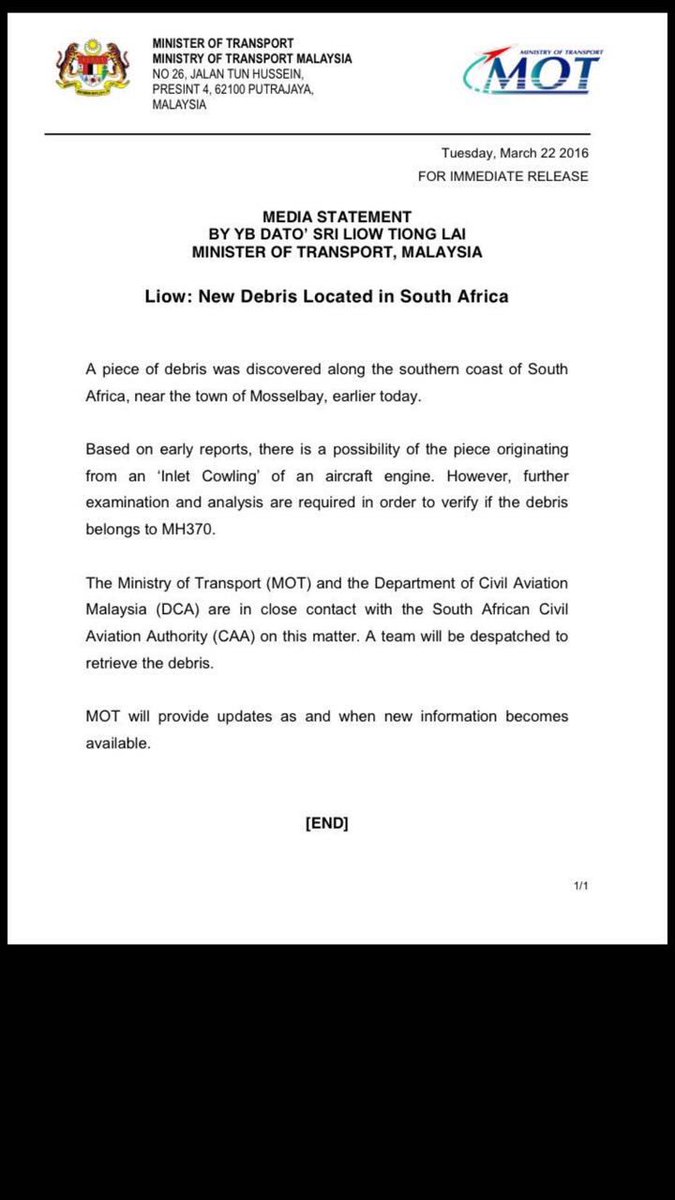

Further reading
- Joint Agency Coordination Centre (JACC)
- Thông tin tai nạn tại Aviation Safety Network
- ATSB investigation of Flight 370; Lưu trữ ngày 26 tháng 8 năm 2019 tại Wayback Machine – webpage of Australian Transport Safety Bureau's investigation (Investigation number: AE-2014-054; Investigation title: "Assistance to Malaysian Ministry of Transport in support of missing Malaysia Airlines flight MH370 on 7 March 2014 UTC")
- ICAO statement on the first anniversary of the Flight 370 disappearance
- The data behind the search for MH370 – Interactive analysis of phase 1 sea-floor mapping data from Geoscience Australia
- Missing flight MH370 – a visual guide to the parts and debris found so far (January 2017) – detailed information about debris
- Summary of possible MH370 debris recovered (April 2017)
- "A Timeline of MH370 Physical Evidence". Aviation Week & Space Technology. ngày 8 tháng 3 năm 2019.
- MH 370 Preliminary Report – Preliminary report issued by the Malaysian Ministry of Transport, dated 9 April 2014 and released to the public on 1 May 2014.
- Factual Information: Safety Investigation for MH370 – Interim report released by the Malaysian Ministry of Transport on 8 March 2015 (586 pages).
- MH370 – Definition of Underwater Search Areas; Lưu trữ ngày 18 tháng 9 năm 2019 tại Wayback Machine (2014) – Report by the Australian Transport Safety Bureau, released on 26 June 2014, and the most comprehensive report on Flight 370 publicly released at that time. The report focuses on defining the search area for the fifth phase, but in doing so provides a comprehensive overview/examination of satellite data, the failed searches, and possible "end-of-flight scenarios".
- MH370 – Definition of Underwater Search Areas (PDF) (Báo cáo). 2015. Bản gốc (PDF) lưu trữ ngày 29 tháng 10 năm 2019. – Report by the Australian Transport Safety Bureau, released on 3 December 2015, covering the Bayesian analysis made by Australia's Defence Science and Technology Group and other developments since mid-2014 in defining the search area.
- MH370 – Search and debris examination update; Lưu trữ ngày 23 tháng 9 năm 2019 tại Wayback Machine (2016) – Report by the Australian Transport Safety Bureau, released on 2 November 2016, comprising further analysis of satellite data, additional End of Flight simulations, analysis of flight debris (wing flap), and enhanced debris drift modelling.
- MH370 First Principles Review and CSIRO reports; Lưu trữ ngày 21 tháng 10 năm 2018 tại Wayback Machine – Report by the Australian Transport Safety Bureau, released on 20 December 2016, documenting the proceedings and outcomes of the First Principles Review meeting held in Canberra between 2–4 November 2016. The review identified a previously unsearched area of 25,000 km2 (9,653 dặm vuông Anh) as having the highest probability of containing the aircraft wreckage.
- The search for MH370 and ocean surface drift – Part III; Lưu trữ ngày 16 tháng 8 năm 2017 tại Wayback Machine – Report by CSIRO to the Australian Transport Safety Bureau, released on 16 August 2017. From the results of drift studies, CSIRO mentions that it is possible to identify a most-likely location of the aircraft, with unprecedented precision and certainty, at 35.6°S 92.8°E, northeast of the main 120,000-km2 underwater search zone.
- Summary of imagery analyses for non-natural objects; Lưu trữ ngày 18 tháng 8 năm 2017 tại Wayback Machine – Report by Geoscience Australia, released on 16 August 2017, comprising analysis of imagery from the PLEIADES 1A satellite, of floating objects identified in the southern Indian Ocean.
- The Operational Search for MH370 (Final); Lưu trữ ngày 10 tháng 3 năm 2020 tại Wayback Machine – Final report issued by the Australian Transport Safety Bureau (ATSB), released on 3 October 2017, documenting where and how the search for MH370 was conducted, the results obtained, and analysis for where future underwater searches could be undertaken. It concludes that the reasons for the loss of MH370 cannot be established with certainty until the aircraft is located.
- Safety Investigation Report by The Malaysian ICAO Annex 13 Safety Investigation Team for MH370; Lưu trữ ngày 9 tháng 3 năm 2015 tại Wayback Machine with appendices; Lưu trữ ngày 19 tháng 10 năm 2019 tại Wayback Machine – Final report issued by the Malaysian Ministry of Transport, dated 2 July 2018 and released to the public on 30 July 2018.
External links
 | Tập tin phương tiện từ Commons |
 | Tin tức từ Wikinews |
 | Danh ngôn từ Wikiquote |
 | Dữ liệu từ Wikidata |
- Website chính thức – maintained by the Malaysian government
- Joint Agency Coordination Centre (JACC)
- Australian Maritime Safety Authority MH370 Search – Media kit
- MH370 at the Australian Transport Safety Bureau; Lưu trữ ngày 8 tháng 10 năm 2014 tại Wayback Machine
- Malaysia Airlines; Lưu trữ ngày 29 tháng 7 năm 2018 tại Wayback Machine
- MH370 Press Statement by Ministry of Transport, Malaysia, Wednesday, 2 April 2014
Bản mẫu:Aviation accidents and incidents in 2014Bản mẫu:Aviation accidents and incidents in Malaysia
- Malaysia Airlines Flight 370
- 2010s missing person cases
- 2014 controversies
- 2014 in Australia
- 2014 in China
- 2014 in international relations
- 2014 in Malaysia
- Accidents and incidents involving the Boeing 777
- Articles containing video clips
- Australia–China relations
- Australia–Malaysia relations
- Aviation accidents and incidents in 2014
- Aviation accidents and incidents in Malaysia
- Aviation accidents and incidents in the Indian Ocean
- China–Malaysia relations
- Malaysia Airlines accidents and incidents
- March 2014 in Asia
- Missing aircraft
- People lost at sea